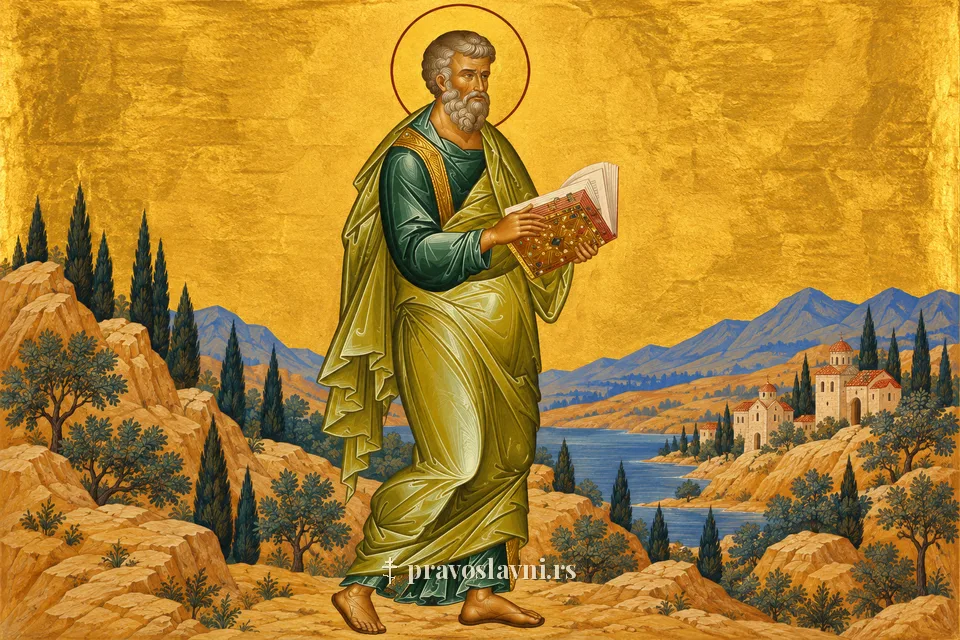
Matthew, the tax collector of Capernaum, also called Levi, was a wealthy man when Jesus, passing by, found him at his work and called him: “Follow Me!” Without delay he left everything he had and went. Afterwards he welcomed the Lord into his own home, where at a great feast He sat with tax collectors and sinners; to the Pharisees, who did not like this, Christ said that He had come to call sinners to repentance.
He entered the circle of the Twelve and followed Christ up to the Crucifixion, the Resurrection and the Ascension, and he received the Holy Spirit at Pentecost. To the Church he left his Gospel, which, according to the Prologue, was written in Hebrew and has been preserved in a Greek translation. Among the lands of his preaching the sources mention Parthia and Media, while Ethiopia, according to his Life, fell to him by lot.
Among the Ethiopian cannibals, his Life says, the preaching began with difficulty, but by the gift of God, through a tree that grew out of the apostle's staff and a spring beside it, gentleness came to them too. Having healed the prince's wife and son, Matthew baptised the people at that spring, and they came out of the water radiant.
Prince Fulvian, angry that the people were renouncing the idols, tried to seize him, but, according to the Prologue and his Life, his men were stopped by darkness and a heavenly light, and he himself was struck blind. Nor did the pyre help: according to both sources, the flames did the apostle no harm. It was with prayer that he ended his life, in the pyre itself, although by then the prince already wanted to bring him out.
The prince threw the coffin with the body into the sea, but the faithful, after the apostle, according to the Prologue and his Life, had appeared to Bishop Plato, found it on the shore. Then Fulvian too, together with his nobles, came to believe, and at his baptism, according to the Life, a voice from heaven decreed that he should be called Matthew. He renounced his rule, became a priest, and afterwards a bishop as well.
St Matthew bears witness that God calls even the despised, and that faithfulness in suffering can turn even a persecutor into a believer.
Full Life
The tax collector who became an evangelist
Matthew was perhaps the least expected apostle. The son of Alphaeus, who is also called Levi, collected taxes in Capernaum in Galilee and was rich, and tax collectors were despised. Yet Christ, walking along the shore, stopped right at his tax booth: “Follow Me!” Matthew left everything at once and went.
He marked his parting from his old life with a feast for the Lord in his own house, where tax collectors and sinners sat at the table. The Pharisees grumbled, and Christ's answer explains Matthew's calling as well: it is the sick who need a physician, and He came to call sinners to repentance.
According to his Life, from then on he was one of the Twelve and travelled with the Teacher through Galilee and Judea; when the apostles were sent to the lost sheep of the house of Israel, he too healed, cast out demons and brought the dead back to life. Both sources stress that he was an eyewitness of Christ's life, crucifixion, resurrection and ascension, and at Pentecost he too received the Holy Spirit.
The Gospel, according to his Life, he did not begin at his own prompting: a written record of Christ's deeds and teaching was asked of him by the faithful in Jerusalem, and the other apostles supported that request. Eight years after the Ascension the book was finished. The Prologue takes an interest in the language: nothing has remained of the Hebrew original, and what has come down to us is the Greek text, made not long after it. It also records a report about his fasting: Matthew, it is said, did not eat meat.
About the lands of his preaching the sources differ: his Life mentions Macedonia, Syria, Persia, Parthia and Media, while the Prologue mentions Parthia, Media and Ethiopia.
The tree that tamed the wild
The lot, according to his Life, assigned him Ethiopia and the city of Myrmena, a settlement of cannibals. The beginning was modest: a few converts, a small church, and Plato, Matthew's companion, as their bishop. Matthew himself withdrew to a nearby mountain to obtain by fasting the conversion of that people, and the answer came in the form of a handsome youth with a staff, with the instruction that the staff be planted by the church doors.
His Life describes what sprang up at once: a tree with sweet fruit and a spring beside it. The fruit and the water, according to the promise, were to give the cannibals a fair face and a gentle heart; the city ate and drank, listened to the apostle and believed. The baptism, according to both sources, was performed at that same spring, and the first into the water were the prince's wife and her son; these, his Life says, Matthew had freed from evil spirits as he came down from the mountain. The change, according to both sources, could be seen on their faces and in their souls.
The prince who could not win
Prince Fulvian owed a debt of gratitude for the recovery of his wife and son. Yet when the gods were left without worshippers, according to both sources the devil kindled his anger and he decided to get rid of the apostle. That same night the Saviour promised Matthew that he would not be alone. Three attempts to arrest him failed one after another: the four men who were sent only heard him in the darkness, the soldiers did not dare to look at him because of the radiance around him, and the prince, coming in person, went blind. Matthew healed his eyes with the sign of the cross, but not his heart — and the prince called that healing sorcery.
Both sources say that they piled wood over the apostle and set it alight, but the fire did him no harm, and he came out alive and well, glorifying God. A new pyre, according to his Life, the prince placed under the protection of twelve golden statues set in a row around it. It turned out the opposite way: after Matthew's prayer the flames devoured those very statues, and then threatened the prince, who begged to be saved, and they died down only at the apostle's command. The prince's wish to pull him out now remained unfulfilled: praying, the apostle ended his earthly path in the fire.
The persecutor with the apostle's name
According to both sources, the prince set a final condition: if water spares Matthew as fire spared him, then his God is the only true one. The sealed coffin with the body was thrown into the sea. Where to look for it was revealed to Plato that night by the apostle himself: on the eastern shore, below the palace — and there the faithful found it at daybreak, on dry land. Then the prince with his nobles confessed Christ, begged forgiveness and asked for baptism. While Plato was laying his hand upon him, the new name was decided, according to his Life, by a voice from heaven: “Give him the name not Fulvian but Matthew.” The new Matthew renounced his princely dignity and received the priesthood from Plato. When Plato died three years later, it was he who succeeded him — the apostle himself, in a vision, encouraged him to do so. As bishop he preached for a long time, led many out of idolatry and ended his life in peace.
The lesson: God calls even those whom no one would call, and true faith opens the eyes of the soul, not only of the body.