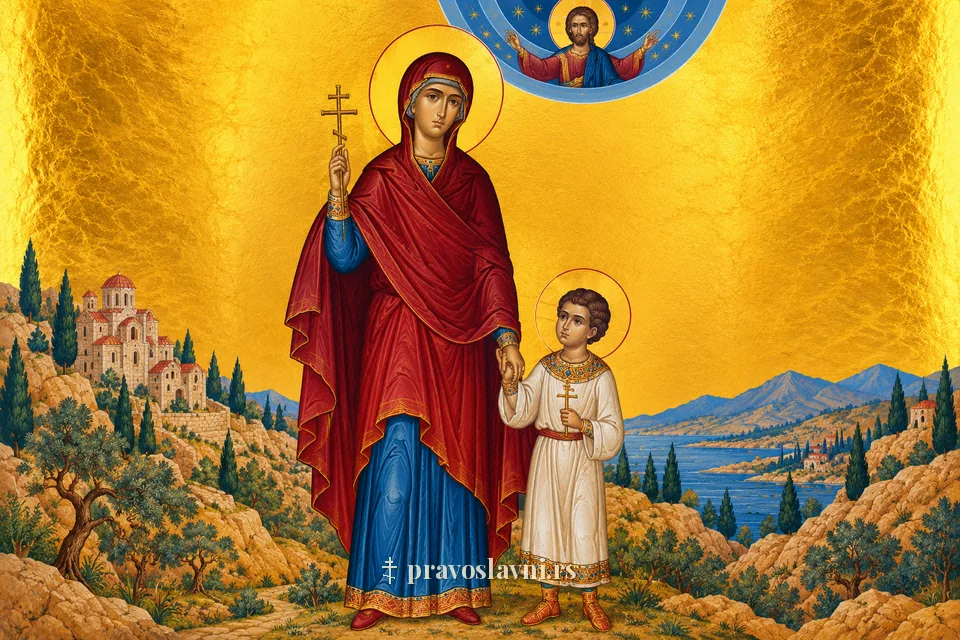
“But when Jesus saw it, He was greatly displeased and said to them, ”Let the little children come to Me, and do not forbid them; for of such is the kingdom of God.”“
— Mk 10:14
About the feast
St Julitta was of noble family, from Iconium in Lycaonia. She was left a widow early, with her little son Cyricus, whom she baptised, brought up in the faith and taught to pray.
When persecution arose in the time of the Emperor Diocletian and many innocent people were killed in Iconium, Julitta fled with her son to Seleucia. According to their Life, she left by night, abandoning her property, her home and her relatives, and since the persecution was raging in Seleucia as well, she took refuge in Tarsus in Cilicia and lived among the poor.
According to their Life, she was seized there and brought before the governor Alexander. She openly confessed Christ, and as for her name she said only that she was a Christian. The Life also records her words: “I will not bow down to the devils and to their deaf and dumb idols!” The judge took the child on his lap in order to break the mother's resolve, but Cyricus, according to the Life, cried out: “I am a Christian! Let me go to my mother!” The judge threw him to the ground, and the child fell down the stone steps and died, receiving the martyr's crown. According to the Prologue, Julitta gave thanks to God that her son had been crowned before her.
The tortures lasted a long time, and the sword brought them to an end: Julitta was beheaded, according to the Prologue in the year 304. According to the Life, their bodies were buried at night by two maidservants. Their relics, according to the Prologue, work wonders to this day, and a part of them is in Ohrid, in the church of the Holy Theotokos Bolnička.
Full Life
Mother and child
Julitta was of noble family from Iconium in Lycaonia; her Life says that she was descended from earlier Roman emperors. She was left a widow early, with her little son Cyricus. She had him baptised, brought him up in the faith and taught him to pray — according to the Prologue, so that already at about the age of three he knew how to pray.
The flight
In the time of Emperor Diocletian a persecution arose and many innocent people were killed in Iconium; her Life states that Lycaonia was then ruled by the cruel governor Dometian. Julitta fled to Seleucia. According to her Life, she left by night, with her three-year-old son and two maidservants, leaving behind her estate, her home, her relatives and her position and concealing her noble origin.
Her Life relates that the persecution was raging in Seleucia too, under the governor Alexander, and so Julitta went further, to Tarsus in Cilicia, and lived among the poor.
The child's confession
According to her Life, she was seized there and brought before the governor Alexander. Julitta openly confessed Christ, and as for her name she said only that she was a Christian. Her Life also records her words: “I will not bow down to devils and to their deaf and dumb idols!” According to her Life, the maidservants ran away at that hour, but they did not abandon their mistress: from a distance they watched to see what would happen to her.
The judge took the child on his lap, hoping in this way to break the mother's resolve. But Cyricus cried out: “I am a Christian! Let me go to my mother!” — so her Life records, while the Prologue gives his words like this: “I am a Christian, let me go to my mother!” Her Life also says that the child scratched the governor's face. The judge threw him to the ground; the child fell down the stone steps and died, receiving the crown of martyrdom. The Prologue says that Julitta rejoiced and gave thanks to God that her son had been crowned with martyrdom before her.
The mother after her son
The tortures went on for a long time, and the sword brought them to an end: Julitta was beheaded — according to her Life outside the city, after she had prayed and given thanks to Christ. The Prologue states that this was in the year 304.
According to her Life, the bodies of the martyrs were left without a grave. Those two maidservants gave them a grave: under cover of night they buried them in a remote place. One of them lived to see the time of Constantine the Great and showed the grave to the faithful; the relics were found incorrupt, fragrant and healing. According to the Prologue, they work miracles to this day, and a part of them is in the Church of the Holy Theotokos Bolnička (“of the Hospital”) in Ohrid.
The mother who had taught her child the faith from his earliest days rejoiced that he was the first to reach God.
Other saints of the day
St Vladimir of Kiev, Equal-to-the-Apostles
St Vladimir was the son of Prince Sviatoslav and the grandson of Igor and St Olga, and at first he was a pagan both in faith and in life. The Prologue says that he examined various faiths and sent envoys to Constantinople; attending the divine service in Hagia Sophia, they were, as the Prologue records, “beside themselves, not knowing whether they were on earth or in heaven”. According to his Life, the boyars told him that the Greek faith must be the true one, since his grandmother, St Olga, had also accepted it. His Life tells that he asked the emperors for their sister Anna as his wife, and they agreed on condition that he be baptised. Then he went blind, and Anna told him that baptism would heal him; he was baptised in Cherson, recovered his sight and received the name Basil, according to his Life in the year 988. Then he baptised his people as well — according to his Life, the people of Kiev in 989 in the River Pochaina. The chief idol, Perun, was taken down from the hill in Kiev and thrown into the Dnieper. Where idols had stood before, churches sprang up throughout the land at his command, and in Kiev he built the church of the Most Holy Theotokos, giving it, according to his Life, a tenth of his property, on the place where the martyrs Theodore and John had suffered. His Life praises his mercy: at his court he gave bread to the poor, the sick too were not left without food, and he sent children to be taught. He reposed in the Lord in the year 1015.
The Holy Martyrs of Velika and Gornje Polimlje are the inhabitants of Velika in Gornje Polimlje who suffered on 28 July 1944, on the feast of Sts Cyricus and Julitta. They suffered in the villages of Velika Ržanica and Gornja Ržanica. According to an incomplete list, 427 people lost their lives, among them 171 children and young people under twenty years of age. As early as 1941, twenty-eight children had died in the prison in Plav. The Holy Assembly of Bishops of the Serbian Church numbered them among the holy New Martyrs. Their commemoration is kept every year on 28 July, and in Velika all the victims of the Second World War from Gornje Polimlje are remembered. In their memory their descendants have begun to build a church of Sts Cyricus and Julitta.