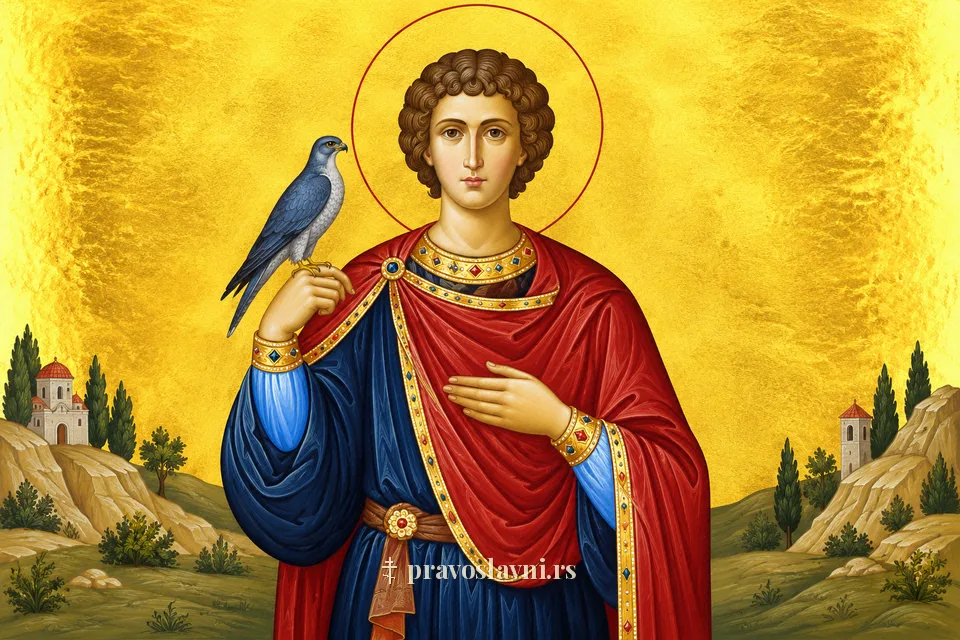
“Christ is my faith, Christ is my glory and the crown of my praise.” This, according to his Life, is how St Tryphon answered the judge in Nicaea, the prefect Aquilinus. Under Emperor Decius he was accused of mocking the gods and of spreading the Christian faith by healing people. He did not wait for them to come looking for him, but went of his own accord to give himself up.
Who was this brave man? A poor village boy from Kampsada in Phrygia, a herder of geese, on whom the grace of God had rested since childhood, so that he healed the sick and cast out demons. One of his miracles took place when the daughter of the Roman Emperor Gordian fell under the power of an unclean spirit. The demon, say the Prologue and the Life, declared that it would come out only before Tryphon. The Emperor's messengers found the young man and brought him to Rome. The Life says that for six days he prepared himself with fasting and prayer, and then, before the Emperor and the Senate, he forced the demon to admit that it has no power over those who believe in Christ. The Emperor's daughter recovered, and many witnesses came to believe in Christ. The Emperor gave Tryphon rich gifts, but he kept nothing: he shared the gifts among the poor and went back to his village, to prayer and healing.
When the persecution came, he bore the tortures, according to both sources, with joy. The Life says that he prayed for his torturers and that neither honours nor gifts could bring him to offer sacrifice to Zeus. He was condemned to death by the sword, but he gave up his soul to God even before the execution, in the year 250. The Christians of Nicaea wished to keep his body, but he, according to the Life, appeared to them in a vision and asked them to take it to his native Kampsada.
Tryphon's life reminds us that evil spirits have no power over those who believe in Christ, and that it is sinful passions that open the way to them. The herder of geese was not tempted by the imperial treasure, but gave it to the poor, and he confessed Christ as his faith and his glory.
Full Life
What the Demon Had to Admit
The most important lesson from the life of Tryphon, according to his Life, was spoken — against his will — by the demon himself. Forced to speak, he admitted that Satan had sent him and that he and those like him have no power at all over those who believe in Christ. He has that power, he said, only over idol-worshippers and those who are enslaved to grave sins, such as blasphemy, sorcery, envy and pride. When Tryphon drove him away into the fire of hell, many who were watching this abandoned paganism.
This took place in Rome, before Emperor Gordian and the Senate. He was a pagan, but Christians, according to the Life, did not suffer persecution from him. His daughter Gordiana was tormented by an unclean spirit — the Prologue says that she lost her reason, and the Life that it used to throw her into fire and into water — and no physician knew what to do. Through the girl the demon declared: “No one can drive me out of here except the youth Tryphon.” The imperial messengers brought many people of that name, to no avail. The real Tryphon, a seventeen-year-old, they found only in Campsada, beside his geese.
The Life records that the evil spirit did not wait for his arrival: three days earlier it left the girl, because it could not bear Tryphon's nearness. Nevertheless, the Emperor wanted himself and the senators to see the enemy with their own eyes. As soon as the seventh day dawned, the demon, according to the Life, at Tryphon's command showed itself to the Emperor and the senators; for that hour the youth had been preparing with many days of fasting and prayer, through which he received authority over unclean spirits.
The Boy with the Geese
And who was the one whom the demon feared? A village boy from Campsada in Phrygia; the Life adds that the village is not far from Apamea. According to the Prologue, his home was poor, and according to the Life, his parents were devout. He tended geese, but while he was still a child God poured out grace upon him: he healed the sick — the Prologue says sick livestock too — and drove out demons. The Life notes that many of his boyhood miracles are described in the collection called the “Great Lives”.
The Emperor repaid him for the healing of his daughter with rich gifts, but Tryphon did not keep them: he gave everything away to the poor while still on the road home. In the village he carried on as before: he prayed, healed the sick and lived a holy life, and the Prologue adds that he once again tended geese.
A Confessor in Nicaea
The Life says that Gordian was succeeded by Philip, who was killed by his own soldiers, and that Decius then raised a fierce persecution. Word reached the prefect Aquilinus of a healer who was spreading the Christian faith and mocking the gods. Tryphon did not hide: according to the Life, he gave himself up and gladly set out for Nicaea, to appear before Aquilinus.
At the trial he said who he was and where he was from, and he rejected “fate”, because everything, as he said, is guided by God's providence. Then, according to the Life, he declared: “Christ is my faith, Christ is my glory, and the crown of my praise.” When they threatened him with fire, he answered that the prefect's fire dies down in time, while the one of which he was speaking lasts for ever — and that he wished to die for Christ.
The Prologue and the Life say that he bore the tortures with great joy. The Life adds that he prayed for his torturers in the words of Scripture: “Lord, do not charge them with this sin” (Acts 7:60), and it mentions a heavenly sign which frightened those who were torturing him. They promised him rewards and honours for a sacrifice to Zeus and a bow before the Emperor's image, but in vain; the pagan gods he explained as names given to nature and to human passions. According to the Prologue, the tortures did him no harm.
The Return to Campsada
The sentence was: death by the sword. The Life also preserves his last prayer outside the city walls: he asked God for protection from the evil spirit and that angels might receive him. Both the Prologue and the Life say that he gave up his soul to God even before the execution. It was the year 250.
The Christians of Nicaea, according to the Life, prepared his body for burial and wanted it to stay with them, to guard their city. The martyr had a different will: in a vision he directed them to carry him to Campsada, his native village. And so the goose-herd returned home.
A poor boy received from God authority over demons, and he did not keep the Emperor's treasure. His life teaches that evil spirits have no power over those who believe in Christ, and that it is sinful passions which open the way to them. He confessed Christ as his faith and his glory, and joyfully received the martyr's crown.