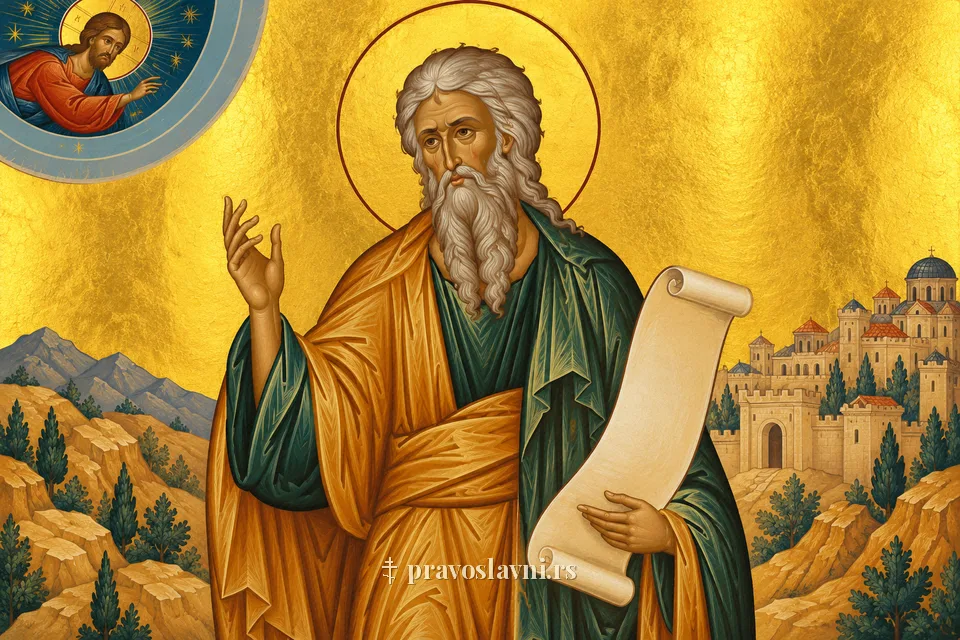
In the time of Zedekiah, Jeremiah used to appear before the people with a yoke around his neck, as a sign of the bondage that was coming from Babylon. When the false prophet Hananiah broke that yoke, Jeremiah answered him that the yoke would be one of iron. That is how he spoke all his life: clearly, without softening anything, and for that he suffered.
He was born in Anathoth, near Jerusalem, and he began to prophesy in his fifteenth year, in the time of King Josiah. His Life says that God chose him even before his birth and that he remained a virgin all his life. He called the king, the princes, the priests and the false prophets to repentance, and for this his own people persecuted him, beat him and imprisoned him. To King Jehoiakim he foretold a shameful burial, and the scroll with the prophecies that he had dictated to Baruch was burnt by the king. He also foretold that Jeconiah would be carried off to Babylon, and to the exiles he wrote that the captivity would last seventy years. In the valley of Tophet he smashed an earthen vessel as a sign of the ruin that was coming.
His Life records that during the siege they lowered him into a miry well and that Ebed-Melech the Ethiopian saved him. When Jerusalem fell, Jeremiah hid the sacred fire from the altar in a well, and the ark of the covenant in a cave on the mountain on which Moses died.
His fellow countrymen then took him by force to Egypt. There, as the Prologue and his Life record, he foretold that the Egyptian idols would fall when a Virgin with a Child came into that land. It was in Egypt that he ended his life: he was stoned, and the sources do not agree on who stoned him — the Prologue says his fellow countrymen, the Life says the Egyptians. Alexander of Macedon translated his relics to Alexandria.
In his words “But I was like a docile lamb brought to the slaughter” (Jer 11:19) the Life sees a foreshadowing of Christ's Passion. Jeremiah teaches us to be faithful to God's word even when it brings hatred. He wept over his people, yet he did not cease calling them to repentance, and the Life teaches that the saints pray for the people even after death.
Full Life
Called even before his birth
Jeremiah was born in Anathoth, not far from Jerusalem; his Life adds that it was a Levitical town in the tribe of Benjamin and that his father was the priest Hilkiah. The Life says that God chose him even before his birth (Jer 1:5) and compares his election with the election of the Prophet Samuel. According to the testimony of St Ignatius the God-bearer, which the Life quotes, Jeremiah remained a virgin all his life (Jer 16:2).
He began to prophesy in his fifteenth year, in the time of King Josiah. The Life gives the words with which he answered the call: “Ah, Lord GOD! Behold, I cannot speak, for I am a youth.” (Jer 1:6). Then the Lord touched his mouth and sent him. In visions He showed him an almond branch and a boiling pot, facing away from the north — signs that the punishment was coming quickly and that the invasion would arrive from the north (Jer 1:11–14).
A truth that is dearly paid for
Jeremiah called everyone to repentance: the king, the princes, the false prophets and the priests. Because of this his own countrymen persecuted him, beat him and threw him into prison. The Prologue records that even in Josiah's time he barely escaped death at the hands of the enraged nobles. The Life says that he prophesied under five kings — Josiah, Jehoahaz, Jehoiakim, Jeconiah and Zedekiah — and that he mourned Josiah when he fell at Megiddo, in battle with Pharaoh Necho.
When he preached in the temple, the priests and the false prophets demanded his death, but, according to the Life, the princes and the elders defended him, and Ahikam the son of Shaphan took him under his protection. To King Jehoiakim he foretold that he would be buried like a donkey, dragged outside Jerusalem, and for this, according to the Prologue, he was thrown into prison. He dictated his prophecies to Baruch, who read them out, and the king burned the scroll; Jeremiah, according to the Life, dictated a new one, with additions (Jer 36). The Life records that God hid the prophet and Baruch from the king's order to kill them. It also mentions the priest Pashhur, who beat him and locked him up, and Jeremiah foretold to him captivity and death in Babylon (Jer 20:1–6). While the enemy was besieging the city, the prophet advised surrender, and so the princes lowered him into a miry well; Ebed-Melech the Ethiopian pulled him out.
Signs before the eyes of the people
Jeremiah did not speak with words alone. In the valley of Tophet, where children were offered in sacrifice to idols — the Life says to Molech — he broke an earthen vessel as a sign of the ruin that was coming. In Zedekiah's time he wore a yoke on his neck, proclaiming bondage to Babylon. The false prophet Hananiah broke that yoke, and Jeremiah answered him that the yoke would be of iron; Hananiah, according to the Life, died before the month was out (Jer 27–28). He foretold that Jeconiah would be led away to Babylon with his household, and so it happened. To the exiles in Babylon he wrote that they would remain in captivity for seventy years.
When the Babylonians captured Jerusalem, Jeremiah hid the sacred fire from the altar of the temple in a well. The Ark of the Covenant — the Prologue says, together with the Levites — he carried to a cave on the mountain on which Moses died, and hid it there. According to the Life, he said that the place would remain hidden until God gathers His people. The Life also records that Nebuzaradan set him free and let him choose, and he stayed in Judea, with Gedaliah at Mizpah.
The last years in Egypt
When Ishmael killed Gedaliah, the people around Johanan asked Jeremiah for the word of God, and he told them not to go to Egypt; they did not listen to him (the Life). His countrymen took him with them to Egypt by force, and he lived there for about four years. The Life says that the Egyptians honoured him and that through his prayer snakes and crocodiles were destroyed. He foretold that the idols of Egypt would fall when the Virgin came to Egypt with the Child; the Life gives this account from the record of St Epiphanius.
Jeremiah was stoned in Egypt — according to the Prologue, by his own countrymen, and according to the Life, by Egyptians who were angered by his words. Alexander of Macedon translated his relics to Alexandria; the Prologue adds the tradition that Alexander visited the prophet's tomb.
The Life also sees in Jeremiah a prophet of Christ's Passion, for he said of himself: “But I was like a docile lamb brought to the slaughter” (Jer 11:19). It also cites the dream of Judas Maccabeus, who saw the high priest Onias and Jeremiah praying for the people, and Jeremiah gave him a golden sword from God (2 Macc 15:12–16). In this way the Life bears witness that the saints pray for us after death as well.
Jeremiah wept over his people, but he did not soften the call to repentance even when it brought him hatred, prison and death. He remained faithful to the word of God to the end.