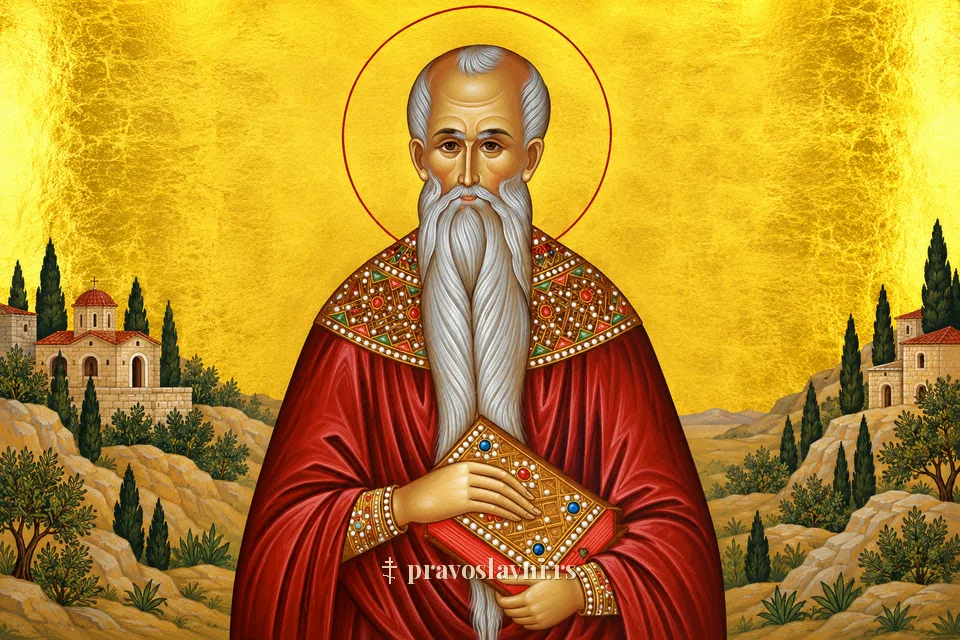
Before his death, when the Lord, according to the Life, offered him to ask for whatever he wished, St Haralambos prayed for others. The Life records that prayer: for every place that keeps his relics and his memory he asked protection from misfortunes, a fruitful year and what is good for the bodies and souls of the people.
He was Bishop of Magnesia in the time of Emperor Septimius Severus. While the Christians were suffering, he did not hide, but openly taught the people the faith. He was seized and, according to the Life, tortured with iron combs, and to his torturers, as the Life records, he said: “Thank you, brothers,” seeing in those torments a gain for eternal life.
Such strength drew people to Christ. According to the Life, both the slaves who tortured him and the women who were watching came to believe. The commander Lucius received baptism, and the governor Lucian, whose head, according to the Life, was twisted round when he spat on the elder, recovered only when Haralambos prayed for him, and then he halted the persecution. The Prologue sums up the whole of his work in a single sentence: miracles followed one upon another, and the converts were many. The faith reached even the imperial household: both the Prologue and the Life say that Galina, the daughter of Severus, became a Christian.
To the Emperor, according to the Life, he said that he was one hundred and thirteen years old, that he had never known marriage and that his betrothed was the Kingdom of Christ. The Life also records other wonders: fire did him no harm, the post against which he was leaning put forth leaves, and at his prayer a dead young man arose.
He was condemned to beheading and, according to the Prologue and the Life, he gave up his soul to God in prayer, before the stroke of the sword, in the year 202. Galina gave him an honourable burial, and her father, according to the Life, did not forbid her to live as a Christian. His head, according to the Life, is kept at Meteora, and his relics are venerated in more than one place.
His life bears witness that faithful perseverance does not go unrewarded, and that the saints intercede before God for the world.
Full Life
An Elder Who Did Not Hide
Haralambos was a bishop in Magnesia in the time of Emperor Septimius Severus, when Christians were being persecuted. He did not flee or seek shelter, but publicly taught the people the faith. Because of this he was seized and brought before the governor Lucian and the commander Lucius. He refused to offer sacrifice to the idols, according to his Life, appealing to his years and to the invisible good things which he did not wish to lose.
He was a man of very great age. To the Emperor, according to his Life, he said that he had one hundred and thirteen years behind him, that he had not known marriage and that his only bride was Christ's Kingdom of Heaven. Both the Prologue and his Life say that he suffered in his one hundred and thirteenth year.
Patience That Converted
The torturers did not spare him: according to his Life, they scraped him with iron combs. He, as his Life records, thanked them with the words: “Thank you, brethren,” seeing in those torments a gain for eternal life. The Prologue notes that he bore the torments as though someone else were suffering them.
Such patience did not leave people indifferent. His Life says that the slaves Porphyrius and Baptus, who were torturing him, admitted that his body was harder than iron, confessed Christ and suffered by the sword; the same was done by three women who were watching this. According to his Life, Lucius, while torturing the elder, suddenly lost his hands, and Lucian, who had spat on him, had his head twisted round. Only when the people of Magnesia cried out for mercy and Haralambos prayed did a voice from a cloud promise healing, and both of them recovered. Lucius received baptism, and Lucian called off the persecution. Many were baptised then, and the sick received their health.
Miracles Before the Emperor
Lucian informed Severus of everything in Pisidian Antioch, and the Emperor sent soldiers for the elder. His Life tells that on the way even a horse rebuked them, speaking like a man and demanding that they let the elder go, but the soldiers paid no heed.
Before the Emperor, according to his Life, one miracle followed another. The fire into which they put him went out and did him no harm. From a man whom a demon had tormented for thirty-five years he drove out the unclean spirit, and at his prayer a young man who had been dead for three days rose up. The prefect Crispus advised the Emperor to put him to death as a sorcerer, while the courtier Aristarchus took the side of Christ. When Severus, blaspheming, shot an arrow at heaven, according to his Life the earth trembled, and he and Crispus were left hanging in the air until Haralambos, at Galina's request, prayed for them. In order to humiliate him, the Emperor lodged him with a certain widow, but, according to his Life, the post against which the elder leaned put forth leaves and spread its branches over her house, and so the widow together with her neighbours received baptism.
Galina, the Emperor's Daughter
The faith reached even the imperial household. The Prologue and his Life bear witness that Galina, the daughter of Severus, became a Christian. His Life also relates her vision, which Haralambos interpreted for her as an image of Paradise, of the Cross, of eternal life and of Christ. Then he foretold to her that her father and Crispus would fall again, and the Emperor, according to his Life, did indeed return to the idols after thirty days. Galina, according to his Life, smashed the statues of Jupiter, Apollo and Hercules, and when they were repaired overnight, she did it once more.
A Prayer for the World
At last he was sentenced to be beheaded. Before his death he sang a psalm and prayed, and his Life says that the Lord then appeared to him, surrounded by angels, and offered him to ask for whatever he wished. His last prayer was a prayer for others. He prayed for people: that God would grant them health and salvation, fruitful years and protection from every misfortune, especially, according to his Life, in the places where his relics are kept and his memory is celebrated. According to the Prologue and his Life, he gave up his soul to God in prayer, even before the stroke of the sword, in the year 202.
The burial, according to the Prologue and his Life, was taken on by Galina, who rendered the martyr due honour. Severus, fearing to harm his own child, according to his Life did not forbid her to remain a Christian. The head of St Haralambos, according to his Life, is kept by the Meteora monastery of the Holy Archdeacon Stephen in Thessaly, and the veneration of his relics is not tied to one place alone.
The word of Christ gives eternal life and conquers the demons, and faithful perseverance does not remain without a reward. St Haralambos even today intercedes before God for the world — especially, in accordance with his last prayer, for health, peace and a fruitful year.