Tuesday19January 20276 January (according to the Julian calendar)
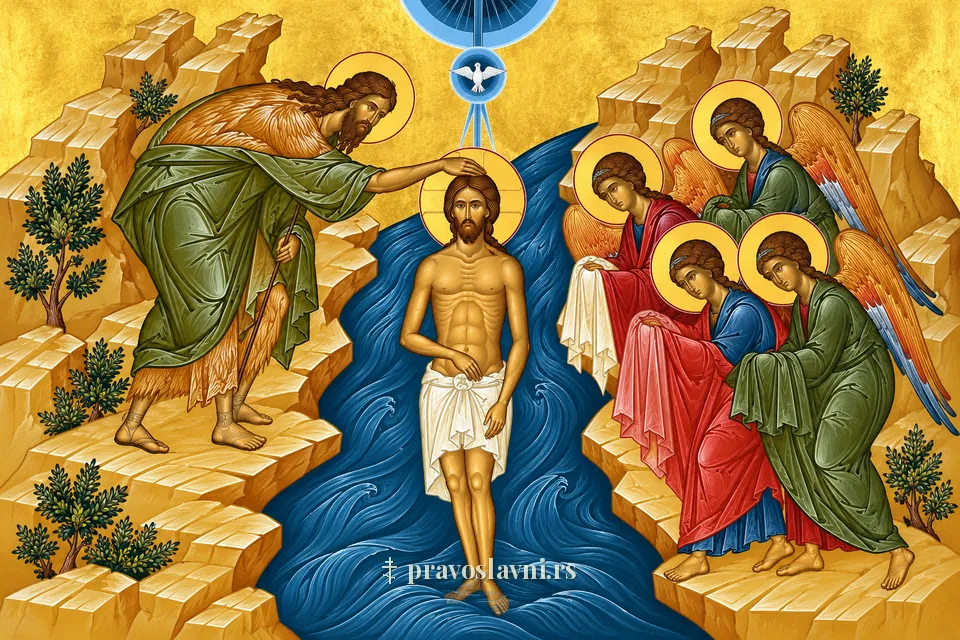
Illustration
Great feast
Theophany
What happenedWhen Jesus came up out of the waters of the Jordan, the heavens were opened, the Spirit of God descended like a dove, and a voice from heaven called Him the beloved Son.
“And suddenly a voice came from heaven, saying, ”This is My beloved Son, in whom I am well pleased.”“
— Mt 3:17
Life
Theophany, or the Baptism of the Lord, is the feast on which the Holy Trinity was revealed at the River Jordan. The Greek name of the feast, Theophania, means the manifestation of God. The Church celebrates it on 6 January according to the old calendar, that is, on 19 January according to the new calendar.
Christ was then thirty years old. The Gospel according to Luke says that Jesus was about thirty years of age when He began His ministry (Lk 3:23). John, who was calling the people to repentance and baptism, then had before him the Messiah Himself, who had come to be baptised by him (Mt 3:13). John resisted this and said: “I need to be baptized by You, and are You coming to me?” (Mt 3:14). Jesus answered him that he should permit it, for it is fitting to fulfil all righteousness (Mt 3:15).
When Jesus came up out of the water, the heavens were opened and the Spirit of God descended upon Him like a dove. A voice from heaven said: “This is My beloved Son, in whom I am well pleased” (Mt 3:16–17). The Prologue and the Life see in this the manifestation of the Holy Trinity: the Son in the flesh, in the water of the Jordan, the Father in the voice from heaven, the Spirit in the form of a dove. John later bore witness that He is the Lamb of God who takes away the sin of the world, and the Son of God (Jn 1:29, 32–34).
The Prologue cites the words of St Cyril of Jerusalem: “The beginning of the world is water, the beginning of the Gospel is the Jordan.” Why did the Sinless One go down into the river at all? The Prologue answers that the immersion in the Jordan and the coming up out of it depict the death for the sins of others and the Resurrection with which His earthly path would end. Everyone who receives baptism follows the same track, for in the water he leaves behind his old life, marked by sin. The Prologue adds that the baptised person is then enlightened and that the heavenly Father receives him as His own.
The Life adds that the Sinless One entered the river as the One who bears the sins of others, in order to cleanse them there, and that by this He sanctified the nature of water and established the holy mystery of baptism. John Chrysostom, as the Life relates, calls this feast the seal of the Christmas feasts. The dove at the Jordan, according to the Life, also recalls the dove of the days of Noah: then too a bird brought the news that the flood had passed.
Theophany teaches us that through the Baptism of Christ the way of salvation has been opened: in the water of baptism a person begins a new life as a child of God.
Full Life
God appears at the Jordan
Theophany is the feast of the Baptism of the Lord in the river Jordan. The Greek name of this feast, Theophania, means the appearing of God. On that day, as the Prologue and the Life record, the Holy Trinity appeared. Each Person was revealed in His own way: the Son was seen by people in the flesh, in the water of the Jordan, the Father bore witness to Him by a voice from heaven, and the Spirit descended in the form of a dove. The Church celebrates the feast on 6 January by the old calendar, that is, on 19 January by the new calendar.
Thirty years
Christ was then thirty years old according to His birth in the flesh. The Gospel according to Luke says that Jesus was about thirty years of age when He began (Lk 3:23). It was then that He came to be baptised and began to teach the people. With this His public work also began. The Life connects this with the Jewish rule that no one could be a teacher or a priest before the age of thirty. It also cites John Chrysostom, who says that the Lord waited until those years in order to sanctify every age of man.
At that time John the Baptist was preaching a baptism of repentance. The Life says that Judea and Jerusalem went out to him and confessed their sins.
The meeting at the river
The Gospel according to Matthew relates that Jesus came from Galilee to the Jordan to be baptised by John (Mt 3:13). John tried to turn Him away: “I need to be baptized by You, and are You coming to me?” (Mt 3:14). Jesus told him to permit it, for thus it is fitting to fulfil all righteousness, and John consented (Mt 3:15).
As soon as He was baptised, Jesus came up out of the water (Mt 3:16). Here the Life records a difference: sinners used to remain in the water to confess their sins, but He came out at once. Then the heavens were opened and the Spirit of God descended like a dove upon Him. And a voice from heaven said: “This is My beloved Son, in whom I am well pleased” (Mt 3:17).
John afterwards bore witness to Him. He called Him the Lamb of God Who takes upon Himself the sin of the world (Jn 1:29) and testified that he had seen the Spirit descending like a dove and remaining upon Him, and that He is the Son of God (Jn 1:32–34).
Why the Sinless One was baptised
The Prologue cites the words of St Cyril of Jerusalem: “The beginning of the world is water, the beginning of the Gospel is the Jordan”. Just as water was at the beginning of the world, so the Jordan became the beginning of the Gospel. The Prologue also gives an answer to the question why the Sinless One went down into the river at all. The immersion in the Jordan and the coming up out of it, according to the Prologue, depict what will happen at the end of His earthly path: death for the sins of others and the Resurrection. Everyone who receives baptism follows in that track too, for in the water he leaves behind his old life, marked by sin, and begins a new one. Nor is he alone in this — in that renewal, as the Prologue teaches, all three Persons of the Trinity take part, so that the baptised person becomes illumined and an adopted child of the heavenly Father.
The Life lists other reasons as well. The Sinless One entered the river as He Who bears the sins of others, and there, according to the Life, He cleansed in the waters what He had taken upon Himself; at the same time He sanctified the very nature of water and laid the foundation of the holy mystery of baptism. John, for his part, became by this a trustworthy witness to Him. The Life, referring to Ps 73:13, also adds that Christ crushed the head of the serpent in the waters. Among the reasons the Life also names the fulfilling of all righteousness, of which the Lord spoke to John. The dove at the Jordan, according to the Life, also recalls the dove of the days of Noah: then too a bird brought the news that the flood had passed. John Chrysostom, according to the Life, calls this feast the seal of the Christmas feasts. Thus the Church sees in Theophany the sanctification of the nature of water, the institution of baptism and an example of dying to sin and rising into a new life.
New life through water
According to the Life, baptism is performed by a threefold immersion in the name of the Holy Trinity, as the Life cites according to the words of the Gospel (Mt 28:19).
At the Jordan God revealed Himself as one in three Persons. The baptism of Christ sanctifies the water and opens the way of salvation. Through baptism a person dies to his old self, rises renewed and becomes a child of the heavenly Father.