Monday13September 202731 August (according to the Julian calendar)
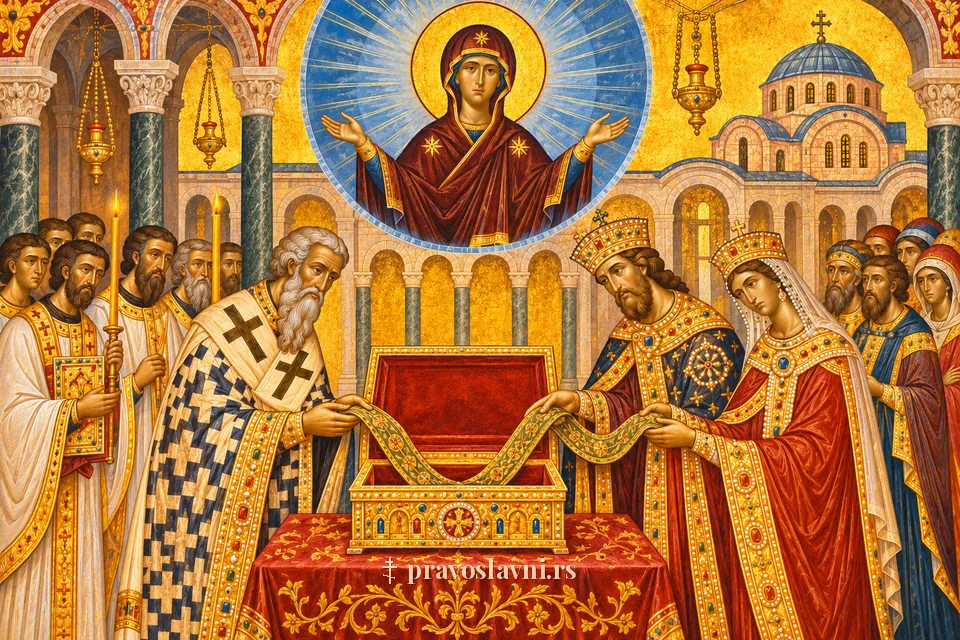
Illustration
Feast of the day
Placing of the Honourable Cincture (Belt) of the Most Holy Theotokos
What happenedThe Empress Zoe recovered as soon as the Cincture of the Most Holy Theotokos was laid upon her, and ever since the Church has honoured that miracle with this feast.
Placing of the Honourable Cincture (Belt) of the Most Holy TheotokosMore about the feast →
Teaching of the day
“Then she spoke out with a loud voice and said, ”Blessed are you among women, and blessed is the fruit of your womb!”“
— Lk 1:42
Life
This feast is connected with the cincture which the Mother of God wore. The first to receive it, after her Dormition, was the Apostle Thomas. Later the cincture was translated to Constantinople and kept sealed in a casket at Blachernae, in the church of the Theotokos which the Empress Pulcheria had built.
The casket remained unopened until the time of Emperor Leo the Wise, who reigned from 886 to 912. His wife, the Empress Zoe, fell ill, and after a certain vision she wished the cincture to be laid upon her body. Leo entreated the patriarch, the casket was opened, and as soon as the holy object was laid upon the empress, the illness vanished. The Church celebrates that event with this feast.
The Prologue and the Life record that the daughter of Emperor Romanus also received healing from the cincture, and the Prologue adds that her father gave her in marriage to the Georgian king Abuchaz. She took a portion of the holy object with her to his land; it is today in Zugdidi, in Mingrelia.
God heals through small, holy things as well, things connected with the Most Holy Theotokos, and the Church remembers such miracles with gratitude.
Full Life
A gift to an apostle
This feast is connected with the cincture which the Mother of God wore. The first to receive it, and that after her Dormition, was the Apostle Thomas.
Later the cincture was translated to Constantinople; the Life states that it arrived from the diocese of Zela. Its place was at Blachernae, in the church of the Theotokos which the Empress Pulcheria had built; there it lay sealed in a casket. That casket remained unopened right up to the time of Emperor Leo the Wise, who reigned from the year 886 to the year 912.
A miracle in the imperial household
The Empress Zoe, the wife of Leo, fell ill; the Prologue calls her illness one of the soul, while the Life says that she suffered in mind and in spirit. After a certain vision she wished the cincture to be laid upon her body. Leo entreated the patriarch, the casket was opened, and as soon as the holy object was laid upon the empress, the illness vanished.
That event the Church has celebrated ever since with this feast.
The journey to Georgia
An emperor's daughter also, as the Prologue and the Life record, received healing from the cincture: she was the daughter of Emperor Romanus, and the Life places that event in the year 942. The Prologue adds that her father gave her in marriage to the Georgian king Abuchaz; she went to his land and took a portion of the holy object with her. That portion is today in Zugdidi, in Mingrelia: the Russian Emperor Alexander I ordered that a special church be built for it.
Homilies in honour of the cincture
The Life mentions that St Germanus of Constantinople and Euthymius Zigabenus dedicated homilies to the honourable cincture, and it also gives the troparion of the feast.
God heals through small, holy things as well, things connected with the Most Holy Theotokos and with the saints, and the Church remembers such miracles with gratitude and celebrates them.
Other saints of the day
Holy Martyrs of Jasenovac
The holy martyrs of Jasenovac are innocent people who suffered in the Jasenovac camp. Jasenovac was not a single camp, but a complex of several camps along the river Sava, about a hundred kilometres south of Zagreb. The women's camp at Stara Gradiška also belonged to that complex. The camp existed from August 1941 until April 1945 Most of those who perished in it were Serbs, and Jews and Roma were killed there as well. The main place of execution was Gradina, and the prisoners were put to death as martyrs. The exact number of victims is not known, because many records were destroyed, and many people were killed without ever having been registered. In those same years, in the state in which the camp was located, three Orthodox bishops and the majority of the Orthodox priests were killed, and many Orthodox churches were pulled down. The Church honours as martyrs the innocent who were killed because of their name and their faith. Their memory calls us to prayer and forgiveness, and not to hatred.