Sunday, 15 August 2027fast with oil · Sunday — a festive day · 2 August (according to the Julian calendar)
Sunday15August 20272 August (according to the Julian calendar)
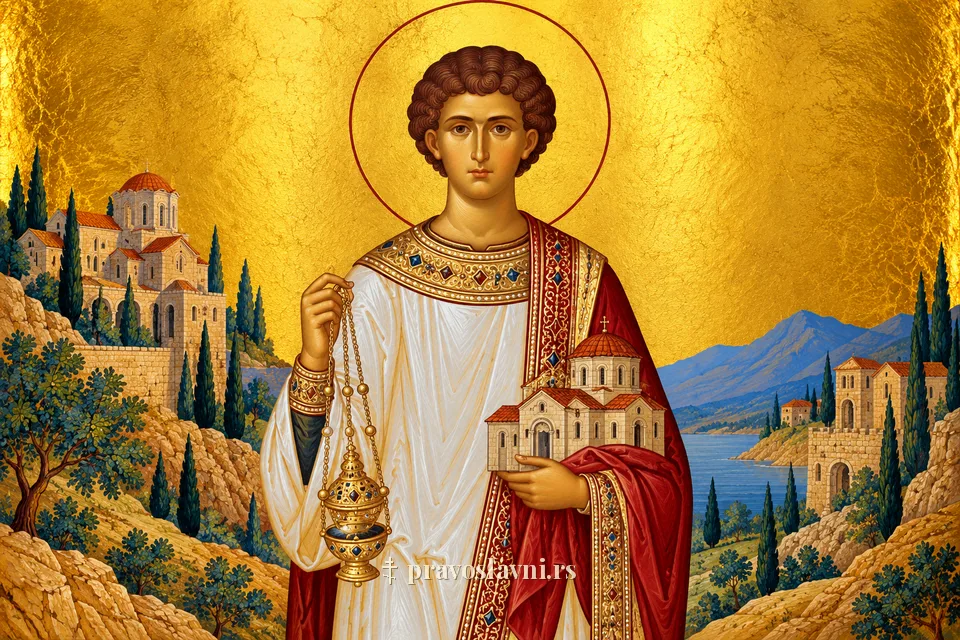
Illustration
Feast of the day
Translation of the Relics of the Holy Protomartyr and Archdeacon Stephen
What happenedThe relics of the Protomartyr Stephen, hidden for centuries, were found when Gamaliel appeared in a dream to the priest Lucian, and were then translated to Constantinople.
“And devout men carried Stephen to his burial, and made great lamentation over him.”
— Acts 8:2
Life
The priest Lucian of Caphargamala three times saw in a dream Gamaliel, the teacher of the Apostle Paul, who revealed to him where the relics of the Protomartyr Stephen lay. According to the Prologue, this was in the year 415, in the time of Patriarch John of Jerusalem.
A cave on Gamaliel's estate hid four graves. Beside Stephen there rested Nicodemus, who, according to both sources, died weeping over Stephen's grave, Gamaliel's baptised son Abibas, and Gamaliel himself, who had brought the body of the Protomartyr to his estate by night. Before that, after the stoning, the body had lain outside the city for a night and two days, and God preserved it from every harm. According to the Prologue, for centuries no one knew of that place.
When, with the patriarch's blessing, the cave was opened, the place was filled with a sweet fragrance, and the sick received healings that day. Zion in Jerusalem received Stephen's relics, and the others were laid in a church on a nearby hill. Later Constantinople received the Protomartyr; the Life records that on the way, in the midst of a storm at sea, Stephen appeared to the travellers and calmed the waves.
God keeps the bodies of those who have pleased Him and reveals them when He Himself appoints, for the healing and consolation of the faithful.
Full Life
A body preserved by God's Providence
When Archdeacon Stephen was stoned, his body was left outside the city for a night and two days. By God's Providence it remained unharmed. At night it was taken by Gamaliel, the teacher of the Apostle Paul and a secret disciple of Christ, who carried it to his estate at Kapharghamala and buried it in a cave.
In the same place were also buried Nicodemus, who died weeping at Stephen's grave, and Gamaliel's baptised son Abibus. Finally, at his own wish, Gamaliel himself was buried there too. The Prologue says that for centuries no one knew where Stephen's body lay.
The appearance to the priest Lucian
In the time of Patriarch John of Jerusalem — the Life calls him archbishop — Gamaliel appeared three times in a dream to Lucian, a priest at Kapharghamala, and revealed to him where the graves were. According to the Prologue, this was in the year 415. The Life records that in one vision Lucian saw four baskets of flowers, which signified the four graves, and that, while fasting, he asked three times for confirmation.
The Patriarch gave his blessing for the digging, and Lucian uncovered four graves; the place was filled with a strong fragrance. The Life says that when the grave was opened the earth shook and heavenly singing was heard. On the same day many of the sick were healed; the Life counts seventy-three of them.
From Zion to Constantinople
Stephen's relics were solemnly translated to Zion in Jerusalem, while the others were laid in a church on a small hill near the cave. Later Stephen's relics were translated to Constantinople.
The Life tells of that translation at greater length. The senator Alexander of Constantinople built a church in Jerusalem for the relics. When his widow Juliana was returning to Constantinople, by God's Providence she took Stephen's coffin with her instead of her husband's. At sea they were caught in a storm, and St Stephen appeared to them with the words: “I am with you, do not be afraid!” — and the sea grew calm. Healings took place in Chalcedon as well, and in Constantinople a church was built for the relics.
God reveals those who have pleased Him
God hides and reveals the relics of His saints at the time which He Himself appoints. The body of the Protomartyr, left outside the city, He preserved unharmed, kept hidden for centuries, and then gave to the Church as a source of healing and of comfort for the faithful.