Friday24September 202711 September (according to the Julian calendar)
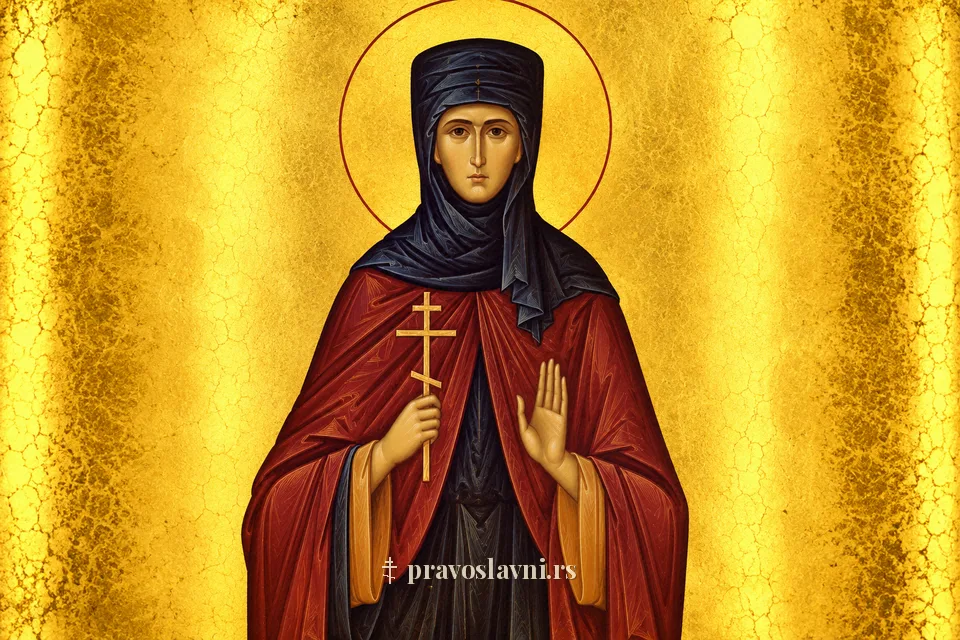
Illustration
Saint of the day
Venerable Theodora of Alexandria
What happenedTheodora, repenting of a single sin, lived as the monk Theodore in a men's monastery, and that she was a woman was discovered only after her death.
“For godly sorrow produces repentance leading to salvation, not to be regretted; but the sorrow of the world produces death.”
— 2 Cor 7:10
Life
The monk Theodore lived in a men's monastery in hard labour and fasting. No one knew that this was a woman, Theodora of Alexandria, who in this way was repenting of one sin.
She was married, and according to her Life also of high birth. Persuaded by a sorceress, she fell into adultery, and her conscience no longer gave her any peace. She cut off her hair, put on men's clothing and entered a monastery under a man's name.
Temptations were not lacking. The Prologue says that visions came to her of her husband calling her back, but they vanished at the sign of the cross. The hardest thing was when a certain girl falsely accused her of being the father of her child. Theodora saw in the slander the deserved consequence of her former fall: she brought up the child and endured being driven out of the monastery. When they received her again, she tamed wild beasts, healed the sick and drew water from a dry well.
That she was a woman became known only after her death, by a revelation of God. Her husband came to the burial and remained in her cell until the end of his life. The Prologue records that she repented of one sin for nine years and that she reposed in the year 490.
The Prologue says that she washed away her sin by virtue and by the mercy of God, and that she bore the slander in humility. And it teaches that no one should hinder a soul that gives itself wholly to God.
Full Life
The sin that gave her no peace
Theodora was a married woman from Alexandria; her Life says that she was of high birth and that she lived virtuously. Persuaded by a certain fortune-teller — according to her Life, on behalf of a rich young man — she fell into adultery. From that time her conscience gave her no peace. Her Life records that an abbess whom she knew read to her that there is nothing hidden that will not be revealed, and encouraged her to repent.
The monk Theodore
Theodora cut off her hair, put on men's clothing and entered a men's monastery, the Oktodekaton, under the name Theodore. According to her Life, she spent the first night in front of the gate, among wild beasts, which did not touch her because of the sign of the Cross. She lived in hard labour and fasting, sometimes, as her Life says, for a whole week at a time.
Her Life tells that, when she was sent into the city, she met her husband beside the church of St Peter and greeted him, and he did not recognise her; an angel had told him beforehand that the one who greeted him would be his wife. Her Life also states that she was carried across a lake by a crocodile which had been killing people and cattle, and that at her word it died.
Temptation and slander
The demons tempted her; the Prologue says — with visions of her husband calling her back, and these vanished at the sign of the Cross. Her Life records her words: “May God crush your power, O devil!”
The hardest temptation was slander. A certain girl — according to her Life, the daughter of the abbot of the Enaton Monastery — falsely accused her of being the father of her child. According to her Life, she said: “God is witness”. Nevertheless she bore the slander humbly, seeing in it the deserved consequence of her former fall, and she took the child in order to bring him up. Driven out of the monastery, she lived outside for years; the Prologue says — in the forest and the wilderness, and her Life — in a hut beside the monastery gate, where she reared the boy. At last the abbot received her again; her Life says — after the monks had interceded for her, and the abbot had learnt in a vision that her sin was forgiven.
The secret revealed
In the monastery she tamed wild beasts, healed the sick and drew water out of a dried-up well; her Life says — in a time of drought, enough to last until the rain fell. That she was a woman the monks learnt only after her death, by God's revelation. Her husband also came to the burial and remained in her cell until his own death. The boy whom she had brought up, as her Life says, later became an abbot. The Prologue records that she repented for nine years for one sin and that she reposed in the year 490.
The Prologue in its hymn says that she washed away her sin by virtue and by God's mercy, and bore the slander in humility and obedience. In its teaching it adds that no one should hinder a soul that has resolved to give itself wholly to God.
Other saints of the day
Venerable Sergius and Herman of Valaam
The Venerable Sergius and Herman founded the Valaam Monastery on Lake Ladoga. According to their Life, their ascetic labours belong to the first half of the fourteenth century, and their repose to about the year 1353. Their principal commemoration is on 28 June according to the old (Julian) calendar. Today the Church celebrates the translation of their relics from Novgorod back to their own monastery on Valaam.