Tuesday20April 20277 April (according to the Julian calendar)
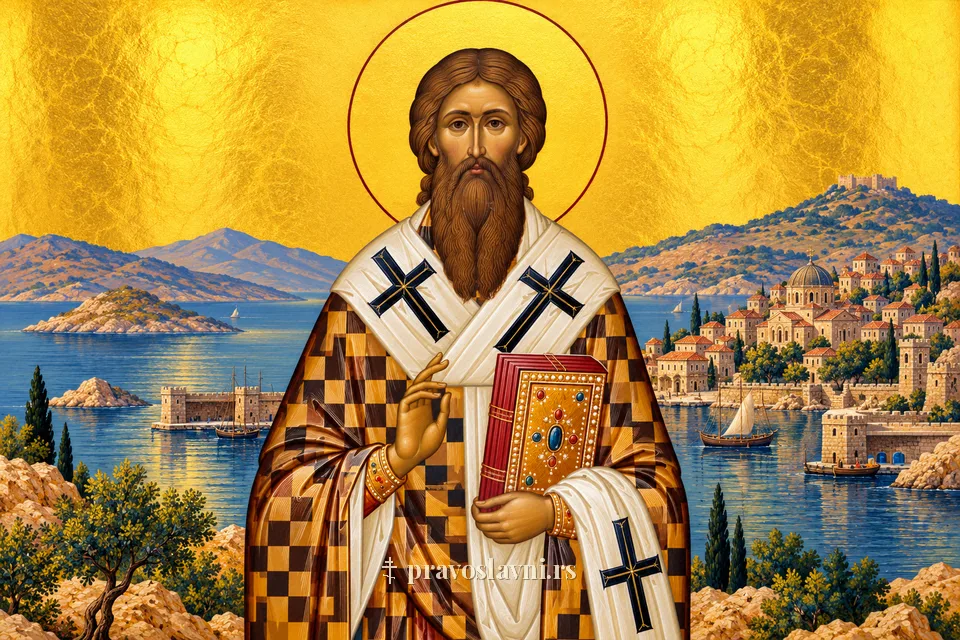
Illustration
Saint of the day
Venerable George, Metropolitan of Mytilene
What happenedMetropolitan George of Mytilene stood before the emperor in deep old age in defence of the holy icons, and for this ended his life in exile.
“He is the image of the invisible God, the firstborn over all creation.”
— Col 1:15
Life
Metropolitan George of Mytilene spent his life as a meek and merciful shepherd, and ended it as an exile, because before the Emperor he would not renounce the holy icons.
A monk from his youth, humble, according to his Life, as few others were, he became Metropolitan of Mytilene. The Prologue praises the zeal and discernment with which he led the faithful until his old age, and his Life remembers his generosity and the sick who recovered through his prayer. According to his Life, he had suffered from the iconoclasts already under Leo the Isaurian.
The hard time, says his Life, was foretold by a sign in one of the churches of Mytilene: the precious cross rose up from the altar by itself and fell, and Venerable Symeon wept and foretold a godless emperor. That emperor was Leo the Armenian. He summoned the bishops to Constantinople, wishing to forbid the veneration of icons. The old metropolitan did not give way. Together with other courageous bishops he rose in defence of the icons, and his Life says that many, listening to his answers to the Emperor and to the false patriarch, understood that they were in error. The Emperor repaid him with mockery and banishment: until the end of his life the metropolitan lived in poverty and hardship, far from his flock, in the region of Cherson.
He reposed around the year 816. Then, according to his Life, a bright star appeared above the island, and his flock understood that it had been left without a shepherd. The Prologue says that he worked miracles after his death as well.
The Prologue teaches that the life of a priest either confirms or denies the Gospel. George's life confirmed it: he chose poverty and exile rather than the betrayal of the faith.
Full Life
A star over Mytilene
The Life remembers that when Metropolitan George reposed in distant exile, around the year 816, an unusually bright star appeared in the sky. It was seen in the city and all over the island, and the faithful understood that they no longer had a shepherd. So ended the life of a man whom the Prologue calls a confessor, because even in old age he did not consent to betray the holy icons.
Meek and merciful
According to the Life, he loved Christ from his childhood, became a monk early, and had no equal in humility. His long ascetic struggle brought him such esteem that he became Metropolitan of Mytilene, and the Life says that this happened in the time of the Orthodox rulers Constantine and Irene. The Prologue praises the zeal and discernment with which he guided his faithful right up to his old age. The Life describes him as a merciful and generous man of great abstinence, at whose prayer the incurably sick recovered and those tormented by unclean spirits were set free. According to the Life, he had suffered at the hands of the iconoclasts as early as the reign of Leo the Isaurian.
Before the Emperor
Towards the end of his life Leo the Armenian, a persecutor of the icons, came to the throne. He gathered the bishops in Constantinople in order to abolish the veneration of icons, and George too was among those summoned. The old metropolitan did not obey. Together with other courageous bishops he stood up in defence of the icons, and the Life says that he answered the Emperor, the false patriarch Theodotus and the heretics so wisely that many, after hearing his words, understood that they were in error.
The price of this was mockery and banishment. He was sent far away, to the region around Cherson, and there he lived in want and hardship until his death. Miracles did not forsake him there either: the Life mentions many of them, and the Prologue says that he worked them both while living and after his death, because of his righteousness and his love for the Lord Jesus. According to the Life, God granted healing to the sick through his relics after his death as well.
Signs that foretold the storm
The Life says that the hard times in Mytilene were announced by signs. In the church of the Great Martyr Theodora beside the harbour, during Vespers, the precious cross rose up from the altar by itself and fell, to the horror of the people, and Venerable Symeon foretold with tears a godless emperor who would trample on the icons. A little later a boar of unusual size burst into the church and even got as far as the high place in the altar, before they drove it out; Symeon saw in this the announcement of a bishop of swinish character. When George was exiled, an iconoclast who trampled on the icons did indeed arrive in Mytilene.
The Prologue reminds us that a shepherd must be different from the flock, for the life of a priest either confirms or denies the Gospel. George's life confirmed it: he was meek while peace reigned, and unshakeable when the time came to suffer.
Other saints of the day
Venerable Nilus of Sora
The Russian Church numbers Venerable Nilus of Sora among her great fathers, and it was he who established the skete way of monastic life in Russia. His Life says that he was born in the year 1433, that his origin is unknown, and that out of humility he called himself an ignorant man and a peasant. According to the Life, he was tonsured a monk in the monastery of Kirill of Belozersk, under the strict elder Paisius Yaroslavov. With his disciple Innocent he visited the holy places of the East and stayed for a long time on the Holy Mountain (Mount Athos), where he learned the stillness of the desert, quiet prayer and watchfulness. The Life says that his favourite occupation was reading the Holy Scriptures, the lives of the saints and the holy fathers. When he returned, he settled on the marshy river Sorka, from which he received his name, and there, according to the Life, the first Russian skete following the rules of the Holy Mountain grew up. In one letter he wrote: “I do not dare to undertake anything by my own will and by my own reasoning.” At the council of 1503 he upheld the idea that monasteries should not own estates, but that monks should live by their own labour. In his testament he asked that he be thrown out into the wilderness for the wild beasts or buried without honours, as a sinner before God. The Prologue considers his Rule of Skete Life one of the most important works, both for its spiritual depth and for its practical value. He reposed in peace in the year 1508, and his relics rest in his Sora skete.