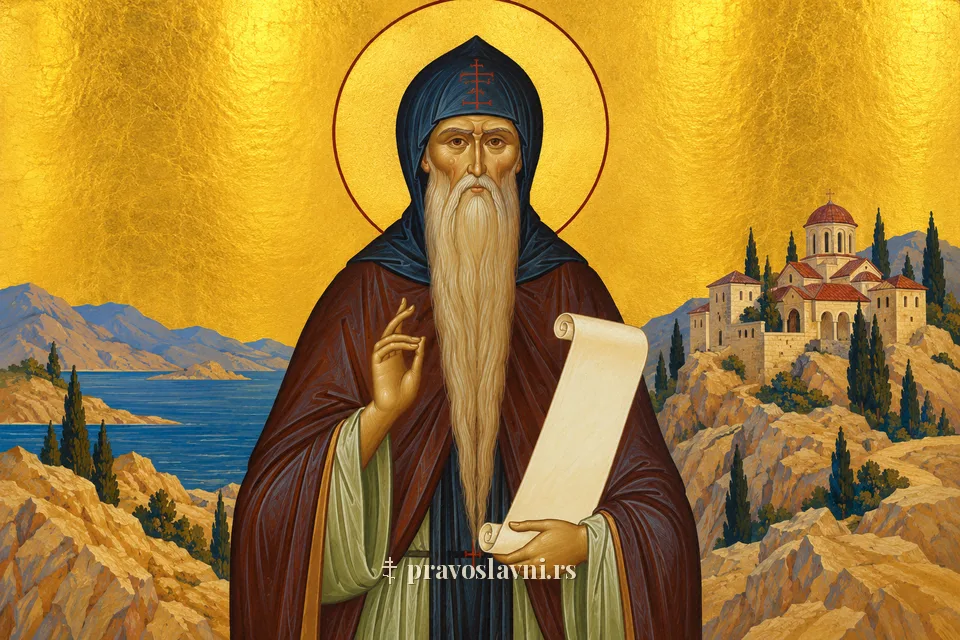
“The angel of the LORD encamps all around those who fear Him, And delivers them.”
— Ps 34:7
Life
When Theodosius the Great came to the throne, he sent for the elder Isaac and showed him honour. That elder was the very same hermit whom Emperor Valens had ordered to be thrown into a ravine, and who had foretold his defeat and death. The Prologue and his Life call him Isaac the Confessor.
He left the hermit's life in the East when the Arians, with the support of Emperor Valens, began to persecute the Orthodox, and he came to Constantinople to strengthen them in the faith. When Valens set out against the barbarians who had come down into Thrace from the far side of the Danube, Isaac three times went out to meet him on the road and warned him. The first time he asked him to open the churches to the Orthodox, but the emperor paid no heed; the second time, according to his Life, Valens had him beaten; the third time the elder seized the emperor's horse by the bridle and threatened him with God's punishment, and the emperor ordered him to be thrown into a deep, muddy and thorny ravine. Both sources say that three angels led him out of it unharmed, and the Life calls them three radiant men.
Coming before Valens once more, Isaac announced to him that, if the Orthodox did not receive their freedom, he would lose both the battle and his life. The prophecy was fulfilled: the army was defeated, and Valens was burned to death in a hut in which he had hidden from the barbarians. Isaac, according to his Life, was released from his chains and honoured as a prophet.
On his advice Theodosius restored peace to the Church and drove the Arians out of Constantinople. The elder wished to return to the desert, but he remained in the capital, where the nobleman Saturninus built him a dwelling. There a great monastery arose, in which Isaac lived until his death as abbot and teacher, working many miracles and giving away even his own clothing to the poor. He left the office of abbot to his disciple Dalmatus, after whom the monastery bears the name Dalmatian. He reposed around the year 383, and was buried, according to his Life, in the Church of the Holy Protomartyr Stephen.
St Isaac teaches that the truth must be defended even before the mighty, and that God guards those who serve Him faithfully.
Full Life
The hermit who came to the capital
In the Prologue and in his Life he is called Isaac the Confessor, and the name “Dalmatian” is connected with the monastery in Constantinople, which later took the name of his disciple. Before that he lived as a hermit in the East; the Life says that in this he followed the Prophet Elijah. In the desert the news reached him that Emperor Valens was supporting the Arians in their persecution of the Orthodox. The Life says that the Orthodox were left without their churches: some were locked, others were torn down, and some were being used for cattle. Isaac then left his solitude and came to Constantinople to strengthen the faithful and, according to the Prologue, also to expose the heretics.
Three warnings and the ravine
The opportunity to speak before the Emperor arose when the barbarians — according to the Prologue, the Goths — crossed the Danube, came down into Thrace and set out towards Constantinople. Valens led the army against them, and Isaac came out to meet him on the road with the words: “O Emperor, open the churches to the right-believing, and God will bless your path!” The Emperor did not listen to him. The warning was repeated; the Life says that the elder then promised him victory and a safe return, but the Emperor, at the urging of one of his Arian commanders, had him beaten and driven away. The third time Isaac seized the horse by the bridle and announced to the Emperor the punishment of God.
The punishment for his boldness was a ravine. According to both sources, they threw the elder into a deep pit, muddy and full of thorns, and the Life says that not even the animals that fell into it ever came out alive. Three angels, whom the Life describes as radiant men, led him out unharmed onto firm ground.
The prophecy that was fulfilled
Isaac stood before Valens once more — the Prologue says, on the fourth day — and declared to him what awaited him: if the Orthodox were not given their freedom, the Emperor would lose both the battle and his life. The Life says that Valens ordered the nobles Saturninus and Victor to keep him under guard in chains, and the elder said to him: “If you return in peace, then know that the Lord has not spoken through me.”
The Greek army suffered defeat. Valens fled with one of his Arian counsellors and hid in a hut, which the barbarians set on fire, and both of them perished there. The Life says that Isaac told his guards that seven days earlier he had already sensed the death of Valens in the flames. When the news arrived, he was set free and honoured as a prophet.
The monastery in Constantinople
The new Emperor, Theodosius the Great, who according to the Life had been brought to the throne by Gratian and who defeated the barbarians, summoned Isaac and showed him honour; the Prologue says that he even bowed down before him. On Isaac's advice he restored peace to the Church and drove the Arians out of Constantinople. The elder was drawn towards the desert, but he agreed to remain in the city. According to both sources, it was Saturninus who built a monastery for him. The Life tells how Saturninus and Victor competed to see who would be the first, because Isaac had promised that he would stay for the rest of his life with the one who finished building first; Saturninus built the monastery outside the city, but the elder sometimes stayed with Victor as well.
Many gathered around Isaac, and the community grew into a great monastery. There he worked many miracles until his death, and the Life remembers him as an abbot and teacher so merciful that he would not refuse a poor man even his own clothing. He appointed his disciple Dalmatus as his successor in the office of abbot, and after him the monastery was called the Dalmatian Monastery. He reposed around the year 383, and according to the Life the whole city came to his burial; he rests in the church of the holy Protomartyr Stephen.
Isaac did not keep silent before the powerful when the Church had to be defended, although he knew what might befall him. God preserved His servant, and humbled the proud Emperor who had rejected the warnings. Humility, almsgiving and prayer filled the rest of his life.