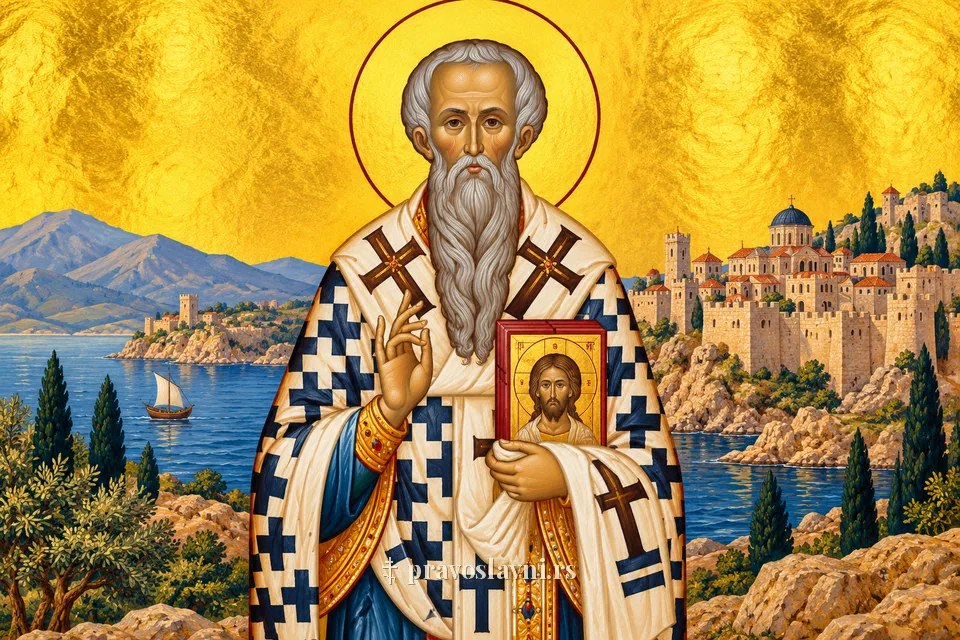
“For this is commendable, if because of conscience toward God one endures grief, suffering wrongfully.”
— 1 Pet 2:19
Life
When the iconoclasts, in the time of Copronymus, demanded of Bishop James that he renounce the veneration of the holy icons, he refused to do so. He paid for it with hunger, prison and mockery — that is how the Prologue lists his torments, and his Life adds persecutions, thirst and hardships that cannot be described. He remained unshaken until he departed to God.
Such steadfastness did not come suddenly. His Life says that from his youth he loved the ascetic life, that he became a monk and that he laboured in the study of the holy books. Both the Prologue and his Life remember him as a man of much fasting and prayer. After that, according to his Life, he became a bishop.
Little has been preserved about him; the Prologue records that it is not even known where he was born. St James bears witness that faithfulness is shown in trial: he was ready to lose his freedom and his life, only so as not to betray what is holy.
Full Life
We know little, yet we know what matters most
Very little has been preserved about St James. The Prologue records that it is not known either where he was born or where he was bishop. Nor do the sources give in the same way the century in which he lived, but they remember that he suffered in the time of the Emperor Copronymus. What has remained, however, is the most important thing: that he was an ascetic and that in the time of trial he did not betray the faith.
Monk and bishop
The Life says that from his youth he loved the ascetic life and that he became a monk. Both the Prologue and the Life testify that he purified himself by much fasting and prayer; the Prologue adds that he fulfilled the law of Christ especially by fasting and prayer, and the Life also mentions standing at prayer through the night and other labours. According to the Life, he was a diligent reader of the holy books, and in prayer he asked for purity of thought. Afterwards he was raised to the rank of bishop.
Faithfulness to the holy icons
The trial came in the time of Copronymus, when the iconoclasts were pressing Bishop James to renounce the veneration of the holy icons. He refused. The price of that refusal was a heavy one. The Prologue speaks of the prison into which he was thrown, of hunger and of the mockery which he had to endure; the Life adds to this persecutions, thirst and sufferings which words cannot describe. He did not give way even in the hardest things, and in such afflictions he ended his life. Both the Prologue and the Life say that he served God faithfully, and the Life adds — to the very end, having gained the Kingdom of Heaven.
St James remains an example of faithfulness: we know little more about him than that he did not betray what is holy and that he bore suffering to the end. On this day the Prologue encourages the faithful not to be afraid of persecution.
Other saints of the day
St Serapion of Thmuis
Venerable Serapion, according to the Prologue, was a companion of St Anthony the Great. He was the superior of the monasteries of Arsinoe in the Nitrian desert, where about eleven thousand monks gathered around him. The ancient church writers Palladius and Sozomen, as the Prologue records, called him the Great. He reposed around the year 366.