“Blessed are those who mourn, For they shall be comforted.”
— Mt 5:4
Life
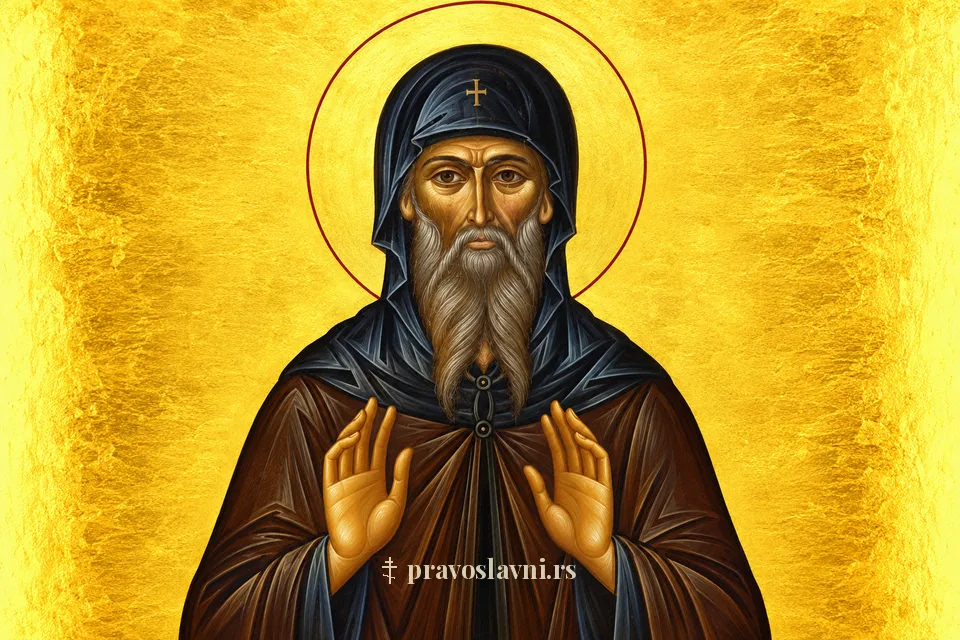
The Prologue sees in Venerable Ephraim the Syrian above all a teacher of repentance, and his many books and beautiful prayers still help people today to return to Christ.
He came from Syria and lived in the time of Constantine the Great; his Life names Nisibis as his homeland. The Prologue admits that his youth was stormy, but also that afterwards he gave himself wholly to Christ. According to the Prologue he studied under St James of Nisibis, and according to the Life he became a monk in the desert while still young.
The Life explains his gift of words by dreams: in one of them a heavenly voice destined a scroll for him alone — “No one else but Ephraim, my servant.” The Prologue remembers his wise speech and the tears that never dried up. By God's will he moved between the desert and Edessa, teaching monks and the people and writing. And to the women who wished to seduce him, according to the Life, he replied that shame before God is greater than shame before men.
He did not seek honours. According to the Life, it is told that as a monk he did not know anger and that he left the serving of the Liturgy to others, in the conviction that he was not worthy of it. He escaped being made a bishop by feigning madness through the streets of Edessa. Of himself, according to the Life, he wrote that he had never possessed precious metals. Most of his time he gave to prayer and to tears at the thought of the Dread Judgement.
He was bound in friendship with St Basil the Great. In Caesarea, according to the Life, he listened to Basil's sermon and praised him with the words: “Truly great is Basil!” Basil ordained him a presbyter and applied to him the words of the psalm: Ephraim also is the helmet for My head (Ps 59:9). He was also close to Abramius the Recluse, whose niece Mary, according to the Life, he helped by his prayer. The Life also remembers the trick by which he put the heretic Apollinarius to shame: the pages of his books glued together.
He knew in advance when he would die, and he left his disciples a testament. He reposed at a great age, according to the Prologue in the year 378, and was buried, according to the Life, in his own monastery near Edessa.
St Ephraim teaches that we should feel more shame before God, who sees even what is hidden, than before men, and that repentance is a path open to everyone.
Full Life
A Teacher of Repentance
What is the most important thing to know about Venerable Ephraim the Syrian? The Prologue answers without hesitation: he is above all an apostle of repentance. He left behind him a multitude of books and beautiful prayers, and the Prologue bears witness that even today these writings do not lose their power to move to repentance even a sinner whose heart has grown hard. The Prologue praises both his wisdom and his frequent tears.
That gift did not remain shut up in his cell. Both sources say that he did not decide for himself when he would be in solitude and when in Edessa, but followed God's bidding. His teachings were heard both by monks and by townspeople. Besides this he wrote, prayed and gave himself to contemplation. According to his Life, his calling was foreshadowed while he was still a child, through a dream his parents had. Later, according to his Life, God-bearing elders also understood through visions in their sleep that it was Ephraim who was called to teach, and one of them, listening to him, came to believe that the Holy Spirit was speaking through him.
Flight from Honours
As much as others wanted to raise him up, so much did he draw back. He escaped the episcopal dignity in an unusual way: both sources remember that he feigned madness, and according to his Life he afterwards stayed in hiding until the see had received another shepherd. Nor did the priestly rank, which Basil the Great conferred on him, change his modesty. His Life passes on the account that he did not consider himself worthy to serve the Liturgy, and so he remained among those who receive the Holy Mysteries. Anger, as his Life relates, became foreign to him from the time of his monastic tonsure onwards.
His day, according to his Life, was filled with prayer and tears at the thought of the Dread Judgement, and to sleep and food he left scarcely any room. Poverty was dear to him, and in his last word to his disciples he testified, his Life says, that he had never owned any possessions at all.
Wisdom in His Encounters
His Life also remembers the women who tried to lead him into temptation. Instead of rebuking them, he turned them towards God, Who sees even what is hidden, so that one of them was converted and ended her days in a convent, while the other went away ashamed.
The Prologue remembers that he and St Basil the Great lived at the same time and were friends. “Truly, Basil is great!” — with these words, according to his Life, Ephraim in Caesarea of Cappadocia greeted Basil's sermon, to which a vision had brought him. To those listening it sounded like flattery, until Ephraim revealed to them what had been shown to him then. Basil applied to Ephraim the words of the psalm: “Ephraim also is the helmet for My head” (Ps 59:9).
With Abramius the Recluse, according to his Life, he was bound by a deep friendship and by visits to one another. Ephraim's prayer helped to save Mary, the niece of Abramius, whom the devil was tempting.
His Life also preserves one of his clashes with the heretic Apollinarius, a learned and eloquent author of many books against Orthodoxy. Ephraim devised a trap for him: two of his books, which he took, on the pretext of being his disciple, from the woman with whom they were kept, he returned with their pages glued together. When the aged heretic wanted to rely on them in a new dispute with the Orthodox, he was left without a weapon before his opponents, and shame and misery, according to the Life, soon finished him off.
Where He Came From and Where He Rests
A Syrian by birth, he came into the world while Constantine the Great was ruling the empire. His Life gives Nisibis as his birthplace and says that his parents were Christians, while the Prologue says that they were poor. His youth, according to the Prologue, was not a peaceful one, but when he was converted he burned with love for Christ. The monastic path, according to his Life, he chose early, by withdrawing into the desert, and the Prologue calls him a disciple of St James of Nisibis.
He knew beforehand that his end was drawing near. He left his teachings to his disciples in a written testament and departed in deep old age — the Prologue says, in the year 378. He was buried, according to his Life, in his desert monastery near Edessa.
St Ephraim teaches that the fear of God is stronger than the fear of men, that humility does not seek honours, and that through repentance even a hard heart returns to Christ. And his Life comforts us with this: that his intercession before God helps even today those who seek the forgiveness of their sins.
Other saints of the day
Venerable Isaac the Syrian
Venerable Isaac the Syrian was one of the greatest teachers of the spiritual life. The Prologue says that he was born in Nineveh, while his Life says in Beth Qatraye, on the shore of the Persian Gulf. While still a young man he entered the Monastery of Mar Mattai near Nineveh, and his Life adds that he came there with his elder brother, who became the abbot. He was chosen as Bishop of Nineveh against his will; what brought this about was the report of his holy life, his knowledge and his miracles. He was bishop for only five months, and then he secretly went away. He withdrew to the desert monastery of Rabban Shabur, where he devoted himself to Holy Scripture. About a hundred of his homilies have come down to us, in which he describes above all what he himself experienced on the path of asceticism. Even St Symeon of the Wonderful Mountain used to come to him for counsel, so deeply did he know the human soul and so well was he able to guide others. His Life records that he taught of three stages of the spiritual life: repentance, purification and perfection. Repentance, according to his teaching, is a gift which comes after baptism and gives a person new birth; hence his saying: “Repentance is the mother of life.” He lived to a great old age and reposed, according to the Prologue, at the end of the seventh century, and according to his Life at the beginning of the eighth. His lesson is that repentance is needed throughout the whole of life, and that the summit of the spiritual life is deep humility.