Saturday17April 20274 April (according to the Julian calendar)
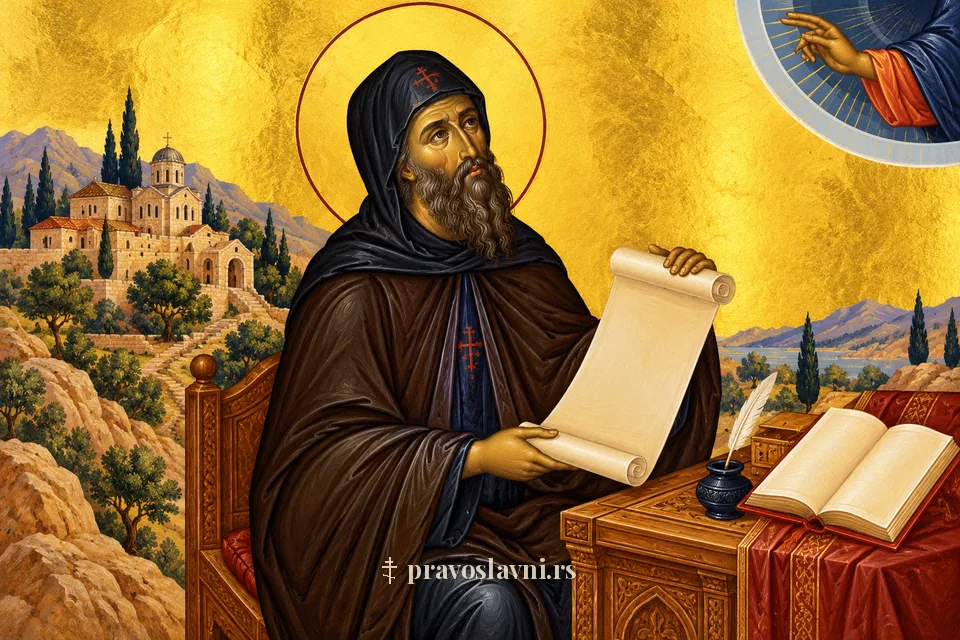
Illustration
Saint of the day
Venerable Joseph the Hymnographer
What happenedVenerable Joseph the Hymnographer looked on his iron fetters in a prison on Crete as golden jewellery, and later wrote a great many church hymns to the Theotokos and the saints.
“Speaking to one another in psalms and hymns and spiritual songs, singing and making melody in your heart to the Lord.”
— Eph 5:19
Life
“Arise and follow me!” — these words, as the Prologue and his Life record, were heard by the monk Joseph in a prison on Crete, on the feast of the Nativity of Christ, when St Nicholas appeared to him. In that same hour Emperor Leo the Armenian, the persecutor of the holy icons, was killed. After six years of captivity Joseph found himself free before Constantinople.
By origin he was from Sicily, the son of devout parents, Plotinus and Agatha. He became a monk in Thessalonica and was made a hieromonk, known for his fasting, prayer and vigil. Gregory of Decapolis took him to Constantinople, where together they encouraged the Orthodox in the time of iconoclasm. When he was sent to Rome to ask for help for the true faith, pirates seized him at sea and carried him off to Crete, into the hands of heretics.
Prison did not break him. He accepted suffering for Christ as an honour, and his chains as an adornment. His Life says that he encouraged the other prisoners too, so that one bishop, who was wavering, remained faithful because of his tears and words and suffered as a martyr. Joseph himself, according to his Life, stumbled for a short while, but he set himself right.
He used his freedom for prayer and work. According to his Life, he founded a monastery in Constantinople, and after an appearance of the Apostle Bartholomew he began to write church hymns. He composed canons and stichera for many saints, especially, says his Life, for the Theotokos and St Nicholas. That is why we call him the Hymnographer.
Later, according to his Life, he was exiled twice more: for resisting iconoclasm and because he rebuked Bardas. Patriarch Photius valued him as a clairvoyant spiritual father and appointed him confessor of the clergy. He reposed in deep old age, in the year 883. The Prologue and his Life remember the vision of St Theodore Phanariotes, according to which the very saints whom Joseph had praised in song came for his soul.
God glorifies those who glorify Him — that is the lesson of Joseph's life. He who wore fetters as an adornment and gave his whole gift to the glory of God and of His saints was not left alone at the hour of death.
Full Life
The poet of the saints
The Church remembers him for his hymns. As the Prologue and his Life record, Joseph composed canons and stichera for many saints, and according to the Life most of all for the Theotokos and St Nicholas. Hence the name Hymnographer; the Prologue calls him the Hymn-writer. The Life says that this gift did not come of itself. In his monastery in Constantinople he kept a large part of the relics of the Apostle Bartholomew, which he had received in Thessalonica. For forty days he fasted and prayed, and on the eve of the apostle's feast Bartholomew, according to the Life, appeared to him, blessed him and left the Gospel on his breast. From that day Joseph began to write hymns for the divine services.
Joy in chains
He came to this through a long school of patience. A Sicilian by birth, the son of Plotina and Agathius, as a boy he, according to the Life, loved fasting and Holy Scripture more than play, and the family, taking refuge from the barbarians, moved to the Peloponnese. He became a monk in Thessalonica, and the bishop there ordained him a hieromonk. He lived the ascetic life strictly: according to the Life, he slept on the ground covered with a hide, spent his nights standing in prayer, and often served the Liturgy with tears. There Gregory of Decapolis came to know and love him, and with him he moved to Constantinople.
When Leo the Armenian raised his hand against the holy icons, the Life says that Gregory and Joseph went round to the faithful in their homes and in the streets and encouraged them. Joseph was then sent to Rome, to ask the Pope and the Roman Church for support for the true faith. He did not arrive: pirates captured him at sea and handed him over to the heretics on Crete. There he spent six years in prison.
What that captivity meant to him is best told by his own words, which the Life preserves: “What can be sweeter and more joyful than these chains”. The Prologue and the Life say that he wore the chains as something precious, grateful to God that he could suffer for Christ; the Life adds that he compared them to the chains of the Apostle Paul. He encouraged others too. One bishop, who was on the verge of renouncing the faith, remained faithful after Joseph's tears and entreaties and suffered as a martyr. According to the Life, Joseph himself once stumbled, but he quickly got up again and kept many from falling.
His release came on the feast of the Nativity of Christ. While Emperor Leo was being killed in church at Matins, St Nicholas appeared to Joseph in the prison, as the Prologue and the Life say: “Arise and follow me!” The Life writes that the chains fell off and the doors opened, and Joseph, as though carried through the air, found himself before Constantinople.
A confessor into old age
Even after that his peace did not last long. According to the Life, he found Gregory dead, and so he built a church of St Nicholas, translated to it the relics of Gregory and of his disciple John, and founded a monastery. Under Emperor Theophilus he again publicly defended the icons and was exiled, and it was Empress Theodora who brought him back; Patriarch Ignatius entrusted him with the care of the sacred vessels of the Great Church. Bardas, says the Life, drove him out once more, because Joseph had rebuked him for sending away his lawful wife, and the Life compares this with John the Forerunner and Herod.
Patriarch Photius valued his gift of clairvoyance, appointed him confessor to the clergy and spoke of him as a man of God. Joseph reposed at a great age, in the year 883. The Prologue and the Life also remember an appearance of St Theodore Phanariot, who helps to find what has been lost: to a man who was looking for a runaway servant he said that on that night Joseph had been accompanied to heaven by a multitude of the saints whose glory he had sung.
God glorifies those who glorify Him, the Prologue teaches. Joseph sang to the saints, and the saints, in the end, came for him.