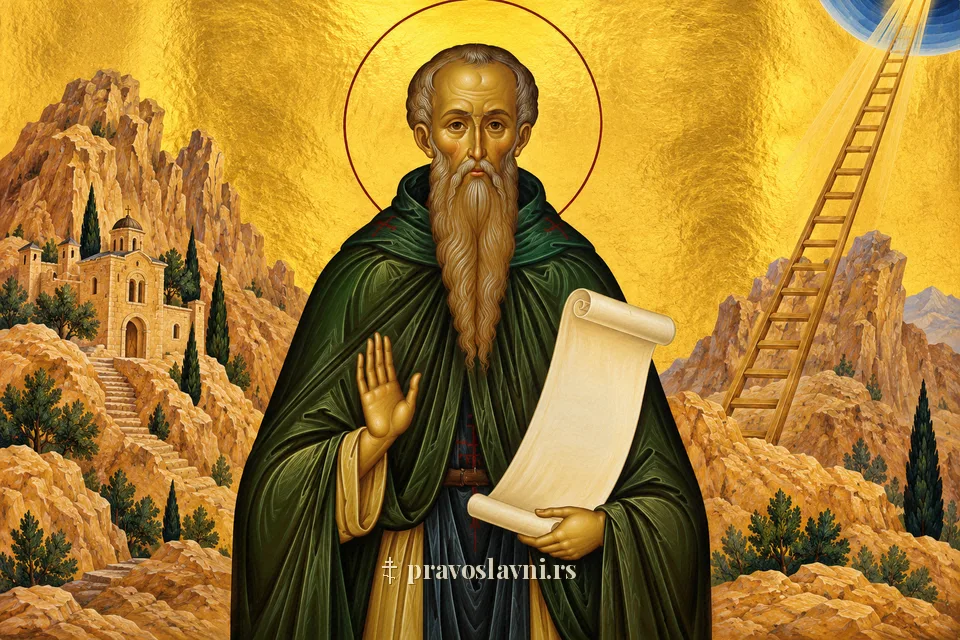
Venerable John Climacus (of the Ladder)Commemoration: 12 April 2027
Commemoration in our calendar
Monday, 12 April 2027strict fast (no oil) · 30 March (according to the Julian calendar)
Monday12April 202730 March (according to the Julian calendar)
Illustration
Saint of the day
Venerable John Climacus (of the Ladder)
What happenedJohn lived on Sinai for decades in obedience, silence and prayer, and out of that ascetic struggle came “The Ladder”, a book about the soul's ascent to God.
“I press toward the goal for the prize of the upward call of God in Christ Jesus.”
— Phil 3:14
Life
Among the books which the Church has received from the desert-dwellers, one takes its name from steps: “The Ladder”. It was written by John, a monk of Mount Sinai, to show how the soul, step by step, climbs towards God. The Prologue says that it was written in the years of silence in a cave, and his Life that John, the abbot of Raithu, asked him to do so.
Nothing is known about his childhood. At the age of sixteen he came to Sinai and remained there until the end of his life. His biographer Daniel saw in that coming the beginning of an ascent much higher than the mountain itself. He spent nineteen years in obedience under Abba Martyrius, and after his death another twenty in a cave, in fasting, weeping and prayer. Anastasius the Sinaite and John the Sabbaite, according to his Life, saw the future abbot of Sinai in him while he was still a young monk.
To the slander that he was talkative he answered with a year of complete silence, which he broke only when the brethren asked him to. His prayer saved his disciple Moses — the disciple leapt up from the place where he was sleeping, a moment before a rock crashed down there. His Life also says that by prayer he freed the monk Isaac from a passion and obtained rain in a time of drought.
At the insistence of the brethren he became abbot. The Prologue says that he led them with zeal and love. His Life tells that once, while guests were sitting at table, there was among those serving an unknown young man who afterwards disappeared. John said to the brethren: “Leave him, do not look for him; it was the holy Prophet Moses serving in his own place.”
In the end he handed over the governance to his own brother George, who outlived him by only ten months, just as John had promised. John reposed around the year 649. His Life compares him with the Prophet Moses, for whom the promised land remained out of reach, while John reached the heavenly Jerusalem.
His life teaches that a person climbs towards God slowly, step by step — by humility, obedience, silence and prayer.
Full Life
The book by which we name him
The place of his birth is not known, and his name is bound up with a book. Among his writings the best known is “The Ladder”: it speaks of how the soul, rung by rung, rises towards God, from the struggle with the passions to the vision of God. The Prologue says that it came into being in the years of stillness which he spent in a cave. His Life adds that he was prompted to write by John, the abbot of Raithu, and that both that abbot and a certain wise man by the name of David bore witness to the holiness of Climacus.
The boy who came to stay
Nothing is written down about his childhood and origins; his biographer, the monk Daniel, admits this as well. It is known only that he came to Mount Sinai as a sixteen-year-old and that he stayed there. The Prologue says that on Sinai he travelled the whole monastic road, all the way to the office of abbot. It seemed to Daniel that, in climbing Sinai, John was in fact conquering the heavenly mountain.
His Life describes him as a young man of mature mind, who also knew worldly philosophy, and yet loved humility and obedience more. At the age of twenty he received the monastic tonsure from Abba Martyrius. Several elders at once recognised something great in him. Abba Strategius, according to his Life, said that this monk would become a light for many. Anastasius the Sinaite called out to Martyrius: “O Abba Martyrius, you have tonsured the abbot of Mount Sinai!” His Life also tells that Martyrius took him to John the Sabbaite in the desert of Guda. The elder there washed his feet and kissed his hand, and explained to his own disciple Stephen that he was welcoming not an unknown youth, but the future abbot of Sinai.
The school of silence
For almost two decades, nineteen years, John was a novice under obedience to Abba Martyrius. When Martyrius died, he went away to a cave — his Life names the place Thola, not far from the monastery — and stayed there for twenty years. Of food, words and sleep he took little, while tears, almsgiving and the thought of death accompanied his days; before going to rest he would write, says his Life. He also had a secret place for prayer, far from everyone, where he could weep aloud.
When they slandered him, saying that he talked a great deal — his Life calls the slanderers envious men and adds that they also called him a liar — he did not defend himself with words. For a year he did not speak. Only at the request of the brethren did he break his silence.
Miracles through prayer
His disciple Moses once lay down to rest beneath a rock. John, at prayer, sensed that danger was threatening him — his Life says that he received the warning in a dream — and prayed for him. Moses leapt to his feet, and the rock crashed down on the place where he had been lying until then. Afterwards he told how John's voice had startled him awake; John, according to his Life, said nothing about his dream. His Life also records the monk Isaac, freed from a bodily passion when John prayed together with him, and a drought which ceased at John's prayer.
Abbot to the end
After forty years of monastic life, according to his Life, the brethren begged him persistently to be their abbot, and he consented. The Prologue says that he led them with zeal and love. His Life says that once six hundred pilgrims came. Among those serving at table there was an unknown young man, dressed as a Jew and quick at his work, who afterwards disappeared. John said to the brethren: “Leave him be, do not look for him; that was the holy Prophet Moses serving in his own place.”
On his deathbed he handed over the governance to his own brother George. George did not wish to be left without him, and so John promised him that, if he had been pleasing to God, he would pray that George too should not remain for long — that he should depart in the same year. Ten months later George reposed. John died around the year 649. His Life in the end sets him beside the Prophet Moses: for the prophet the promised land remained out of reach, whereas John arrived in the heavenly Jerusalem.
St John Climacus teaches that one goes towards God slowly, step by step — through humility, obedience, silence and prayer.