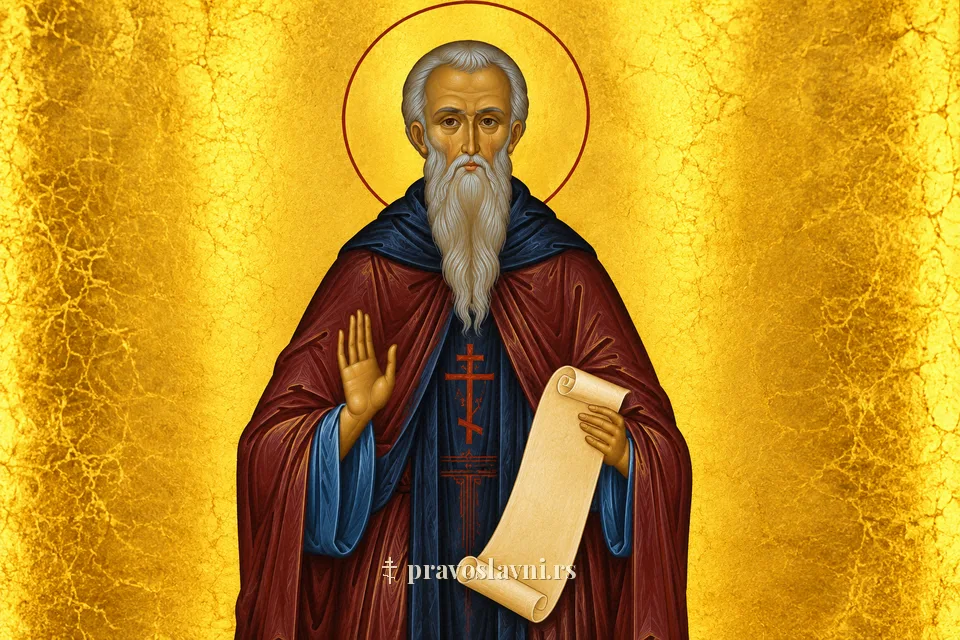
Venerable John, disciple of St Gregory of Decapolis
Commemoration: 1 May 2026
Venerable John, disciple of St Gregory of DecapolisCommemoration: 1 May 2026
Commemoration in our calendar
Friday, 1 May 2026fast with oil · 18 April (according to the Julian calendar)
Friday01May 202618 April (according to the Julian calendar)
Illustration
Saint of the day
Venerable John, disciple of St Gregory of Decapolis
What happenedJohn followed St Gregory of Decapolis from his youth, endured the iconoclast persecution with him, and after his death continued his ascetic struggle in Constantinople.
When Venerable John reposed, St Joseph the Hymnographer laid him with honours near his teacher, St Gregory of Decapolis. Teacher and disciple thus remained one beside the other.
From his youth, as his Life says, John loved Christ more than the world, and that is why he came to Gregory. Gregory tonsured him a monk. Humility, according to his Life, was the chief trait of this disciple, and the elder gave thanks to God because of him.
In this way the disciple, beside his teacher, became an ascetic himself. They lived in the time of Emperor Leo the Armenian, who renewed iconoclasm and persecuted the Church. According to the Prologue, the Emperor tortured John together with Gregory and Joseph. His Life remembers that in Constantinople, together with Joseph, he encouraged the Orthodox to persevere in the faith.
After Gregory's death John, according to the Prologue, became abbot of the Decapolite's monastery in Constantinople and gave himself still more to the ascetic life; his Life says that there he cared for his own salvation and that of others. He reposed in peace around the year 820. His Life adds that Joseph later translated the relics of Gregory and John to the church of St Nicholas the Wonderworker, which he himself had built.
John teaches that the faith is kept by humility and obedience, and that one who is himself established in the truth can establish others as well.
Full Life
The Disciple Who Chose His Teacher
According to the Life, even as a young man John was drawn more by Christ than by the world, and that love led him to St Gregory of Decapolis. Gregory tonsured him a monk, and John remained with him, in ascetic struggle and in the service of God.
The Life writes of him as a disciple without pride, who obeyed the elder and gladly accepted every good work. His teacher had joy in him and gave thanks to God for him. The Life notes that Gregory was from the Decapolis of Isauria, but it does not say where John was from.
In the Time of Persecution
The Emperor Leo the Armenian revived iconoclasm and began to persecute the Church. The Prologue mentions torture at the hands of the iconoclasts as the common lot of the three: Gregory, St Joseph the Hymnographer and John. According to the Life, John came with his teacher to Constantinople, where he and Joseph went about the capital supporting the Orthodox, so that they would not waver in the faith. The Life adds that Joseph never reached Rome, to which he had been sent: as a captive of the heretics, he found himself in chains on Crete.
Heir to the Ascetic Struggle
Soon Gregory reposed in the Lord. The Prologue says that after this John became abbot of the monastery of the Decapolite in Constantinople and that he increased his ascetic struggle still more for the sake of the Kingdom of God. The Life does not mention the abbacy; according to it, John went on labouring in Constantinople, caring both for his own soul and for the souls of others. When Joseph, after some time, was set free and returned to Constantinople, John departed to the Lord. He reposed peacefully, around the year 820, as the Prologue states.
Beside His Teacher's Tomb
St Joseph laid his body with honours near the place where Gregory rested. The Life adds that Joseph later moved to a quiet place beside the church of St John Chrysostom, built there a church of St Nicholas the Wonderworker and translated the relics of Gregory and John into it. Thus teacher and disciple remained together even after death.
John's life shows what it means to be a faithful disciple: from his teacher he learned humility and obedience, in the time of persecution he remained firm in Orthodoxy, he strengthened others in the faith, and he laboured both for his own salvation and for the salvation of his neighbours.