Monday08February 202726 January (according to the Julian calendar)
Illustration
Saints of the day
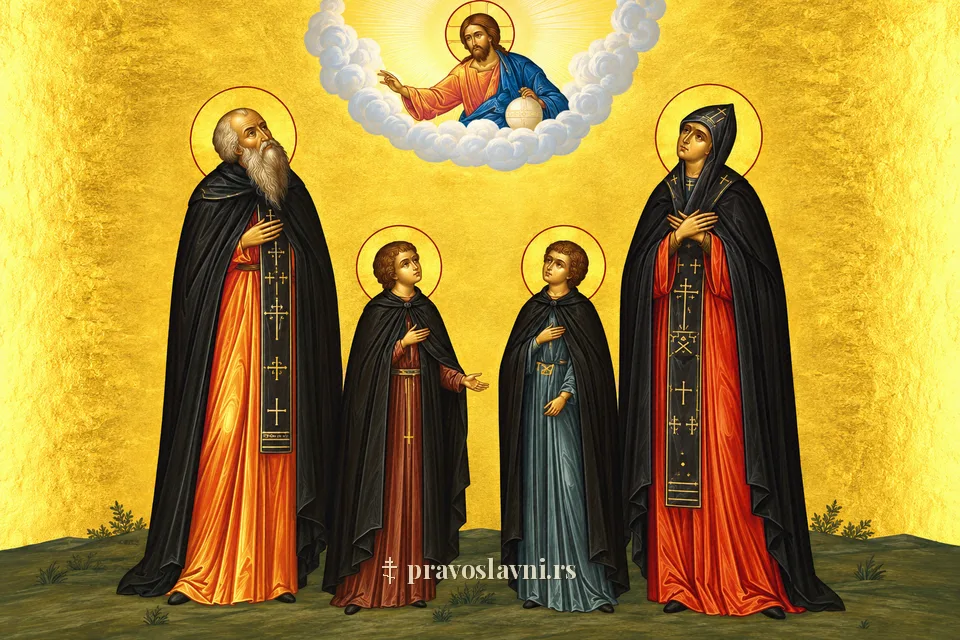
Venerable Xenophon, Mary and their sons
What happenedThe brothers John and Arcadius, separated by a shipwreck, were reunited with their parents in Jerusalem, and then the whole family chose the monastic life.
“And we know that all things work together for good to those who love God, to those who are the called according to His purpose.”
— Rom 8:28
Life
Of the wealthy Constantinopolitan family of Xenophon and Mary it was not an estate that remained, but four monastics: the father, the mother and their sons John and Arcadius. They were brought to this, as the Prologue and their Life record, by a path through a loss that seemed final.
Their house was a devout one. The Prologue says that the parents cared most of all about bringing up their sons as Christians. Their Life also preserves the father's instruction to his sons, spoken when he fell gravely ill: “Fear God, and live according to His holy commandments.” He taught them to help the poor and prisoners, to take care of slaves who had grown old and to set them free.
The young men were educated in Berytus. On one voyage a storm destroyed the ship. Both of them survived, separated, and each mourned his brother as drowned. In their grief they found consolation in monasticism, each in a different monastery; Arcadius, according to the Life, in the Lavra of Chariton near Jerusalem, after a dream had revealed to him that his brother was alive.
For a long time the parents did not know what had happened. Their Life says that, when they at last heard that their sons had never arrived at the school, they spent the night in prayer and in a dream saw them both glorified beside Christ. They set out on pilgrimage to Jerusalem, giving alms as they went, and there a clairvoyant elder told them that their sons were alive. They saw them already on Golgotha, in the elder's company, but they did not recognise them. Only at the inn, from the story told by the two young monks, did the parents understand who was sitting before them.
For the parents that meeting was also a parting from the world: they too became monastics, and their wealth became bread for the poor. Their Life says that Mary went to a convent, and the father and the sons into the desert. Their Life also remembers the gifts of God which they gained there: the sons foresaw their own deaths, Mary healed the blind, and Xenophon worked miracles and saw things in advance.
Their story teaches that God does not abandon those who trust Him even in the deepest sorrow, but leads them to a joy greater than the one that was lost.
Full Life
Four Monastics from One House
In Constantinople in the fifth century there lived a family that lacked nothing: Xenophon was a wealthy and respected nobleman, Mary was his wife, and they had two sons, John and Arcadius. And yet what remained of that house was not wealth, but four monastics — the father, the mother and both sons.
Piety mattered more in that house than property. The Prologue stresses that what was most important to the parents was the Christian upbringing of their sons. The young men gained their learning far from home, in Berytus, present-day Beirut, where there was a famous school.
How seriously the father took the faith was seen when he once fell gravely ill. According to the Life, his sons then came home, and he left them this instruction: “Fear God, and live according to His holy commandments.” Along with this he taught them mercy towards the poor and towards prisoners, respect for the clergy and for monks, and care for slaves who had grown old, who ought to be set free. He also confided to them that he and Mary had lived in continence, as brother and sister, ever since their sons were born. According to the Life, God gave him a sign in a dream that he would live on; he recovered, and his sons went back to their school by ship.
The Sea That Parted Them
On that voyage the brothers were separated. The Prologue and the Life say that the ship was wrecked in a storm. Both of them survived, but apart from each other, and each mourned his brother as a drowned man. The Life also states where: the sea carried the servants to Tyre, John to Malmephetan, and Arcadius to Tetrapyrgia.
Grief led them, each one on his own, along the same road — into monasticism. The Life records that John was received and tonsured a monk by the abbot of a monastery in Malmephetan. To Arcadius it was revealed in a dream that his brother was not dead; he set out for Jerusalem, where a clairvoyant elder directed him to the Lavra of St Chariton, which is called the Souka Lavra, and there he became a monk.
The Parents' Faith Put to the Test
In Constantinople they knew nothing of all this. According to the Life, it was only after two years that Xenophon sent a servant to Berytus to ask after his sons. No one there had seen them, and the servant was told that they had drowned. Mary, as the Life says, bore that news calmly. She and her husband spent the night in prayer, and both were shown the same thing in a dream: their sons were glorified in the presence of Christ.
The Meeting in Jerusalem
The Prologue and the Life say that the parents then set out on pilgrimage to Jerusalem, giving alms wherever they passed. There a clairvoyant elder assured them that their sons were alive. On Golgotha they saw him accompanied by two young monks, and they did not even suspect who these were. The truth came to light at the inn, while the young men were telling what had happened to them — and the family found itself together once more.
Their joy at once became gratitude. According to both sources, they showed their gratitude by complete renunciation: Xenophon and Mary became monastics, and of their wealth nothing remained that was not given to the poor. The Life says that the elder tonsured them. Xenophon sold his estates, freed his servants and withdrew into the solitude of the desert; his sons too set out for the desert, together with the elder, while Mary entered a convent. The Life also records the gifts they acquired there: the sons knew of their death in advance, Mary restored sight to the blind and delivered those possessed by demons, and Xenophon worked miracles and foresaw things to come.
The Life also passes on the opinion of some that John is in fact St John of the Ladder (Climacus). It cites as well the testimony of Daniel of Raithu: George Arselaites, who had earlier been called Arcadius, had as his brother the son of Xenophon.
This family's loss was not an end, but a beginning: through the grief they bore with faith, God led them to a joy greater than the one they had lost. All four of them left their wealth for the sake of God.