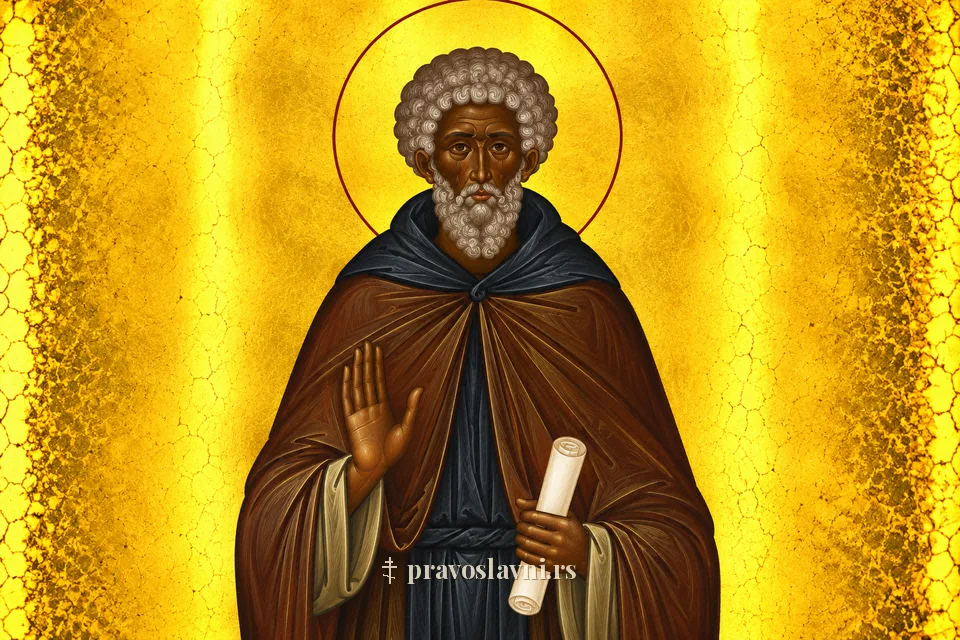
“I have not come to call the righteous, but sinners, to repentance.”
— Lk 5:32
Life
His Life tells that St Moses once overpowered four robbers who had attacked his cell, carried them bound to the brethren and asked what he should do with them. The fathers said that it is not fitting for monks to kill, and he let them go, and the robbers repented and became monks. That event carries a special weight, because Moses himself had once been a leader of robbers.
An Ethiopian by birth, he was a slave, but he left his master and joined a band, which made him its chieftain on account of his strength and fierceness. His conscience, however, awakened him; his Life says that God touched his heart. He left the robbers, became a monk and obeyed the abbot in everything.
The hardest struggle was the inner one. For years he was tormented by lustful passions, and Abba Isidore led him through fasting and night vigils, until after six years he healed him; his Life says that in doing so he also warned him against pride. According to his Life, not even mockery of his dark skin provoked him, but he kept silent, and when at his ordination they tested him by sending him away from the altar, he called himself unworthy.
He served in secret: at night, so that no one would know, he carried water to the brethren from a distant well. When a certain governor came to see him, he spoke of himself with contempt, so that he would not be praised. His Life also says that once, for the sake of guests, he departed from the fast, and the fathers saw in this the fulfilment of God's commandment. As an old man he received the priesthood and gathered seventy-five disciples.
His end came at the hands of barbarians. He foresaw the attack and told the brethren to flee, but he himself remained, because he who has used violence should also perish by violence. Six monks remained with him and all were killed, and a brother who had hidden saw shining crowns above them.
St Moses bears witness that repentance and humility can make a saint even out of a robber.
Full Life
Strength turned towards evil
Moses, whom the Church calls the Black, was an Ethiopian by birth; the Life adds that he was dark-skinned and that he lived in Egypt. He began as a slave. He parted from his master — the Life says that the master drove him away because of his bad conduct and a murder — and found a place among robbers. They saw a leader in him, for he was mighty in body and fierce in temper. According to the Life, he lived by plunder and violence, and once, in order to take revenge on a certain shepherd, he swam across the swollen Nile holding a sword in his teeth.
The long road of repentance
The turning point began in his conscience; the Life says that God touched his heart. He left the robber's life, and in the monastery he accepted without reserve obedience to the abbot and to the monastic rule. According to the Life, he wept over his sins both day and night, and afterwards he went away to live alone in a cell.
The struggle did not end with that. For a long time he was tormented by demonic passions of lust. His teacher was Abba Isidore, and the Prologue also names Sts Macarius and Arsenius as his teachers. Isidore directed him first to fasting and less food, and then to vigil, and Moses spent his nights standing at prayer; the Life states that it was so for six years. According to the Life, Isidore once showed him the demons gathering in the west and the angels in the east, so that he might understand that those who are with us are more numerous. After six years St Isidore freed him from that temptation. The Life says that in doing so he warned him to beware of excessive zeal and of pride and directed him to Holy Communion.
Service without praise
The older monks had water, and they did not know who was bringing it to them: by night, in secret, Moses used to go for it to a distant well. According to the Life, on that road a demon once struck him, so that he spent a whole year ill.
He could not bear praise. When a certain governor wished to see him, Moses spoke of himself disparagingly to the governor's servants, only in order to avoid the honour; the Prologue gives this story as an example that a Christian ought to flee from human glory. According to the Life, when they mocked him because of his dark skin, he did not answer. His Life also records that at his ordination they tested him by sending him away from the altar, and he humbly admitted that he was not worthy. He received the priestly rank as an old man, and according to the Life he lived some fifteen years more after that. Seventy-five disciples gathered around him, and according to the Prologue he also founded a monastery of his own.
According to the Life, he once departed from the fast for the sake of guests, and the fathers praised the fact that he had preferred God's commandment to a rule laid down by men.
Without a sword
The former robber learned not to answer with force. The Life tells that four robbers attacked his cell. He overpowered them, tied them up and carried them to the church, and asked the brethren what he should do with them. “It is not fitting for us to kill anyone,” was the answer of the fathers. Moses let them go, and the robbers repented and became monks.
He remained consistent at the end as well. When he learned beforehand that barbarians were coming, he told the brethren to take shelter, but he himself refused to flee: one who once reached for force, he used to say, ought also to fall by force, according to the word of the Gospel (Mt 26:52). Six brethren stayed with him and the barbarians killed them all. A monk who had hidden himself, as the Prologue and the Life record, saw a shining crown come down over each of the seven martyrs; the Life adds that he buried them afterwards.
St Moses bears witness that neither a robber nor a murderer is lost to God: through repentance and humility even such a man can become a great saint. One who is Christ's does not seek to be praised by men.
Other saints of the day
Venerable Savva of Pskov (Krypetsk)
St Savva of Pskov was, according to the Prologue, a Serb by origin; his Life, however, says that it is not known from which land he came, but only that he was not born in the Russian land and that he came to Pskov as a stranger. He lived in the Pskov monastery of the Theotokos, which his Life calls the Snetogorsk Monastery, and people praised him for his virtue; according to the Prologue, he was the abbot of that monastery. Fleeing from human glory, he left the monastery. His Life says that he went to St Euphrosynus on the river Tolva and humbly served the brotherhood. Then, according to his Life with the blessing of Euphrosynus, he settled in the wilderness beside the Krypetsk lake, where he endured demonic temptations. There he founded a monastery dedicated to St John the Theologian, and many brethren gathered around him. His Life says that Yaroslav Vasilyevich, the Prince of Pskov, respected him, gave the monastery land and lakes and often came for his blessing. When the prince came with his wife, Savva did not let her into the monastery, but blessed her in front of it, prayed for her and healed her of her illness. He reposed in 1495. His relics are wonderworking; according to his Life, they were found in 1554 through a revelation to the hieromonk Isaiah of the same monastery, and healings still take place. The Prologue teaches that we should flee from human praise, which steals the heart, just as Savva, according to the Prologue, gave up the office of abbot.