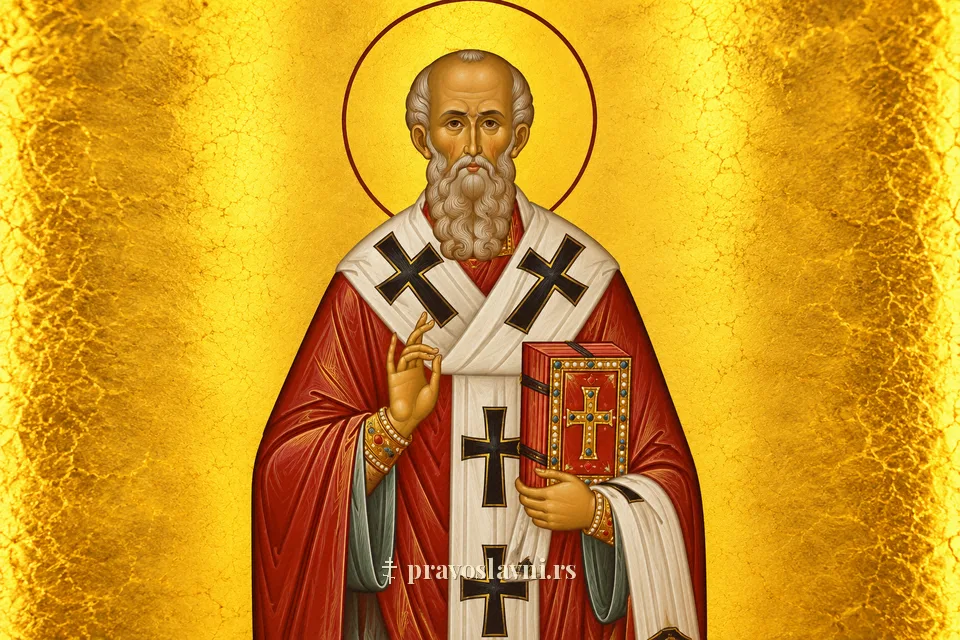
“Nor do they light a lamp and put it under a basket, but on a lampstand, and it gives light to all who are in the house.”
— Mt 5:15
Life
St Nicetas chose to go into exile rather than agree to communion with the iconoclast Patriarch Antony. According to his Life, this condition was put to him by the imperial envoy Theodosius, and Nicetas replied that he would not give up the veneration of the holy icons, and they might do with him as they wished. He was banished that very hour.
He became a monk while still a young man, because he came to love Christ more than the world. For his God-pleasing life he was chosen Bishop of Chalcedon. In his ministry he was marked by mercy: his Life says that he took orphans and the wronged under his protection, and to everyone in trouble, from the hungry to travellers, he gave help.
Under Emperor Leo the Armenian, when iconoclasm prevailed, he rose in defence of the icons. The Prologue says that he did not hesitate to point out to the emperor his error and to explain the meaning of the icons, and the Life that he taught the faithful to venerate the icons of Christ, the Theotokos and the saints. He paid for this with exile, humiliation and ill-treatment, and according to the Prologue with prison too.
After long labours he departed to the Lord, and from his relics, according to his Life, many miracles and healings flowed.
St Nicetas shows that God crowns faithfulness under persecution with glory, and that mercy is the duty of every shepherd.
Full Life
His answer to the envoy
According to the Life, St Nicetas faced his greatest test before the imperial envoy Theodosius. The demand was clear: either he would accept communion with the iconoclast patriarch Anthony and give up the veneration of icons, or he would go into exile at once. Nicetas chose exile. The Life preserves his words: “I shall not cease to venerate the holy icons in prayer,” with the addition that he does not recognise Anthony as patriarch and that he is ready for banishment, death or any other evil. He was sent into exile that very hour.
A monk on the bishop's throne
The road to that moment began in his youth, when out of love for Christ he left the world and became a monk and ascetic. His God-pleasing life brought him to the throne of the diocese of Chalcedon, and the Life says that as a bishop he shone upon all those around him. Mercy, according to both sources, was the mark of his ministry: the poor, widows and those who had nothing at all found a support in him. The Life shows his mercy in action: he was the protector of orphans and of those who had been unjustly wronged, and he gave help to the hungry, the naked and travellers.
Defender of the icons
He lived in the time of Emperor Leo the Armenian, when the iconoclast heresy came to power. Nicetas did not draw back: according to the Prologue, he pointed out the error to the Emperor himself and showed him why icons are venerated. The Life adds that he refuted the heretical teaching and instructed the faithful to honour the icons of Christ, of the Theotokos and of the saints.
The crown of glory
For the Orthodox faith he endured exile, disgrace and ill-treatment, and the Prologue also mentions imprisonment. After long labours and sufferings he departed to the Lord and, as the Prologue says, received the crown of glory. The Life records that from his precious relics there came many miracles and healings of every kind of illness.
The life of Nicetas joins together faithfulness in persecution, which God crowns with glory, and mercy towards the poor, which is the duty of every shepherd. He defended the faith not only with words before the Emperor, but also with deeds of love towards the least of men.