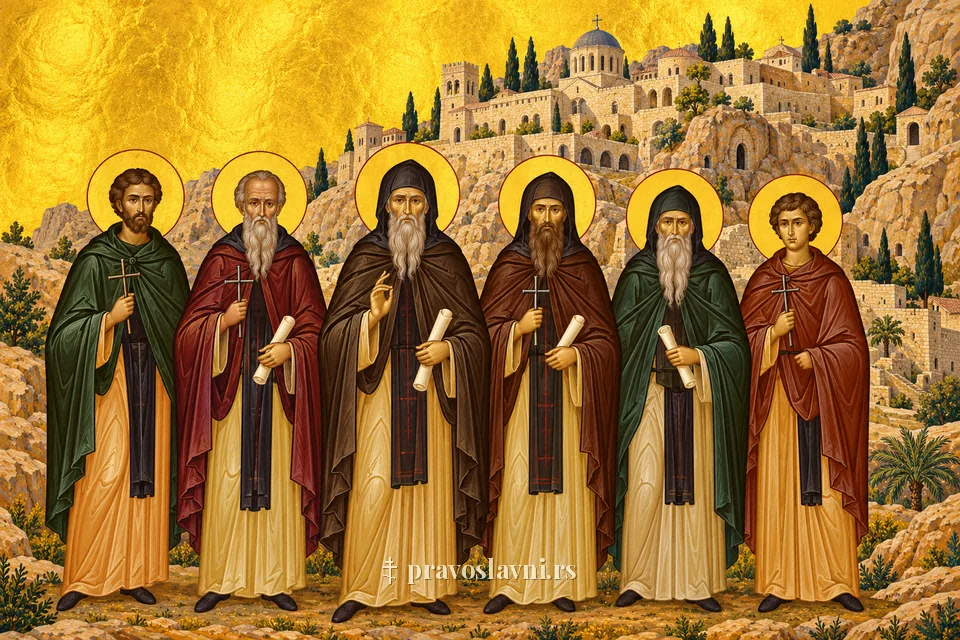
Venerable Fathers slain in the Monastery of St Sabbas the Sanctified
Commemoration: 2 April 2026 · 2 April 2027
Venerable Fathers slain in the Monastery of St Sabbas the SanctifiedCommemoration: 2 April 2026 · 2 April 2027
Commemoration in our calendar
Thursday, 2 April 2026strict fast (no oil) · 20 March (according to the Julian calendar)
Friday, 2 April 2027strict fast (no oil) · 20 March (according to the Julian calendar)
Friday02April 202720 March (according to the Julian calendar)
Illustration
Saint of the day
Venerable Fathers slain in the Monastery of St Sabbas the Sanctified
What happenedThe monks of the Lavra of St Sabbas the Sanctified did not abandon their monastery when robbers came, and suffered out of love for Christ.
“As it is written: ”For Your sake we are killed all day long; We are accounted as sheep for the slaughter.”“
— Rom 8:36
Life
“Do not be afraid, brethren, I will go out for all of us” — with these words, as the Life records, the monk Patricius spoke to the brethren with whom he was hiding in a cave, when the robbers' sentry caught sight of them. He went out alone and said that there was no one inside.
This happened in the year 796 in the Lavra of St Sabbas the Sanctified near Jerusalem, in the time of Patriarch Elias and of the rulers Constantine and Irene. According to the Life, bands of robbers were then ravaging Palestine. The Prologue says that the monastery had been attacked and rebuilt before as well, and that the monks, after taking counsel with the abbot Thomas, decided not to flee: “If we are killed here, we shall be killed because of our love for Christ.”
The Life describes two attacks in March. In the first, on the thirteenth, the robbers were looking for treasure, and they met the elders who offered them food with arrows; thirteen monks were killed, and the wounded were helped by Abba Thomas, a skilled physician. On the twentieth of March an even larger band came. They killed the monks and tortured them to make them show the treasury, and they also demanded a ransom of four thousand gold coins. The monks answered that they had no gold or silver and that the abbot was in Jerusalem.
According to the Prologue and the Life, the robbers drove them inside and lit a fire in front of the entrance, and the rest they killed with arrows. The monks, according to the Life, answered every interrogation with prayer alone; eighteen of them breathed their last in the smoke, among them Patricius and the young guest-master John. The robbers carried off what they had found and went away, and the surviving monks buried their brethren.
How many suffered in all is not known. The Prologue says only that there were many of them, and the Life that God knows all their names. The Prologue adds that the attackers soon perished in a quarrel among themselves.
This lavra, according to the Prologue, was also visited by St Sava of Serbia, and the Serbian rulers bestowed gifts upon it.
The monks of St Sabbas remain an example of Christians who answered armed men not with weapons but with faithfulness, and of a brother who laid down his life in order to save the others.
Full Life
The Lavra in a troubled age
The Lavra of St Sabbas the Sanctified, not far from Jerusalem, remembers many devastations. The Prologue records that it had been attacked before as well and that each time it came back to life again; St Sava of Serbia visited it, a number of Serbian rulers gave gifts to it and, as the Prologue says, it still exists today. The story of its martyrs is bound up with the year 796, the time of Patriarch Elias of Jerusalem and of the rulers Constantine and Irene in Constantinople. Palestine was then, according to the Life, under the rule of the Arabs, whose tribes were fighting one another, while bands of robbers ravaged towns and villages; the Monastery of St Chariton was destroyed at that time and was never restored.
They would not flee
The monks could have dispersed, but they did not. The Prologue preserves the words with which they made that decision: “If we are killed here, we shall be killed because of our love for Christ.” The Prologue adds that they agreed on this with the abbot Thomas and decided to meet the robbers with bare hands. The sources differ here: according to the Prologue the abbot was Thomas, while according to the Life the abbot Basil was in Jerusalem at the time, whereas Abba Thomas was a physician and only later became abbot of the “Old Lavra”.
The gold they did not have
The robbers, according to the Life, came twice, on 13 and 20 March, and both times they were looking only for treasure. To the elders who met them with food during the first raid they snapped: “We did not come here for food but for gold and silver,” and later they also set a condition: “Ransom yourselves and your church with four thousand gold pieces.” The monks gave the same answer — they had no gold or silver, the abbot was away, and all of them were equal among themselves.
That answer cost them dearly. The Life states that thirteen monks fell in the first attack. The cells were plundered and burnt, and the church was saved only by a mistake: the attackers caught sight of people in the distance, thought that an army was coming from Jerusalem and fled. Abba Thomas drew the arrows out of the wounded and bound up their wounds. In the second attack the brethren were killed in various ways and tortured to make them reveal the treasury; among those who suffered the Life makes special mention of the young guestmaster John and of the sacristan Sergius, who tried to save the church's valuables.
Patricius and the brethren in the cave
The Life remembers Patricius in particular. With several of the brethren he was hiding in a cave outside the monastery, and when a sentry discovered them, he said, according to the Life: “Do not be afraid, brethren, I will go out for all of us” — and he went out alone and maintained that there were no others.
Not all of them fell by arrows. Many, as both the Prologue and the Life say, were driven by the robbers into the cave of St Sabbas, and a fire was lit before the entrance, so that the smoke suffocated them. The Life records that to each new interrogation they answered only with prayer, such as these: “O Lord, receive my spirit in peace!” and “Lord, remember me when You come into Your kingdom!” Eighteen of them, according to the Life, breathed their last there, and among them John and Patricius.
What remained
The plunderers left with their camels loaded. The brethren who, according to the Life, had been hiding in the surrounding area came back, spent the night in prayer beside the bodies and buried them. How many martyrs there were is not known: the Prologue says only that there were many of them, and the Life that God alone knows all their names. Of the attackers the Prologue records that they soon perished in a quarrel among themselves, and the Life that God cut them down with a sudden death; of the martyrs the Life says that their souls are in the hand of God.
These monks remain a testimony that faithfulness is not defended with weapons and that love for one's brethren can be stronger than fear — as with Patricius, who went out alone so that the rest might be spared.