Friday25June 202712 June (according to the Julian calendar)
Illustration
Saint of the day
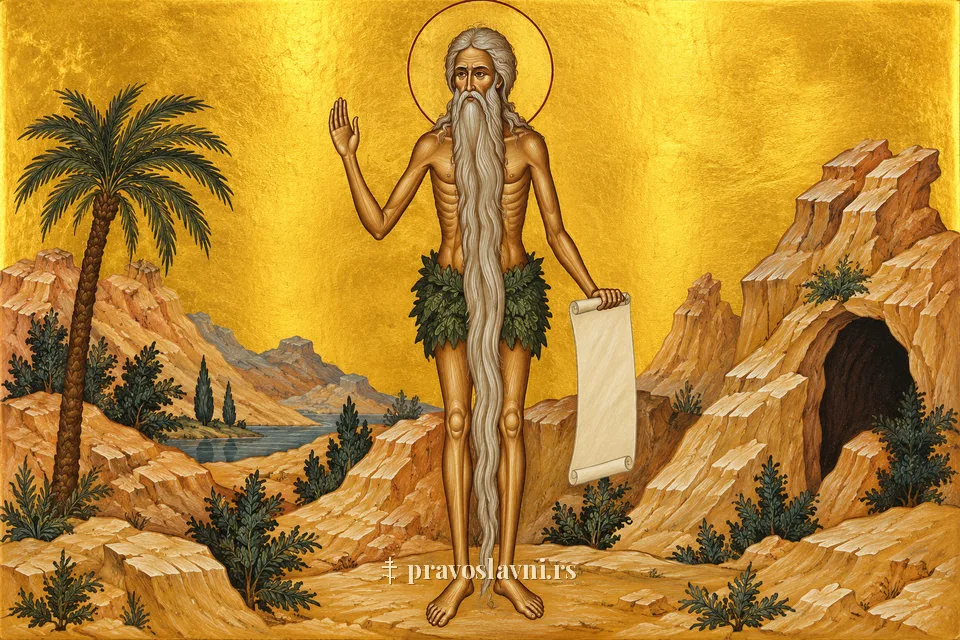
Venerable Onuphrius the Great
What happenedThe monk Paphnutius found in the desert Venerable Onuphrius, who had lived there alone for sixty years, covered only by his own white hair.
“Your words were found, and I ate them, And Your word was to me the joy and rejoicing of my heart; For I am called by Your name, O LORD God of hosts.”
— Jer 15:16
Life
For sixty years Venerable Onuphrius lived in the desert, far from people. When, at the end of that time, the monk Paphnutius found him, the elder, as the Prologue records, said to him: “But most of all I feed myself and sweetly quench my thirst with the words of God.”
Paphnutius, according to the Life, set out from his Egyptian monastery to find a desert-dweller more devoted to God than himself. After a long journey and many days without food, on the seventeenth day he reached a mountain where Onuphrius appeared, without clothing, covered with long white hair and a beard. The frightened monk fled up onto a rock, but the elder called him to come down, for he too was a man living in the desert for God's sake.
His Life records that Onuphrius had once been a novice in the monastery of Eriti in the Thebaid. He longed for the life of a desert-dweller, and an angel, who said that he had been guarding him since birth, led him to a cave. An elder taught him the desert-dweller's rule and visited him every year until his death, and Onuphrius buried him.
God took care of him: according to both sources, an angel brought him bread and gave him Holy Communion, and beside the cave there sprang up a palm tree and a spring of living water.
They spent the last night, according to the Life, in prayer. In the morning his face changed and he told Paphnutius that the day of his death had come. He asked him, according to the Life, to remember him to the brethren and to return to Egypt. He knelt, prayed and gave up his spirit, and Paphnutius, as both the Prologue and the Life say, saw a heavenly light and heard angelic singing. He buried him in the rock. According to the Life, when he wished to stay, the cave collapsed, the palm tree fell and the spring dried up, and in this he saw a sign that he should leave. The Prologue records that Onuphrius reposed in the year 400.
His life reminds us that man lives above all by the word of God, and that God does not abandon those who seek Him, not even in the deepest solitude.
Full Life
Sixty Years in the Desert
Venerable Onuphrius spent sixty years in the desert, as both the Prologue and his Life record. The Prologue says that he reposed in the year 400. We know about his life thanks to the monk Paphnutius, who found him at the end of that time. According to the Life, Paphnutius set out from his monastery in the Egyptian desert to look for a desert-dweller who was more devoted to God than he himself was. The journey was long: he buried a hermit long since reposed whom he found in a sealed cave, he met the desert-dweller Timothy, who had lived for thirty years beside a spring and a palm tree, and after many days without food he was strengthened by a radiant man who touched his lips. On the seventeenth day, says the Life, he reached the mountain on which Onuphrius appeared.
His body was covered by long white hair. The Life also mentions a girdle of palm leaves. Paphnutius was frightened and fled up onto a rock, but Onuphrius called him to come down: he too, he said, was a man living in the desert for God's sake.
The Road from the Monastery to the Cave
The Life also reveals his earlier path. Onuphrius was a novice in the monastery of Eriti, near Hermopolis in the Thebaid, where about a hundred brethren lived together. He listened to the elders praising the desert-dwellers and came to desire such a life. Then an angel appeared to him in light, told him that he had been guarding him since his birth, and led him into the desert, to a certain cave.
He did not begin alone. The Life records that an elder in the desert taught him the rule of the desert-dweller's life, stayed with him for thirty days, and then visited him every year, right up to his own death. Onuphrius buried him.
Bread, a Palm Tree and the Word of God
God took care of him. Both sources say that an angel brought him bread — the Life says for thirty years — and then a palm tree and a spring of living water sprang up beside the cave. According to the Life, the palm had twelve branches, and each one bore fruit in its own month.
Yet Onuphrius did not consider that it was bread that sustained him. To Paphnutius he said, as the Prologue records: “But most of all I am fed and sweetly given to drink by the words of God.” Not even the deepest solitude separated him from the Holy Mysteries: both the Prologue and the Life say that an angel regularly gave him Holy Communion, and the Life adds that other desert-dwellers receive Communion in the same way.
The Last Night
According to the Life, they spent the night in prayer. In the morning the face of Onuphrius changed, and he told his guest that this was the day of his death. He asked him, according to the Life, to remember him to the brethren, and he charged him to return to Egypt and not to remain in the desert. Then, as the Prologue and the Life record, he knelt down, prayed and gave up his spirit, and Paphnutius saw a heavenly light and heard angels singing.
He buried him — according to the Life, wrapped in a part of his own cloak, in a hollow of the rock, covered with stones. He wanted to remain in that place, but, says the Life, the cave collapsed, the palm tree fell and the spring dried up, and he understood this as a sign that he ought to go. On his way back, according to the Life, he met four elders, and then four young men from Oxyrhynchus — John, Andrew, Heraclemon and Theophilus — to whom an angel also gave Communion, and with them he himself received Communion too.
A Story That Is Read
Paphnutius told everything in a certain skete. The Life says that the brethren wrote it down, and the record was kept in the church so that it might be read.
From this life the Prologue draws a lesson: even the desert-dwellers, far from everyone, longed for Holy Communion, and God gave it to them through angels. Man lives above all by the word of God.
Other saints of the day
Venerable Peter of Mount Athos
St Peter of Mount Athos spent fifty-three years in a cave on the Holy Mountain, and his road to it began in captivity. He was a Greek and a soldier, according to his Life a military commander from Constantinople, and in the war against the Arabs he was taken captive and was kept chained in a prison. His Life says that there he remembered that he had promised God to become a monk, but had not done so, and that he repented with fasting. Both sources record that St Nicholas and St Simeon the God-receiver then appeared to him: touched by Simeon's staff, the chains vanished, and Peter was free. He fulfilled his promise in Rome, where the Pope tonsured him a monk at the tomb of the Apostle Peter. The place of his ascetic struggle was revealed to him, according to both sources, by the Most Holy Theotokos in a vision while he was sailing to the east, and that place was Mount Athos; his Life says that the ship stopped off Athos as if at anchor and that they put him ashore there. There he endured all the hardships of the desert life and the attacks of the demons. The devil, who came to him in the likeness of others, according to his Life as a former servant and then as an angel, he drove away with the sign of the Cross and the name of the Theotokos. Heavenly manna, as both sources say, was brought to him by an angel every forty days. A certain hunter came to know of him, having been led into those parts by the hunt for a deer; from the saint he heard the story of his life. According to his Life, when he came back after a year, he found him reposed, and the relics healed the hunter's brother of an evil spirit. They were translated to Macedonia, where, according to his Life, many received healing.