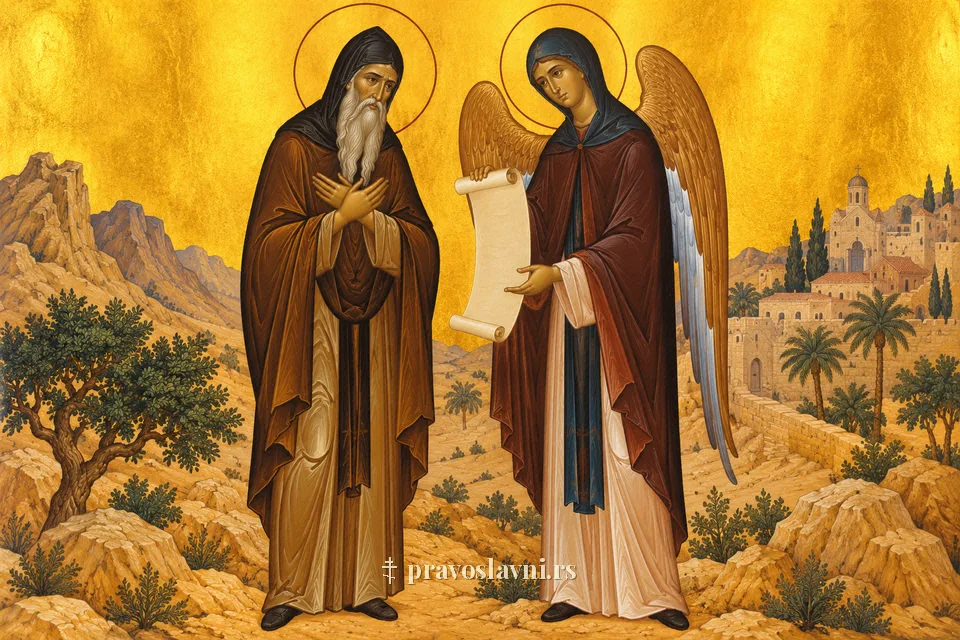
According to the Prologue, St Pachomius stands at the beginning of communal monastic life, just as St Anthony stands at the beginning of the life of the hermits.
He was born in Egypt as a pagan. As a soldier of the Emperor Constantine he came to know Christians, and their kindness and piety led him to faith and baptism. Then for ten years, in the desert of the Thebaid, he learnt the ascetic life from the elder Palamon.
At Tabennisi an angel handed him a tablet with the rule of communal monastic life and commanded him to build a monastery there. Pachomius began to build many cells while only he and his brother John were there. When his brother reproached him, he said that he was carrying out God's command, whoever might come. And come they did: he founded six more monasteries, and the brotherhood grew to seven thousand monks. His Life says that he wrote rules about prayer, work, food, clothing and sleep.
To everyone he was like a father or a brother, an example of humility, diligence and self-restraint. God worked many miracles through him, and he withstood many attacks from demons and from men. Among his disciples were Theodore, Paphnutius and Pecusius, and the former actor Silvanus also repented under his guidance. He reposed in peace in his 74th year.
Pachomius obeyed God even before he saw any fruit, and out of that obedience there grew a community of thousands of monks.
Full Life
A soldier won over by love
St Pachomius was born in Egypt and in his youth was a pagan. His Life says that he was born around the year 290 in the Thebaid, near Esna, of zealous pagan parents, and that he grew up among them like a lily among thorns. While still a child, according to his Life, he vomited up food from the sacrifices to idols, and in the temple the demon in the idol fell silent before him, so the pagan priest drove him out.
The Emperor Constantine was at war with Maxentius, and among his soldiers was the young Pachomius; his Life says that he was taken into the army at the age of twenty. It was then that he came to know Christians. From them he heard of the one God, and their kindness and devout life moved him so deeply that he was baptised. According to his Life, the soldiers were held in a certain city where the Christians took care of them, and Pachomius, when he was released, was baptised in Chenoboskion.
Then he went into the desert of the Thebaid and for ten years learned the ascetic life from the renowned elder Palamon. His Life mentions strict fasting, prayer and the weaving of rush mats, and Palamon kept him awake at night by giving him sand to carry.
A rule from heaven
The Prologue and his Life record that in Tabennisi an angel in the monastic schema appeared to him, handed him a tablet with the rule of a coenobitic monastery and told him to build a monastery there. His Life preserves those words: “Pachomius, stay here, and build a monastery in this place”. Palamon, according to his Life, accepted the revelation, and when the elder died, Pachomius buried him.
He began to build many cells, although only he and his brother John were there. When his brother reproached him for it, he answered that he was fulfilling God's command, whoever might come. His Life says that Pachomius was angry at first, and then repented in prayer.
Moved by the Holy Spirit, many gathered under his rule. He founded six more monasteries, and the brotherhood grew to seven thousand monks — according to his Life, in Tabennisi alone there were about one thousand four hundred of them. His Life says that he wrote rules about prayer, work, food, clothing and sleep and appointed superiors over the monasteries. According to his Life, he did not go out to meet his sister when she came to see him, but built for her a separate cell and a community of women.
The father of the common life
The Prologue compares them: if Anthony is the father of the desert-dwellers, Pachomius is the father of the monks who live together. To the monks he was an example of humility, diligence and abstinence, and to everyone he was like a father or a brother. The miracles he worked could not be counted, nor could the attacks he endured both from evil spirits and from men; his Life mentions a woman who was healed by touching his clothing and the possessed whom he cured with blessed oil and bread. According to his Life, he refused the challenge of heretical ascetics to walk on water.
Among his disciples were Theodore, Job, Paphnutius, Pecusius, Athenodorus, Eponychus, Sourous, Psoes, Dionysius, Psenthaisius and others, as well as the former actor Silvanus, who repented. He reposed in peace in his 74th year, and his Life says that thousands of brethren buried him.
Pachomius, a former pagan and soldier, was brought to Christ by the love of Christians. He obeyed God and built before anyone had come, and he became the father of thousands of monks. The Prologue reminds us that violence against a righteous man harms the one who does the violence, and raises up the righteous man.
Other saints of the day
St Achillius, Bishop of Larissa
St Achillius is remembered for a sign at the First Ecumenical Council. Before the Arians he held a stone in his hand and asked them: “If Christ is a creature of God, as you say, then tell this stone to let oil flow from it?” Then he demanded the opposite — that oil should flow if the Son is equal to the Father — and, as the Prologue and his Life record, oil flowed from the stone. His Life places the Council in the year 325 and says that by his teaching and holy life he won the respect of the fathers, while the heretics were put to shame. He was a native of Cappadocia; according to his Life, he learned the faith from his devout parents, and he joined secular learning with spiritual. His Life says that he was Bishop of Larissa and that in his own city, after the Council, he rooted out idolatry, pulling down temples and building churches. He reposed in peace in Larissa in the year 330. His relics did not remain there: the Macedonian Tsar Samuel, into whose hands Thessaly had fallen, translated them to Prespa, to the island in the lake which bears the name Achil or Ail. His Life also mentions the church that King Dragutin built for him in Arilje.
Separate page: St Achillius, Bishop of Larissa →