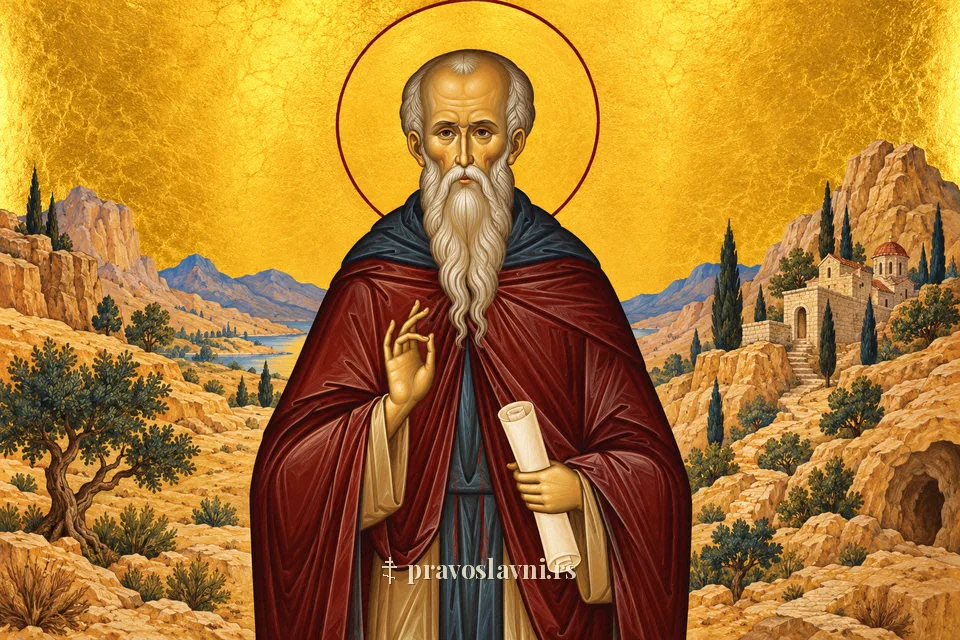
Venerable Sisoes the Great was an Egyptian. The Prologue calls him a disciple of St Anthony the Great, and his Life calls him an imitator of Anthony's way of life. When Anthony died, Sisoes moved to his mountain in the desert and spent sixty years there. His strict ascetic struggle, says the Prologue, made him as meek as a lamb, and according to his Life he overcame the invisible enemies by humility and prayer.
God granted him to heal the sick and to cast out unclean spirits. His Life tells that a father once brought him a son who had died on the way; the elder, not knowing what had happened, told the child to get up, and he got up. Sisoes did not rejoice at this, for he did not want glory, and he asked that the miracle be kept silent as long as he lived. When, according to his Life, his disciple Apollos was seized by a desire for the priesthood and secretly set out for Alexandria, a demon attacked him on the road, but vanished as soon as Apollos called upon his elder; the disciple came back and confessed.
By his counsel, according to the Prologue, he helped both monks and people from the world. He taught that trouble should be accepted as something God permits and as the fruit of one's own sins, and for that reason, according to his Life, he did not allow the barbarians who were attacking to be killed. Humility, he used to say, is gained when a man places himself behind everyone else. To Abba Ammon, who was worried that he could not remember wise sayings, he answered: “It is necessary to acquire purity of mind and to speak out of that purity.” According to his Life, he said that God accepts sincere repentance even in three days, and the one who falls often he advised always to rise up again.
Not even on his deathbed did he think that he had finished his repentance. The brethren watched his face shine like the sun. According to his Life, he explained to them that the angels were coming for him, and that he was begging for a delay for the sake of repentance; to the brethren, who saw no need for that, he confessed that he did not yet see in himself even the beginning of repentance. The cell was filled with a sweet fragrance. According to the Prologue, he reposed in deep old age, in the year 429.
Full Life
Heir to Anthony's mountain
Sisoes was an Egyptian. His Life says that he loved God from childhood and that he took up his cross to follow Christ. According to the Prologue he was a disciple of St Anthony the Great, and his Life calls him an imitator of Anthony's way of life. When Anthony died, Sisoes withdrew to that very mountain of his in the desert, which is named after Anthony. He spent sixty years in the desert.
The Prologue says that his strict ascetic life made him as meek and gentle as a lamb. According to his Life, he overcame the invisible enemies by humility and prayer. God gave him the grace to heal the sick and to cast out unclean spirits, and his Life also mentions the gift of raising the dead.
The child who rose
According to his Life, a certain layman was bringing his little son for the elder to bless him, but the boy, struck down by illness on the way, did not arrive alive. The father quietly carried the body in and laid it down before the elder. Sisoes, whom no one had told what had happened, called to the child to get up and go out — and the child got up and went off with his father. Instead of joy, the elder felt sorrow, for he did not want to be praised because of a miracle, and so he forbade the father to speak of it for as long as he was alive.
His Life also records that his prayer delivered his disciple Apollos from temptation. Apollos was tormented by a desire for the priesthood: he dreamed of demons disguised as saints making him a bishop. Sisoes forbade him this, but Apollos went off in secret to his relatives in Alexandria. On the way a demon attacked him; Apollos made the sign of the cross, prayed and called upon his father Sisoes. The demon admitted that he had wanted to make him a priest and a bishop and that the prayers of Sisoes were driving him away, and then he vanished. Apollos returned, made his confession to the elder and told everything to the brethren. By prayer Sisoes, according to his Life, also cast an unclean spirit out of another disciple, Abraham.
What he advised
The Prologue remembers him as a counsellor to whom both monks and people from the world used to come. Let a man accept the trouble that befalls him as something permitted by God and as the fruit of his own sins, and let him ascribe every good thing to God's providence. When, according to his Life, they asked him whether they might kill the barbarians who attacked them, he did not allow it: it is better, he said, to give oneself up to God.
The way to God, according to the Prologue's summary of his teaching, leads through separation — from the world and from attachment to created things — towards the Creator, with Whom a man is united in prayer and tears. Humility is acquired by practice: that a man should place himself, in his thoughts, behind every one of his neighbours.
When Abba Ammon complained that wise sayings did not stay in his memory, Sisoes assured him that this was not the main thing: “It is necessary to acquire purity of mind and to speak out of that purity.” His Life speaks here of purity of heart.
Repentance to the last breath
According to his Life, when asked how long a fallen brother ought to repent, he answered that God receives a sincere penitent within three days; a year he considered severe, and six months or forty days too much. A brother who kept falling again and again heard from him that after every fall he should get up once more, for no one knows when the last hour will come. To a brother who asked for a teaching for his whole life he did not give a saying, but his own example.
Before his death the brethren marvelled at the light on his face, which was like that of the sun. According to his Life, the elder first announced: “Behold, Abba Anthony has come,” and then he addressed a prophet, an apostle and others with whom he spoke but whom the brethren did not see. Asked who they were, he said that the angels had come for him, and that he was begging them for a short delay, for the sake of repentance. The monks wondered that he should need repentance, and he answered them that he was not sure that he had even begun. Only when his face shone still more brightly and when he said that the Lord was coming did he give up his soul. The cell was filled with a sweet fragrance, and his Life also mentions a flash like lightning. According to the Prologue, he reposed in deep old age, in the year 429.