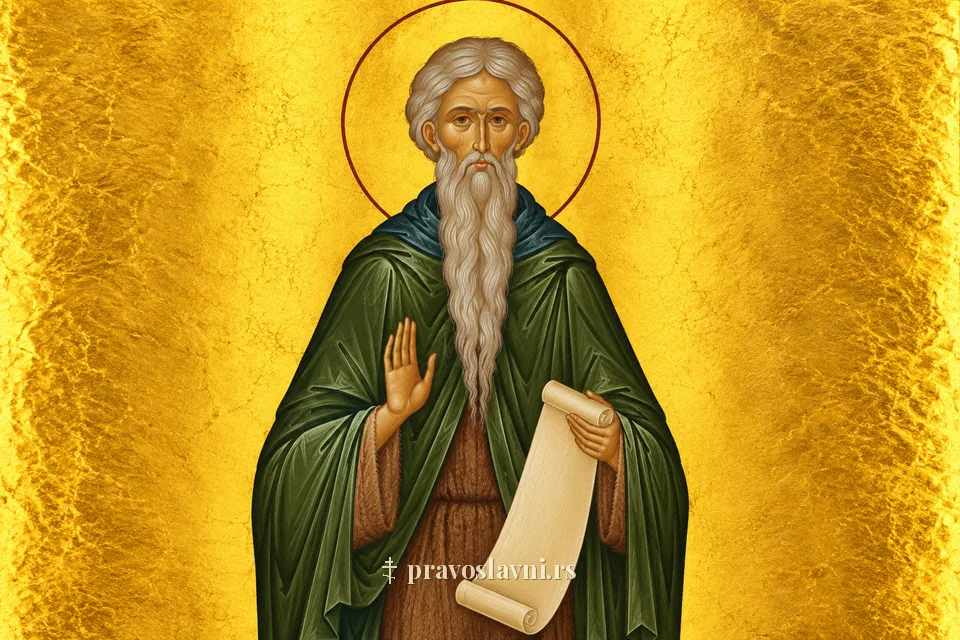
Venerable Theodore TrichinasCommemoration: 3 May 2026
Commemoration in our calendar
Sunday, 3 May 2026no fast · Sunday — a festive day · 20 April (according to the Julian calendar)
Sunday03May 202620 April (according to the Julian calendar)
Illustration
Saint of the day
Venerable Theodore Trichinas
What happenedTheodore, the son of wealthy parents in Constantinople, left everything for God and received the name Trichinas from his garment of haircloth.
“But I discipline my body and bring it into subjection, lest, when I have preached to others, I myself should become disqualified.”
— 1 Cor 9:27
Life
In a certain desert monastery in Thrace there lived the ascetic life a monk named Theodore, whom they nicknamed Trichinas, that is, “the Hair-shirt Wearer”, after his clothing: all his life he wore only a rough garment of haircloth and went bareheaded. The Prologue records that he lay on a stone in order to shorten his sleep, and his Life that he spent his nights standing in prayer, even in the cold.
He did not come to the desert out of poverty. He was born in Constantinople, into a wealthy family, but as a young man he left his own people and all his possessions for the sake of God.
The gift of working miracles, which he had both during his life and after his death, Theodore received from God for his labour. Theodore reposed in peace around the year 400. Myrrh flowed from his relics; his Life records that by it the sick were healed, and demons were driven out of the possessed.
His example teaches that God glorifies the one who, for His sake, leaves behind wealth and comfort.
Full Life
A Nickname from a Coarse Cloth
Venerable Theodore received the name Trichinas, or in Serbian Kostret (“the Hair-shirt Wearer”), not from his family nor from a place, but from his clothing. All his life he had only one garment of haircloth, a coarse fabric, and he put nothing on his head. The Life adds that later the monastery in which he lived was also named Trichinas after him.
What He Left Behind
He did not come from poverty. He was born in Constantinople, in a wealthy house, but as a young man he left his family and possessions for God's sake — the Life also mentions the glory he could have had — and went far from the capital, to Thrace, to a monastery in the wilderness. There, according to the Life, he received the monastic tonsure; the name of the monastery has not been preserved.
Nights without Sleep
His ascetic struggle was as hard as a man can bear. In order to shorten his sleep he lay, according to the Prologue, on bare stone. His nights, according to the Life, he spent standing in prayer, even in the cold. From such a life his face, as the Life records, became like that of a dead man. All this he endured for the salvation of his soul.
Myrrh after Death
Miracles accompanied Theodore both in his lifetime and after his death; both sources see this as God's answer to his labour for the salvation of his soul. He reposed in peace around the year 400, and myrrh flowed from his relics. According to the Life, the myrrh had a pleasant fragrance and healing power: it helped the sick, and demons were driven out of the possessed.
Theodore shows that renouncing wealth and comfort for God's sake is no loss: the body that he subdued by labour God glorified with a grace that heals even after death.
Other saints of the day
Translation of the Relics of St Nikolaj of Žiča (Velimirović)
According to his Life, St Nikolaj of Žiča reposed in prayer on 18 March 1956 in the Russian monastery of St Tikhon in South Canaan, in Pennsylvania. The faithful at once began to call upon him in their prayers as a saint. His body was then taken to Libertyville, to the Serbian monastery of St Sava, and with solemn honours it was laid in a grave in the Serbian cemetery beside the monastery. Later the relics were translated to Serbia. The Life sets this event alongside the translation of the relics of St Sava from Tarnovo to Mileševa.
St Joasaf was called Jovan Uroš Nemanjić-Palaiologos in the world; he was the son of Simeon-Siniša of the Nemanjić line and of Thomais, and he was born around 1350. According to his Life, as a young man he often visited the ascetics of the Holy Mountain and the monasteries of Meteora. Around 1369 he inherited his father's rule in Thessaly, but he wished to leave it behind: he handed it over to a kinsman and withdrew to the Great Meteoron, to St Athanasius, where he received the monastic name Joasaf. Before his death Athanasius appointed him to be abbot after him. Joasaf enlarged and adorned the church of the Transfiguration, and with the help of his sister he built cells, a hospital and other buildings, and so he is honoured as the ktetor (founder) of the monastery. When the Turks took Thessaly, he spent several years at Vatopedi on the Holy Mountain, and around 1401 he returned to Meteora. He spent his last years in a small cell at Meteora, devoted to prayer, and there he died in the year 1422 or 1423. His relics rest in the monastery of the Transfiguration, together with the relics of St Athanasius.