Saturday25April 202612 April (according to the Julian calendar)
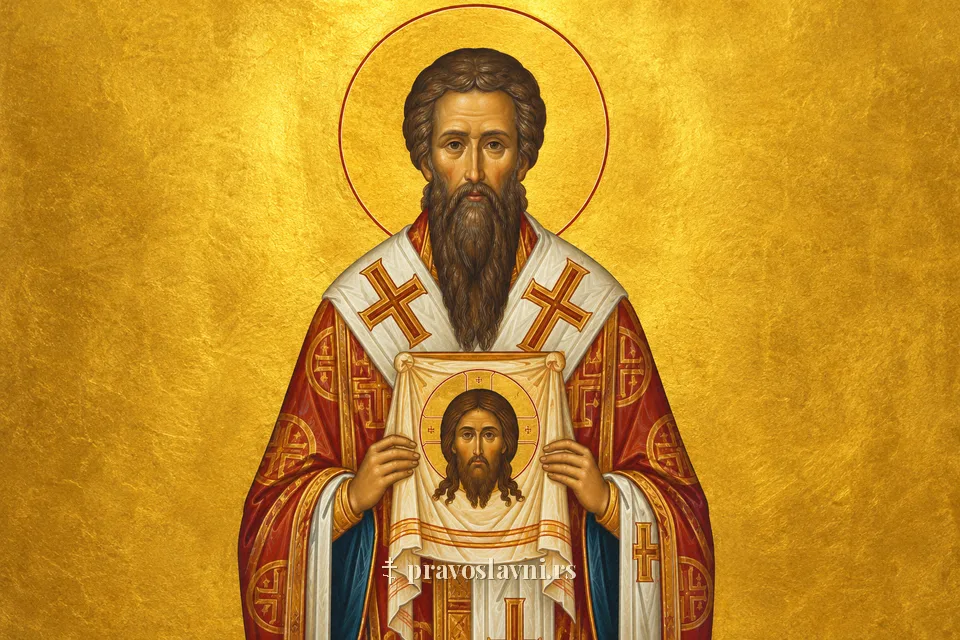
Illustration
Saint of the day
Venerable Basil the Confessor, Bishop of Parium
What happenedBishop Basil of Parium refused to sign the imperial document against the veneration of icons and, though tortured, remained as firm in Orthodoxy as a diamond.
“Therefore, my beloved brethren, be steadfast, immovable, always abounding in the work of the Lord, knowing that your labor is not in vain in the Lord.”
— 1 Cor 15:58
Life
Basil, Bishop of Parium, is remembered for a signature which he would not give. He was asked to put his name to an imperial document against the veneration of icons. His Life says that this was in the time of the iconoclast heresy, under Emperor Leo the Isaurian, and that they tried to force him to sign. He did not yield.
The Prologue and his Life remember him as a man of virtue, and his Life adds that he was chosen as bishop in Parium, a city in Asia Minor under the Metropolitan of Cyzicus, because of his God-pleasing life. For his faithfulness to the icons he endured persecution and tortures, and according to his Life his whole life was marked by hardships. The Prologue says of him: “But he remained firm in Orthodoxy, like a diamond.” He reposed in the first half of the eighth century, having, according to his Life, pleased God in all things.
Full Life
Bishop of Parium
The Life notes that Parium is an ancient city of Asia Minor, which received a bishop after accepting Christianity and came under the Metropolitan of Cyzicus. Basil was chosen as bishop of that city. The Prologue and the Life remember him as a virtuous man, and the Life says that he was chosen for his outstanding virtue and his God-pleasing life.
The Signature He Would Not Give
He lived in the time of iconoclasm. The Life records that this heresy appeared in the reign of the Emperor Leo the Isaurian (717–741) and that Basil then showed himself a confessor of Christ. He was required to sign an imperial document against the veneration of icons. The Prologue puts it briefly: “He refused to sign the imperial paper against the veneration of icons.” The Life adds that they tried to force him to do so, but he did not give way.
Firm as a Diamond
This refusal cost him dearly: the Prologue and the Life say that he endured persecution and tortures. The Life does not list the particular torments. It says only that troubles and hardships accompanied him, and it cites a passage from the Second Epistle to the Corinthians (6:4). The Prologue concludes: “But he remained firm in Orthodoxy as a diamond.” He reposed in the first half of the eighth century and departed to the Lord, having pleased Him, as the Life says, in everything.
St Basil did not put his name to the imperial document against the icons and, although persecuted and tortured, he remained firm in Orthodoxy.