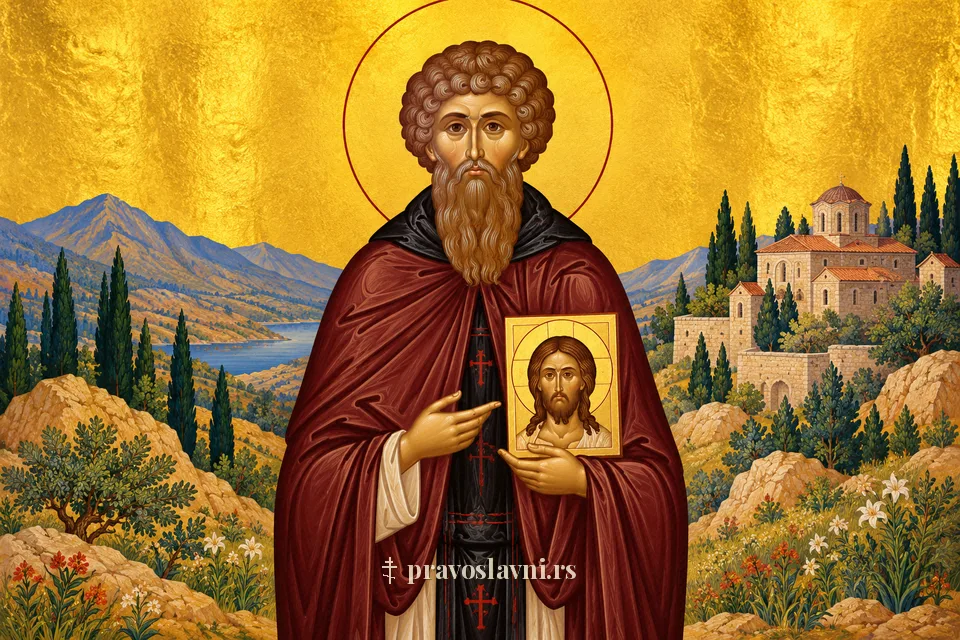
Venerable Basil the ConfessorCommemoration: 13 March 2026 · 13 March 2027
Commemoration in our calendar
Friday, 13 March 2026strict fast (no oil) · 28 February (according to the Julian calendar)
Saturday, 13 March 2027dairy allowed (no meat) · 28 February (according to the Julian calendar)
Saturday13March 202728 February (according to the Julian calendar)
Illustration
Saint of the day
Venerable Basil the Confessor
What happenedVenerable Basil the Confessor, the faithful disciple of St Procopius the Decapolite, endured tortures and prison defending the veneration of the holy icons.
“So they departed from the presence of the council, rejoicing that they were counted worthy to suffer shame for His name.”
— Acts 5:41
Life
St Basil the Confessor became a monk as a young man and became a disciple of St Procopius the Decapolite. The Prologue presents him as a disciple whose devotion to his teacher did not change with circumstances, so that he stayed beside him when persecution came as well; both sources remember him as Procopius's companion and fellow sufferer.
He lived in the time of the iconoclast Emperor Leo the Isaurian. When the Emperor moved against the icons, Basil, according to the Life, took their side and publicly bore witness to the faith of the Church, shoulder to shoulder with Procopius. Because of this the iconoclasts seized him and subjected him to many tortures, and then threw him into prison. Neither the tortures nor the prison forced him to turn away from the confession of the faith.
Freedom, according to the Life, was brought to him only by Leo's death. The Prologue sees in the fall of the iconoclasts the providence of God, after which teacher and disciple found themselves once more in their monastery. Fasting and prayer again filled his days, and in this way, according to both sources, he lived for a long time. His word and example, according to the Life, did not remain without fruit: sinners found the way of repentance, and heretics the way into Orthodoxy. Thus the disciple, in freedom too, remained faithful to the path of his teacher.
The Life also remembers his end: he met it joyful, thankful to the Lord whom he had loved from his young days. According to the Prologue, this was in the year 747. His life teaches that faithfulness is shown both in hard days and in peaceful ones, and that a steadfast example can bring others back to God as well.
Full Life
A confession that cost him his freedom
St Basil the Confessor bears that name with good reason. When the iconoclast Emperor Leo the Isaurian raised his hand against the veneration of the holy icons, Basil did not keep silent. His Life says that he bravely stood up in their defence and that he did not cease to preach the Orthodox truth even when it became dangerous to do so. The iconoclasts, as both sources say, seized him and subjected him to harsh tortures, and then, according to the Life, shut him up in a dungeon.
In that struggle he was not alone. Beside him, as a fellow fighter in preaching, was St Procopius the Decapolite — a man to whom he was bound by more than a shared misfortune.
Disciple and teacher
That bond had begun much earlier. His Life records that Basil received the monastic tonsure while still a young man and became the disciple of Procopius. The Prologue describes his faithfulness by saying that he did not leave his teacher either in peaceful days or in the days of persecution. Both sources therefore call him the companion and fellow sufferer of Procopius: they shared the same path in the monastery, and the same path in suffering.
The fruits of stillness
The dungeon did not remain his lot. Only the death of Leo the Isaurian, the Life records, brought him freedom. In the fall of the iconoclasts the Prologue sees the providence of God, after which teacher and disciple found themselves once again in their own monastery.
There Basil returned to what he had known before the persecution too. Both sources say that he lived for a long time in fasting and prayer, as the ascetic he had been before. But his influence did not stay within the walls of the monastery. The Life says that his word and his life moved to repentance many who were living in sin, and brought back to Orthodoxy those who had gone astray in heresy. And so the same man who had confessed the faith in the dungeon was now helping others also to find it again.
He met his departure from this life, according to the Life, with joy and thanksgiving to the Lord, whom he had loved from his youth. According to the Prologue, he reposed in peace in the year 747.
The lesson of his life is a simple one: true faithfulness to one's teacher and to the truth does not depend on whether the times are peaceful or hard, and the example of steadfast faith leads others to repentance as well.
Other saints of the day
Venerable John Cassian
Venerable John Cassian is remembered as a mediator between the desert fathers of the East and the monks of the West. He wrote his works at the request of monks: the Prologue mentions in particular eight books on the struggle with the eight principal passions, while his Life mentions his instructions on the coenobitic life and on the remedies against the eight principal vices, as well as the Conferences. At the request of the archdeacon Leo, according to the Prologue, he also composed an important work against the heresy of Nestorius. He gained that knowledge on his travels: the Life says that around the year 383, with his spiritual brother Germanus, he entered a monastery in Bethlehem, and of all the places in Egypt, as both sources say, he stayed longest in Nitria, where he learned every virtue from renowned ascetics. In Constantinople he was taught by St John Chrysostom, from whom he also received the rank of deacon. According to the Life, after Chrysostom was condemned he went to Rome, where Pope Innocent ordained him a priest and where he gained a friend in the deacon Leo, later Pope Leo the Great. Before all of this he had studied the secular sciences, according to the Prologue especially philosophy and astronomy, until he devoted himself entirely to Holy Scripture. About his origin the sources speak differently: according to the Prologue he came of distinguished parents from Rome, while according to the Life he came of wealthy and devout parents from Provence in southern Gaul, where he was born around the year 365. He spent the last part of his life in Marseilles. There he built one monastery for monks and one for nuns, and the Life calls the men's monastery the Monastery of St Victor. It was in Marseilles too that he passed away in the year 435, and there his relics rest. In this way what he had gathered in the East became the treasure of many in the West.