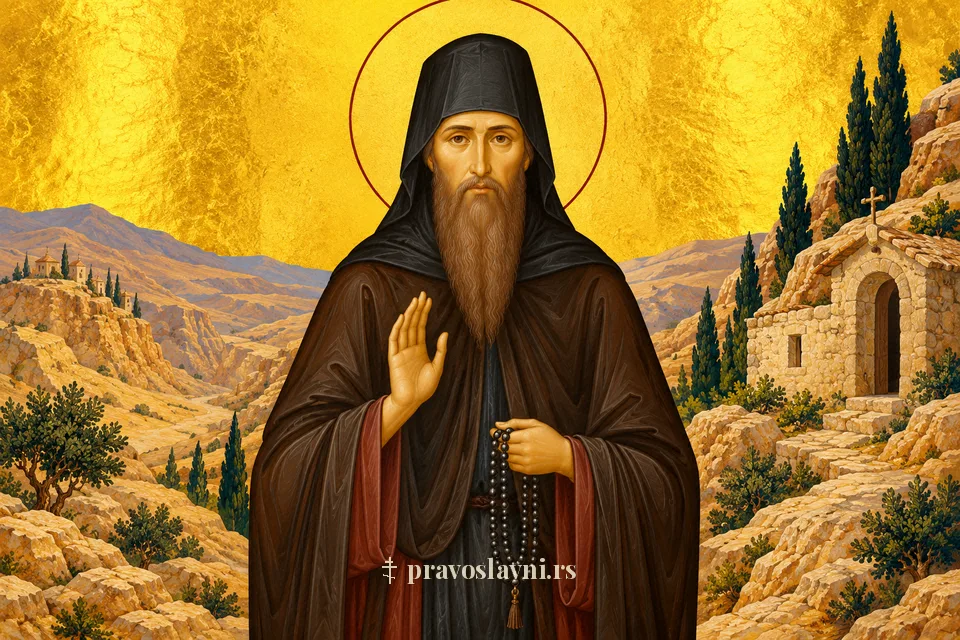
“And from the days of John the Baptist until now the kingdom of heaven suffers violence, and the violent take it by force.”
— Mt 11:12
Life
What does it mean to be a monk? That is what both Abba Macarius and Abba Moses, elders of the desert of Scetis, asked the young Zacharias. To Macarius, according to the Prologue, he answered that a monk is one who constantly strives to fulfil God's commandments. Before Moses he took off his monastic cowl, trampled it underfoot and said: “Unless a man crushes himself like this, he cannot be a monk!”
The older monks wanted to learn from the younger one. Both sources record that Zacharias, although younger than many, received more grace than many among them. His Life explains that the elders sought his instruction because they knew that the Holy Spirit was with him.
He was brought into the desert while still a boy by his father, Carion the Egyptian. The Prologue explains why the boy ended up in the desert: Carion had left his home for the sake of the monastic life, and he took his son in only when the mother was left without the means to feed him. His Life records that Zacharias too became a monk in Scetis. Carion himself, according to the Life, admitted that he had laboured more than his son, yet had not attained his son's measure; that height he ascribed to humility and silence.
Silence marked his end as well. To Abba Moses' question as to what he saw, the dying man, according to his Life, replied with the question whether it was not better to keep silent. His Life also says that Abba Isidore, who was beside him at the hour of death, declared that the gates of the Heavenly Kingdom had been opened to him. The Prologue numbers him among the most radiant monks of the desert and records that he departed early to the Lord.
St Zacharias teaches that humility raises even a younger man above his elders, and that a monk does not exalt himself but, in his own words, always strives to fulfil what God commands.
Full Life
A boy in the desert
Zacharias was the son of Carion the Egyptian. The Prologue says that Carion left his wife and children and became a monk, and that later he took his son to himself as well, because the mother had nothing to feed him with. His Life records that Zacharias, while still a child, went with his father into the desert of Scetis and there became a monk.
Younger than the elders, richer in grace
Many elders lived in Scetis who had lived the ascetic life longer than he had. Yet Zacharias, as the Prologue and his Life record, received greater gifts of grace than many among them. According to both sources, the grace of God took hold of his heart and his whole inner being, and did so, as his Life says, without ceasing. His Life gives as the cause his deep humility and virtue; because of them the Holy Spirit found His home in him. The elders recognised this and wanted to learn from him.
Abba Macarius once asked him what the work of a monk is; according to the Prologue, he asked him who is a true monk. The young man, according to his Life, was confused that an older man should seek instruction from him, and Macarius admitted that something in his own soul was moving him to do so. A monk, as it stands in the Prologue, is “he who unceasingly forces himself to keep the commandments of God”.
The trampled cowl
Abba Moses, too, asked him for counsel. According to his Life, Zacharias threw himself at his feet, as though defending himself, and Moses explained to him that he had to ask, because he had seen the Holy Spirit coming down upon him.
Zacharias then took off his monastic cowl — the Prologue says his kamilavka — threw it on the ground, trampled it and said: “If a man does not crush himself like this, he cannot be a monk!” That is how his Life hands down those words, while the Prologue records them thus: “If a man is not broken in this way, he cannot be a monk!”
The secret of silence
His father Carion, according to his Life, admitted that he had laboured and lived the ascetic life more than his son, but had not reached his measure. He ascribed his son's height to humility and silence.
Silence marked his end as well. His Life says that Abba Moses, while Zacharias was dying, asked him what he saw. Zacharias answered with a question: “Is it not better, father, for a man to keep silent?” Moses agreed. His Life also records the words which Abba Isidore spoke at the very moment of parting, looking upwards: “Rejoice, my child Zacharias, for the gates of the Kingdom of Heaven have been opened to you.” The Prologue records that among the monks of the desert he was one of the most radiant and that he departed to the Lord before he had grown old.
The example of St Zacharias shows that humility and silence raised a young monk above elders who had laboured longer. A true monk unceasingly forces himself to keep the commandments of God and does not exalt himself.
Other saints of the day
St Artemon, Bishop of Seleucia
St Artemon, according to the Prologue, was born and brought up in Seleucia. When the holy Apostle Paul came to that city, he found Artemon there, strengthened him in the faith and appointed him bishop. Thus Artemon received his pastoral ministry from the hands of the Apostle himself. He was a caring shepherd who, according to the Prologue, healed his faithful both spiritually and bodily. The Prologue says that he “passed over into eternity in deep old age”.