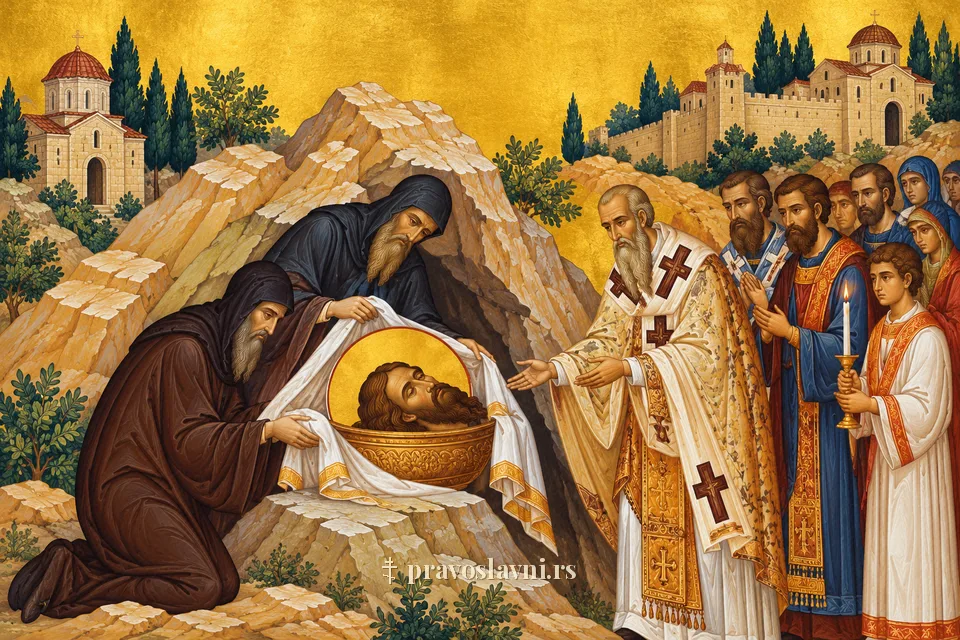
First and Second Finding of the Head of St John the Baptist
Commemoration: 9 March 2026 · 9 March 2027
First and Second Finding of the Head of St John the BaptistCommemoration: 9 March 2026 · 9 March 2027
Commemoration in our calendar
Monday, 9 March 2026fast with oil · 24 February (according to the Julian calendar)
Tuesday, 9 March 2027dairy allowed (no meat) · 24 February (according to the Julian calendar)
Tuesday09March 202724 February (according to the Julian calendar)
Illustration
Feast of the day
First and Second Finding of the Head of St John the Baptist
What happenedThe head of John the Baptist, which Herodias had hidden in the ground, was lost and found again more than once, and then taken to Constantinople.
“Assuredly, I say to you, among those born of women there has not risen one greater than John the Baptist; but he who is least in the kingdom of heaven is greater than he.”
— Mt 11:11
Life
The Gospel says that during his life John the Baptist “performed no sign” (Jn 10:41). The Prologue reminds us that wonderworking power was nevertheless given to his relics, and both sources record many healings which came from his head. The path of that holy thing was long and uncertain.
Herodias, at whose urging John was put to death, did not allow the head to be buried with the body, but buried it in a hidden place. Joanna, the wife of Herod's courtier Chuza, secretly carried it to the Mount of Olives in Jerusalem. And Herod, hearing of the miracles of Jesus, was afraid that John had risen from the dead. On the Mount of Olives the head was found, while digging, by Innocent, a distinguished man who had left his service and become a monk; the Life places this in the time of Constantine the Great. That is the first finding. Innocent reverently returned the head to the earth. The head then passed from hand to hand and fell into oblivion.
The Life tells how, after many wanderings — by way of two monks from the East and a poor potter from Emesa — it came to a cave near Emesa, where a monastery later arose. To Archimandrite Marcellus there appeared in a vision choirs announcing John's coming, and a voice directed him to follow a star; digging, he found a vessel with the head. That is the second finding. Uranius, Bishop of Emesa, opened the vessel with prayer, and a presbyter who doubted and touched the holy thing was left, according to the Life, with a withered hand until they prayed for him. The head was then kept in the altar, until a new church was built in Emesa.
Later the head was taken to Constantinople, to the church of the Forerunner at the Hebdomon. In the time of iconoclasm, as the Life says, it was hidden at Comana, where St John Chrysostom died, and in the time of the Empress Theodora and Patriarch Ignatius it was found again and brought to the capital.
This history teaches that God keeps His saints even when people hide and forget them, and reveals them in His own time; therefore one should approach what is holy with reverent awe, without unbelief.
Full Life
A holy treasure that was lost more than once
The feast of the Finding recalls the head of St John the Baptist, which was hidden, forgotten and found again more than once before it reached Constantinople. First it was hidden by Herodias, and after her by those who venerated it as well.
Those who hid it
John was put to death at the urging of Herodias. She did not allow the head to be buried with the body because, as the Prologue says, she was afraid that John might rise again, and so she buried it in an unclean, hidden place — according to the Life, in her own palace. When Herod heard of Christ's miracles, he thought that it was John risen from the dead (Mk 6:16). The body, according to the Life, was secretly buried by his disciples in Sebaste.
The head was secretly taken out by Joanna, the wife of Herod's courtier Chuza, and she laid it on the Mount of Olives. Later the monk Innocent too, when he found it, returned it to the earth — according to the Life, so that the pagans would not defile it. The Life also tells of a potter from Emesa, who kept it in his house and before his death left it, sealed, to his sister, and of the Arian Eustathius, who, when he was driven out, buried it in a cave near Emesa.
Those who found it
Innocent was a man of high standing who received the faith, left his office and became a monk on the Mount of Olives; the Life says that this was in the time of Constantine the Great. While digging — according to the Prologue for a cell, according to the Life for a small church — he found an earthen vessel, and God revealed to him that John's head was in it. This is the first finding. After that the head, both sources say, passed from one man to another and fell into oblivion.
The Life states that it was then dug up, at John's direction in a dream, by two monks from the East. The second finding is linked with Marcellus, archimandrite of the monastery that arose by that cave in Emesa: after a vision of choirs announcing John, a voice directed him to follow a star, and so, according to the Life, he found the vessel with the head in the cave. According to the Life, the head was later brought to Constantinople, to the church of the Forerunner in the Hebdomon; during the time of iconoclasm it was hidden in Comana, and in the time of the Empress Theodora and Patriarch Ignatius it was found once more and returned to Constantinople.
Unbelief beside the holy treasure
The Life does not pass over in silence the human weaknesses shown beside the holy treasure either. Eustathius attributed to himself the healings that the head worked. Marcellus hesitated to inform the bishop and fell ill, and he recovered when the monks agreed to do so. The presbyter Malchus, who doubted and touched the holy treasure when Bishop Uranius opened the vessel, was left with a paralysed hand until prayers were offered for him, and later John healed him in a vision. After that, according to the Life, the holy treasure was placed in the altar, and there it remained right up to the building of the new church in Emesa.
A power that was not in signs
The Gospel says that during his lifetime John “performed no sign” (Jn 10:41). Even so, his head became a source of many healings, of which both the Prologue and the Life speak. God guards the relics of His saints even when people hide them or forget them, and He reveals them when He wills.
Other saints of the day
Venerable Erasmus of the Kiev Caves
Venerable Erasmus, a monk of the Monastery of the Caves, reposed as a schemamonk, only three days after he had sincerely repented, following a time of negligence. He had inherited a great estate from his parents and, according to his Life, held that a monk ought not to have earthly treasure, and so he gave everything for the church of the Caves: many of its icons are overlaid with his gold and silver. He was left with nothing, and everyone began to look down on him and to avoid him. Then the devil slipped into his mind the thought that he had thrown the money away in vain, instead of distributing it to the poor. Erasmus gave himself up to despair and let his life go to ruin. The Life says that a grave illness then came upon him, and for seven days he lay speechless and with his eyes closed, while the brethren, gathered around him, grieved for his soul. Then he suddenly sat up and confessed: “I am sinful and I did not repent.” He told them that Sts Anthony and Theodosius had been praying for him and that the Lord had granted him a little more time to repent. The Theotokos also appeared to him and, according to the Prologue, said: “The poor you have with you in every place, but My church you do not have”, while according to the Life she promised him that, just as he had adorned her temple, so she would adorn him in the Kingdom of her Son. He confessed his sins before the brethren, received the schema and on the third day departed joyfully to the Lord; the Prologue records the year 1160. His example teaches that despair is not the last word, for even at the end of life God offers an opportunity for repentance.