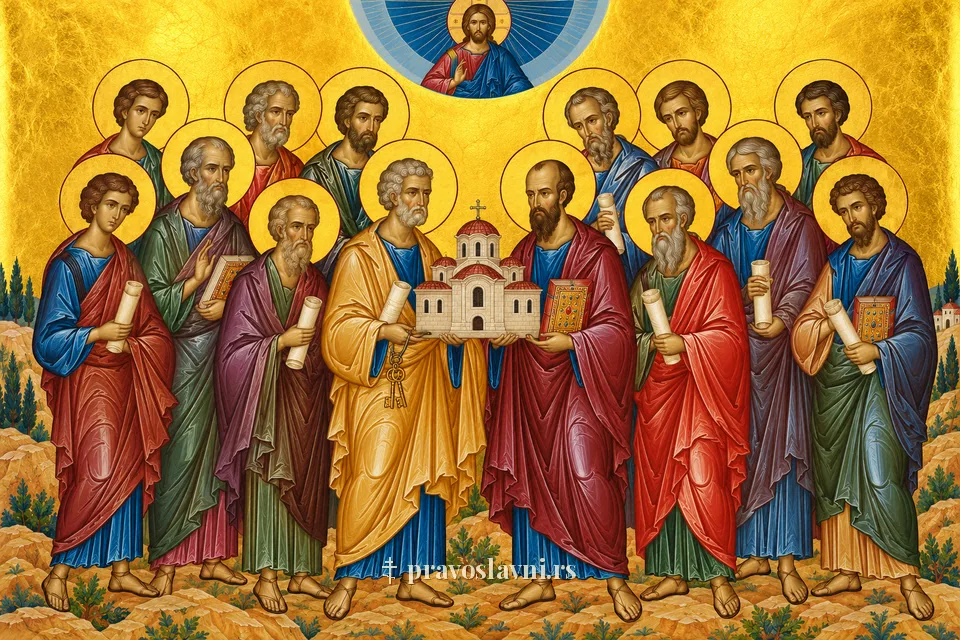
“Then He appointed twelve, that they might be with Him and that He might send them out to preach.”
— Mk 3:14
Life
The apostles are commemorated in the calendar individually as well, but on this day the Church honours them all together, along with Paul. This feast comes on the day after the feast of Sts Peter and Paul. According to the Life, the Synaxarion of Constantinople on this day also commemorates the Seventy Apostles.
The Prologue and the Life record how the apostles ended their lives. Peter was crucified upside down. Andrew, Philip, James the son of Alphaeus, Thaddeus and Simon the Zealot were crucified as well. James the son of Zebedee and Paul were beheaded, Bartholomew was crucified and beheaded, Thomas was pierced by spears, Matthew the Evangelist met his end in fire, and Matthias was stoned and beheaded. Only John the Theologian reposed in a wondrous manner.
The Prologue stresses that the apostles cared for all people — John Chrysostom calls the Apostle Paul the common father of the whole world. Their love embraced even their enemies: Peter twice saved from death Simon Magus, his adversary, once from the people who wanted to burn him, and once from a dog that had set upon him.
The Prologue also cites the words of St Cyprian: “As long as we are in the body, everything happens to us Christians just as it does to the pagans; the difference is only in the spirit.” The homily of the Prologue, on the words of the Apostle Peter, speaks of the power of good deeds, which quench enmity: “A meek and kind deed is like water on a fire.” The apostles laid down their lives for Christ, and their love reached out to all.
Full Life
One feast for all the apostles
On this day the Church gathers together in one place all the great apostles, together with Paul, although each of them also has his own separate commemoration in the calendar. Peter is celebrated on 29 June and 16 January, Andrew on 30 November, James the son of Zebedee on 30 April, John the Theologian on 26 September and 8 May, Philip on 14 November, Bartholomew on 11 June and 25 August, Thomas on 6 October, Matthew the Evangelist on 16 November, James the son of Alphaeus on 9 October, Thaddaeus, who is also called Jude the brother of James, on 19 June, Simon the Zealot on 10 May, Matthias on 9 August, and Paul on 29 June — all according to the Julian calendar. The Life adds that, according to the Synaxarion of Constantinople, the Seventy Apostles are also commemorated on this day, whose commemoration otherwise falls on 4 January (according to the Julian calendar).
How they ended their earthly life
Both the Prologue and the Life record how each apostle ended his life. Peter was crucified upside down, with his head downwards. Andrew, Philip, James the son of Alphaeus, Thaddaeus and Simon the Zealot were also crucified. James the son of Zebedee and Paul were beheaded. Bartholomew was crucified, and then beheaded as well. Thomas was pierced by spears. Matthew the Evangelist died in the fire. Matthias was stoned, and then also beheaded. Only John the Theologian reposed in a wondrous manner.
A love that embraces all
The Prologue says in its teaching that the apostles cared for all people; John Chrysostom calls the Apostle Paul the common father of the whole world. That love did not pass over enemies either. Peter twice saved his opponent Simon Magus from death — once when the people wanted to burn him, and a second time when a dog set upon him.
The Prologue also quotes the words of St Cyprian on what distinguishes Christians from others: “As long as we are in the body, everything happens to us Christians just as it does to the pagans; the difference is only in the spirit.”
Repentance and good works
On this day the Prologue also dwells on the two thieves crucified beside Christ (Lk 23:40). One blasphemes in his torment, while the other, the wiser one, recognises that God is beside him and asks for salvation. The homily of the Prologue, on the words of the Apostle Peter (1 Pet 2:12 and 15), speaks of the power of good works, which quieten enmity: “A meek and gentle deed is like water on a fire.”
The apostles, according to the Prologue, are the most useful men in the history of the world. They laid down their lives for Christ, and their love reached out to all people, even to their enemies.