Save your slava — you'll get a reminder a week and a day before.
Sunday21November 20278 November (according to the Julian calendar)
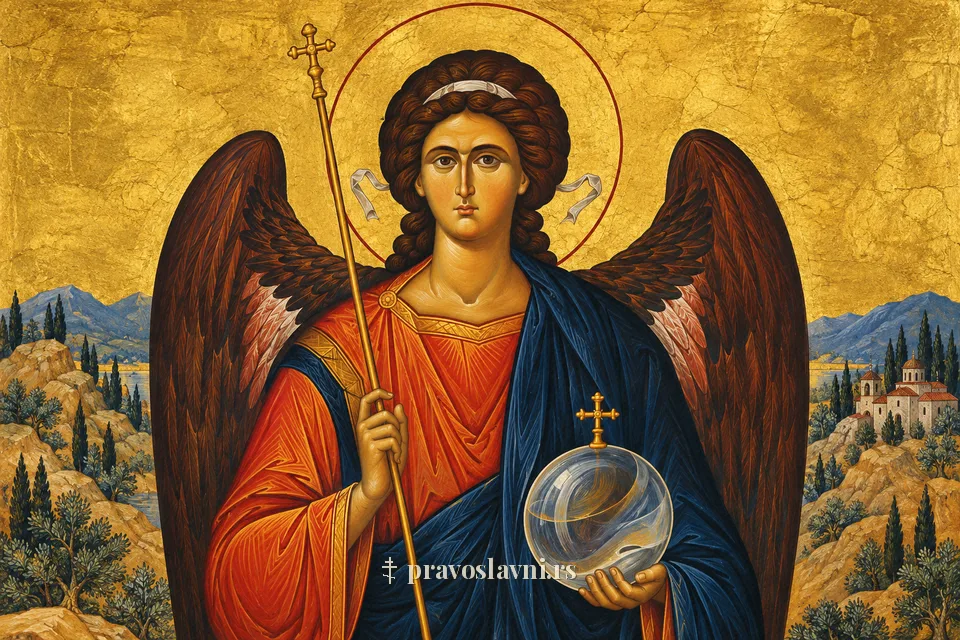
Illustration
Great feast
Aranđelovdan — Synaxis of the Holy Archangel Michael
Synaxis of the Holy Archangel Michael
What happenedWhen the proud Lucifer fell, the Archangel Michael, the Chief Commander, cast him down from heaven and called the faithful angels to stand humbly before the Creator.
Sung at the Slava (family patron saint's feast) and on the saint's feast day.
O Commanders of the heavenly hosts, we the unworthy ever entreat you, that by your prayers ye encompass us with the shelter of the wings of your immaterial glory, guarding us who fall down fervently and cry: Deliver us from misfortunes, as captains of the powers on high.
Aranđelovdan is the Synaxis of the Holy Archangel Michael and the other Bodiless Powers of Heaven. The name Michael means: who is like God.
Aranđelovdan is the second most common Krsna slava (family patron saint's day). Many Christians think of St Michael as a living saint. In some regions this is given as the reason for not preparing žito (boiled wheat, koljivo) for this Slava. Nevertheless, it is stressed in the Church that “žito should be prepared for all Slavas”.
In former times, in some of our regions, in times of great trouble such as illness, natural disasters or war, an extraordinary fast before Aranđelovdan used to be imposed. When the Slava falls on a fasting day, the Slava table is also a fasting one; for more on fasting, see the guide “Fasting — simply explained”.
Life
Aranđelovdan, the Synaxis of the Holy Archangel Michael, is the feast of all the bodiless powers of heaven, with Michael as their leader. It is celebrated on 21 November, which is 8 November by the old calendar.
It was established in the fourth century, a few years before the Council of Nicaea; at that time Sylvester was Pope in Rome and Alexander was Patriarch in Alexandria. The way for the feast was opened by the council in Laodicea, which anathematised the heretical teaching about angels as gods or creators of the world, and taught the faithful the right measure of veneration. There are nine ranks of angels, from the Seraphim and Cherubim to the Archangels and Angels, as St Dionysius the Areopagite set them in order; November too is a reminder of that number, being the ninth month if one counts from March, the month of the creation of the world.
Michael is the chief commander — God entrusted to him the leadership of all nine ranks. Pride separated Lucifer from God, and a part of the angels went after him; then Michael cast the apostate down into the abyss, and called those who remained to humility. The Prologue reminds us that Scripture shows him as the commander before Jericho and as the one who disputed with the devil, while the Life records that he appeared to St Archippus at Chonae.
Each one of us has an angel who guards him: whatever we do, openly or in secret, we do before him, and he does not leave us even when we sin. We honour the angels as God's servants and helpers, and not as gods. From Michael we learn humility, watchfulness and zeal, and we ask for his help in the struggle against sin and the devil.
Full Life
Gathered around one commander
Aranđelovdan (the Synaxis of the Holy Archangel Michael) is a feast on which the Church does not celebrate one saint, but the whole heavenly host. Its full name is the Synaxis of the Holy Archangel Michael and the other Bodiless Powers of Heaven: around Michael, as around their chief, all the angels gather. By the old calendar it falls on 8 November, and by the new on 21 November.
Angels have been honoured from the most ancient times, but people have not always known the right measure. The Prologue and the Life also remember heretical errors — from the worship of angels to the tale that Michael is the god of the Jews. For that reason the local council in Laodicea (the Prologue mentions its 35th canon) barred the way to error, but it did not abolish the honour which the angels deserve. The feast dates from the fourth century, from the time before the Council of Nicaea, when Rome and Alexandria were governed by Pope Sylvester and Patriarch Alexander.
The heavenly host in three triads
The Prologue and the Life say that the angels are the first thing God created. Their order is described in the book On the Celestial Hierarchy, whose author is Paul's disciple, St Dionysius the Areopagite: nine ranks in three groups — the highest is made up of the Seraphim, Cherubim and Thrones, the middle of the Dominions, Virtues and Powers, and the lowest of the Principalities, Archangels and Angels. Some kindle love for God and give enlightenment, some help in mastering the passions, in patience and in the struggle with the devil, and some guard the nations, proclaim the will of God and watch over every believer — each rank has its own task. The Epistle to the Hebrews also stresses their service: “Are they not all ministering spirits sent forth to minister?”
The number nine also explains why the feast is in November of all months: counting from March, in which the creation of the world is placed, November is the ninth in order.
Michael's cry
The Prologue says: “The commander of the whole angelic host is the Archistrategos Michael.” Michael's best-known cry is bound up with the fall of the Morning Star, Lucifer: pride separated him from God, and a part of the angels went after him. The Life remembers what Michael said then: “Let us attend! Let us stand reverently before our Creator.” Michael cast the apostate down into the abyss, and those who remained faithful glorified the Holy Trinity.
The Prologue finds Michael in Scripture as well: before Jericho the Commander of the army of the Lord appears to Joshua the son of Nun (Josh 5:13–15), and the Apostle Jude writes that Michael contended with the devil over the body of Moses (Jude 9). The Life also adds Chonae, near Colossae: there he appeared to St Archippus, and so a church was built on the site of the miraculous spring. In her prayers the Church calls him the first of the angels and the commander of the heavenly powers, and she asks his protection when sin, illness, death or unclean spirits threaten.
A witness of our every day
The Prologue and the Life teach that God gives a guardian to every nation, and also to each one of us personally. That guardian is there both when no one sees us and when we act in front of everyone, and he does not go away even when we sin. And at the Dread Judgement, on the eighth day, everything will come to light.
That is why we give honour to the angels as God's servants and our helpers, never as gods. Let us live aware that our guardian angel always sees us, let us learn from Michael humility, watchfulness and zeal, and let us call on him for help against sin and the devil.