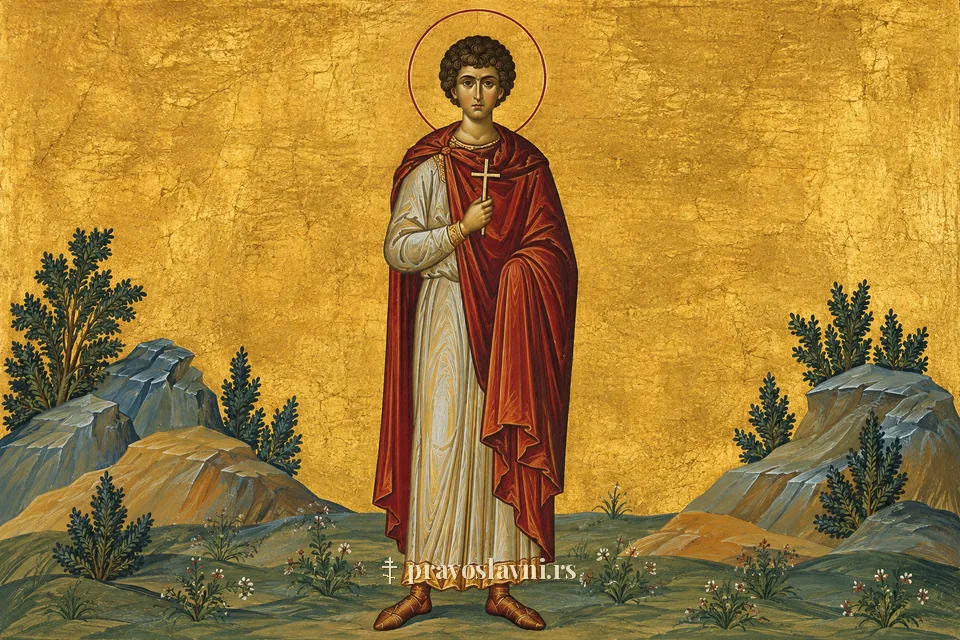
“Put on the whole armor of God, that you may be able to stand against the wiles of the devil.”
— Eph 6:11
Life
Hieron of Tyana in Cappadocia, the leader of the thirty-three martyrs of Melitene, was the support of his blind mother Stratonica. In the time of Diocletian and Maximian the governor Lysias wanted to take the strong Hieron into the army. Hieron refused, because he would have had to offer sacrifices to idols, and he drove the soldiers off with a branch. According to his Life, he gave himself up only when his friend Cyriacus won him over with gentle words.
He parted from his mother and set out for Melitene. On the first night of the journey, according to both sources, a vision announced to him salvation and glory soon to come in the service of the heavenly King. In the prison at Melitene he encouraged the other Christians not to offer sacrifice. For admitting that he had beaten the soldiers he paid with his right hand, and his companions were beaten. His kinsman Victor, being frightened, paid a bribe to get out of the prison, but he died soon afterwards. Hieron grieved bitterly for him.
Four days later Lysias sentenced them to be beheaded. Before their death they sang a psalm and committed their souls to Christ. The Prologue records that this was in the year 298. His head was bought from Lysias by the wealthy Chrysanthus; he kept it, and the church that he later built on the place of their suffering became its resting-place. His severed hand was brought to his mother by relatives at night, as Hieron had asked.
These martyrs teach us that faithfulness to Christ to the end is worth more than any earthly security, while Victor's fate is a warning of what fear can take away from us.
Full Life
The strong son of a blind mother
Hieron lived in Tyana, in Cappadocia Secunda. His mother Stratonica, a devout widow, was blind, and he looked after her devotedly. This was in the time of the Emperors Diocletian and Maximian. According to his Life, Cappadocia and Armenia stubbornly refused the idols. Lysias, whom the Emperors sent to Cappadocia, had the task of gathering strong men for the army, and of punishing with death the Christians who would not offer sacrifices.
Word of Hieron's strength reached Lysias too, and so soldiers set out to fetch him and found him in his field. Hieron refused military service, because he would have had to offer sacrifices to idols, and he drove the soldiers away with the branch of a tree. When the troops came back in greater numbers, his Life says that Hieron shut himself up in a cave with eighteen Christians, and the soldiers did not dare to come near. What the soldiers could not do, Lysias entrusted to Cyriacus, a friend of Hieron's: he first talked the troops into withdrawing, and then with gentle words persuaded Hieron to give himself up.
A voice in the night
His blind mother begged him to stay, but he had to go. On the road to Melitene he took with him his kinsman Victor, while Matronian and Antony, also kinsmen, followed after them. On the very first night, according to the Prologue and his Life, Hieron received in a vision the news of salvation and of the glory soon awaiting him in the service of God. Hieron then told his companions that earthly goods are nothing compared with the soul, and he entrusted his mother to God.
In Melitene he was imprisoned with thirty-three Christians. He encouraged them not to offer sacrifice and to glorify the true God, and they answered him: “Your words are as sweet to us as honey!” Before Lysias they confessed the Creator of heaven and earth. Because of the beating he had given the soldiers Hieron lost his right arm up to the elbow, and his companions were severely beaten.
Faith stronger than fear
Fear overcame Victor: with money he bought the removal of his name from the prison list, and he went out by night. His freedom did not last long: he died soon afterwards, and so he kept neither his life nor his place among the martyrs. Hieron grieved for him: “Why did you sacrifice eternal life for a temporary life?” In his last will, as his Life hands it down, he thought most of all of his mother: to her went his severed hand, which she was to keep in the house at Vadisana, and all his property except the estate in Pisidia, which was intended for his sister Theotimia.
When four days had passed, not even beatings had forced the martyrs to sacrifice, and so Lysias sentenced them to be beheaded. The thirty-three went to their death singing: “Blessed are the undefiled in the way, who walk in the law of the Lord,” and then they prayed that the Lord Jesus Christ would receive their souls. The Prologue lists them by name, says that they are written in the Book of Life, and gives the year 298.
Antony and Matronian searched in vain for Hieron's body. Chrysanthius, a wealthy man, bought the head from Lysias, who demanded gold for it. Later he laid it in a church which he built on the place of execution. Lysias wanted to turn the hand into money too, but Antony and Matronian got there before him: by night they fled with it to Stratonica, and she wept over it and placed it as her son had wished. The Christians buried the bodies of the martyrs in secret.
Hieron's example teaches that eternal goods are greater than any earthly security, and that faithfulness to Christ unto death is worth more than a temporary relief. Victor's fall remains a warning of what fear can take away.
Other saints of the day
Venerable Lazarus of Mount Galesius
Venerable Lazarus, a stylite from Mount Galesius near Ephesus, comes from a village in the neighbourhood of Magnesia, where, according to his Life, he was born in the year 967 in the respected and devout house of Nicetas and Irene. Before he returned to his native parts, he was a monk for ten years in the Lavra of St Sabbas the Sanctified, to which his journey to Jerusalem had brought him as a young man; there the patriarch ordained him a priest. He was told to return, according to his Life, by a voice from heaven: “Lazarus, Lazarus, Lazarus, you must return to your fatherland.” Neither the devil's deceptions on the road nor a meeting with his mother held him back. On Galesius he built the Church of the Resurrection, and in this he was helped by Emperor Constantine Monomachus, who held him in great reverence. His Life records that on that mountain one night he heard angels singing: “Let God arise, let His enemies be scattered!” He lived the ascetic life on a pillar beside the church, weighed down with chains, and he ate only once a week. He worked miracles and prophesied, and so he became a centre for monks and devout people. The fifteen years which, according to his Life, the Theotokos added to his life at the request of his disciples brought the brotherhood growth to more than nine hundred monks. He was buried in the pillar itself, and many healings take place through his relics. His life teaches us obedience to God's call and reliance on God's help in temptations.