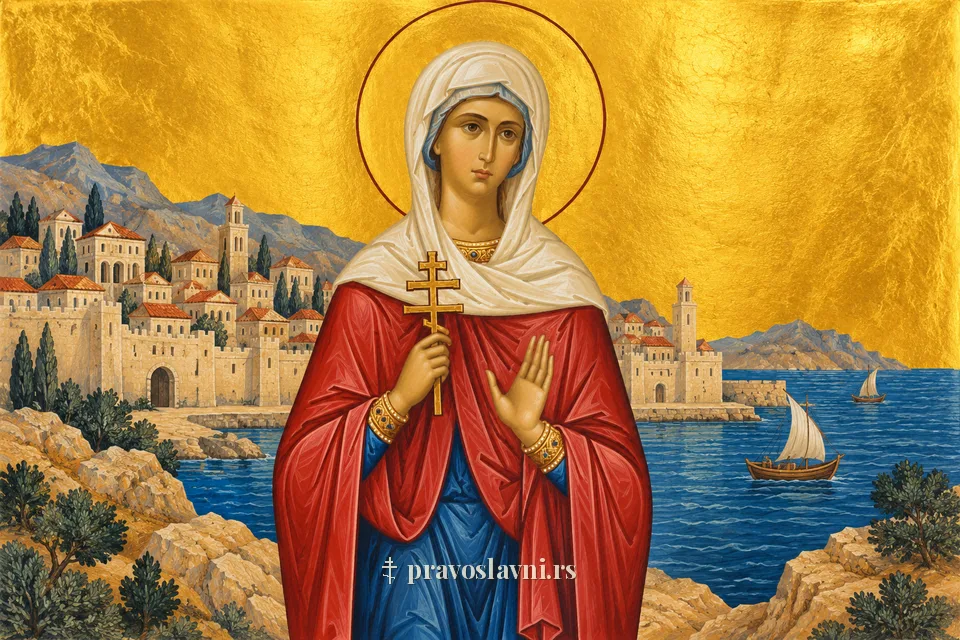
Saturday26June 202713 June (according to the Julian calendar)
Illustration
Saint of the day
Holy Martyr Aquilina
What happenedTwelve-year-old Aquilina of Byblos refused to offer sacrifice to idols, and after her tortures an angel raised her up and healed her in the night.
“Out of the mouth of babes and nursing infants You have ordained strength, Because of Your enemies, That You may silence the enemy and the avenger.”
— Ps 8:2
Life
Aquilina was only twelve years old when she stood before the governor Volusian and refused to offer sacrifice to the idols. She was born in Byblos in Palestine, into a Christian family. Her father, according to her Life, died early, and her mother brought her up in the faith. At the age of seven she knew the life of the Gospel well, and at about ten she was teaching her friends about Christ and telling them that the idols were powerless.
In the time of Emperor Diocletian she was denounced to the governor. She was shaken neither by his false pity for her youth, which the Life mentions, nor by the tortures: after cruel torment she fell down as if dead and was thrown onto the rubbish heap outside the city.
Both the Prologue and the Life record that an angel raised her up and healed her that night. According to the Life, she gave thanks to God and asked for a martyr's crown. The city gate, according to both sources, opened of its own accord, and Aquilina appeared before the governor in his bedchamber and terrified him. The next day she was condemned to be beheaded. She prayed on her knees, and the Life says that she gave up her spirit before the sword fell. According to the Life, the Christians buried her in Byblos, and at her grave many of the sick received healing. The Prologue states that she suffered in the year 293, at only twelve years of age.
St Aquilina reminds us that neither youth nor weakness is a hindrance to courageous faith, for God gives strength to those who confess Him.
Full Life
A Child Who Taught Others
The holy martyr Aquilina was born in Byblos, in Palestine, into a Christian family; her Life states that her father's name was Eutolmius. According to the Life, her mother brought her as a four-month-old baby to Bishop Euthalius, who signed her with the sign of the Cross, and she was baptised about two months later. Her father died when she was one year old, and so her mother brought her up in the faith by herself.
The fruit of that upbringing was seen early. Both sources say that by the age of seven she already knew the life of the Gospel well, and at about ten years of age she was speaking to girls of her own age about Christ and about the fact that idols have no power at all.
Before the Governor
In the time of Emperor Diocletian someone denounced her to the governor Volusian — the Life says it was his servant Nicodemus. According to the Life, she was twelve years old when they seized her. She refused to offer sacrifice, and the governor's feigned pity for her youth and beauty did not shake her.
First they beat her, and then they subjected her to still harsher torments, after which she fell down as though dead. Her torturers threw her out of the city, as one dead, onto the rubbish heap, among the dogs.
A Night on the Rubbish Heap
God did not abandon her. Both sources say that on that night an angel raised her up and healed her; the Life states that this was at midnight. According to the Life, she gave thanks to God and asked for the martyr's crown, and a voice from heaven promised it to her. According to the Prologue and the Life, the city gate opened of its own accord, and Aquilina appeared before the governor in his bedchamber. Volusian was terrified.
The Crown
On the following day she was sentenced to be beheaded. Before her death, as both sources record, she prayed on her knees. The Life says that she gave up her spirit before the sword fell, and when the executioner struck, milk flowed instead of blood. The Christians, according to the Life, buried her with honour in Byblos, and at her tomb and relics many of the sick were restored to health. The Prologue records that she suffered at the age of twelve, in the year 293.
Her life shows that the faith of a child can be stronger than any torture: the power of God raised her from the rubbish heap and confirmed her confession.
Other saints of the day
St Triphyllius, Bishop of Leucosia in Cyprus
St Triphyllius was born in Cyprus, and his Life says that he studied the secular sciences in Berytus. He was a disciple of St Spyridon, and later also his fellow bishop in the service of the Church in Cyprus. With Spyridon he went to Antioch to the sick Emperor Constantius, the son of Constantine; both sources say that the Emperor recovered as soon as Spyridon touched his head. When, according to his Life, Triphyllius marvelled at the imperial court, Spyridon taught him that earthly glory passes away. He became bishop in the city in Cyprus which the Prologue calls Lekvousia, and his Life Leucosia, formerly Ledra. His Life remembers that, when he wanted to buy a vineyard for his church, Spyridon reminded him of the good things of heaven. According to his Life, he took part in the Council of Sardica in the year 343. Once, while reading the Gospel, he changed one word, and Spyridon rebuked him publicly; Triphyllius repented and learned humility. According to the Prologue, he was a great ascetic, remained a virgin until his death, and was marked by mercy, purity of thought and abundant tears. According to the Prologue, he reposed in peace in the year 370.