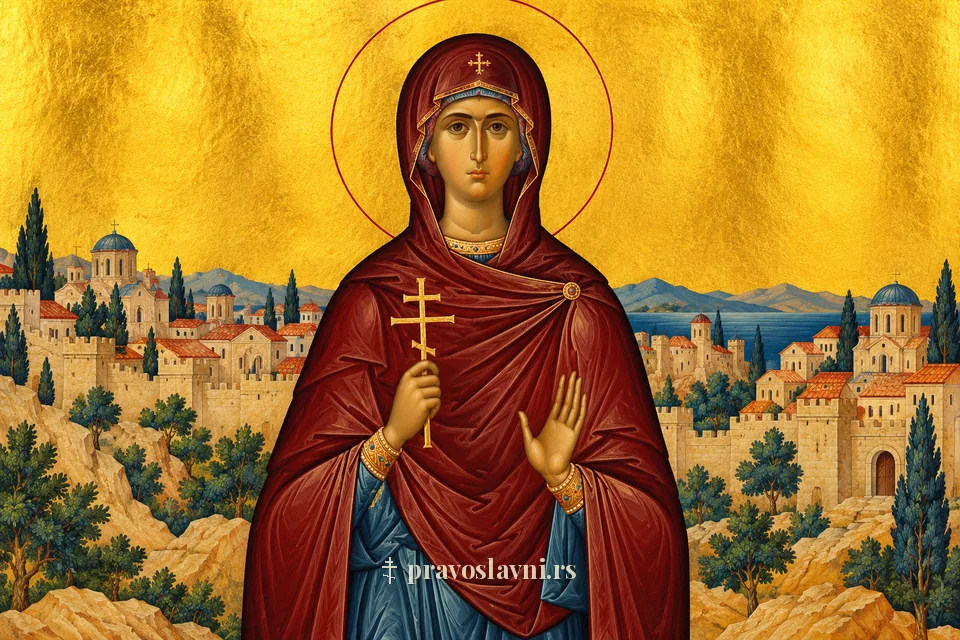
“Do not harm the earth, the sea, or the trees till we have sealed the servants of our God on their foreheads.”
— Rev 7:3
Life
St Glyceria suffered for Christ in the reign of the Emperor Antoninus. She was the daughter of a Roman governor; after her father's death she lived in Trajanopolis and, as her Life says, dedicated her life to Christ.
Her martyrdom began at a pagan festival at which everyone was holding lamps. Before the governor she pointed to the cross that she had traced on her forehead — “This is my lamp” — and after her prayer, as the Prologue and her Life record, the idol was struck down by thunder.
The tortures that followed did not break her. According to her Life, the stones could not touch her, and in prison the priest Philocrates strengthened her with the sign of the cross. When they wanted to wear her down by hunger, God fed her through an angel. Nor did the furnace do her any harm. The gaoler Laodicius recognised the power of God in this, accepted faith in Christ and was beheaded at once.
Glyceria gave up her soul to God in front of the lions, after praying. According to her Life, she was buried not far from Heraclea by Bishop Dometius, who had earlier met her on the road to that city and had prayed for her. Many who were gravely ill received health from the myrrh that flowed from her relics.
The steadfastness of one young woman showed that the sign of the cross, made with faith, stands stronger than idols and than torturers, and it converted even the man who was guarding her in chains.
Full Life
A cross instead of a torch
It was a feast in honour of an idol, and everyone was carrying lamps. To the governor, who wanted to know why she had no lamp, Glyceria showed the cross that she had traced on her forehead beforehand: “This is my lamp”. The Prologue calls the idol Dius, and her Life calls it Zeus. According to her Life, the governor Sabinus, by the Emperor's order, proclaimed a three-day festival with torches, and Glyceria went into the temple of her own accord and said that she would offer the first sacrifice. Instead of a sacrifice there followed a prayer, and after it thunder, which, as the Prologue and her Life record, shattered the idol. The Emperor at that time was Antoninus, whom the Prologue calls godless.
A maiden from a distinguished house
Her father had governed Rome — her Life calls him Macarius and says that he was a former prefect. According to her Life, the family moved from Rome to Trajanopolis in Thrace, where Glyceria was left without parents. Her Life says that she vowed herself to Christ as a bride, honoured the Mother of God and asked the Christians to pray that she might be made worthy of the martyr's crown. According to her Life, she explained her boldness to the governor: “I know only one God; He lives in heaven, and He helps me to destroy your pagan power.”
Kept by the hand of God
Her Life says that the stones they threw at her could not hit her and that the pagans declared her a sorceress, but she ascribed everything to Christ. The Prologue and her Life record that after the beating they wanted to starve her to death behind the sealed doors of the prison, but she received food from an angel; her Life says that they found her unbound, with bread, milk and water beside her. The priest Philocrates, according to her Life, strengthened her in prison with the sign of the cross, and in her torments she felt no pain; an angel also appeared to her.
According to her Life, Bishop Dometius met her outside the city, on the road to Heraclea, and prayed for her. Not even the furnace harmed her: in the flames she glorified God, like the three youths in Babylon; her Life says that dew from heaven put out the fire.
The fruit of steadfastness
When the governor saw that after all this she was healthy and joyful, the gaoler Laodicius took the side of Christ and paid for it with his head on the spot. Her Life says that he put her chains on himself, and that she prayed for him.
In the end they brought her out before the lions. The Prologue says that she prayed and breathed her last; according to her Life, one lioness lay down peacefully at her feet, and after a voice from heaven another seized her with its teeth, without a wound, and she gave up her soul. Her Life records that Bishop Dometius buried her, not far from Heraclea. According to the Prologue and her Life, many who suffered from grave illnesses were healed by the myrrh from her relics.
Glyceria exchanged the comfort of a distinguished house for faithfulness to Christ, and her steadfastness also brought her guard to the faith. On her day the Prologue reminds us that the demons fear the name of the Crucified One and that the Cross has greater power than all the armies of the earth.