Monday18October 20275 October (according to the Julian calendar)
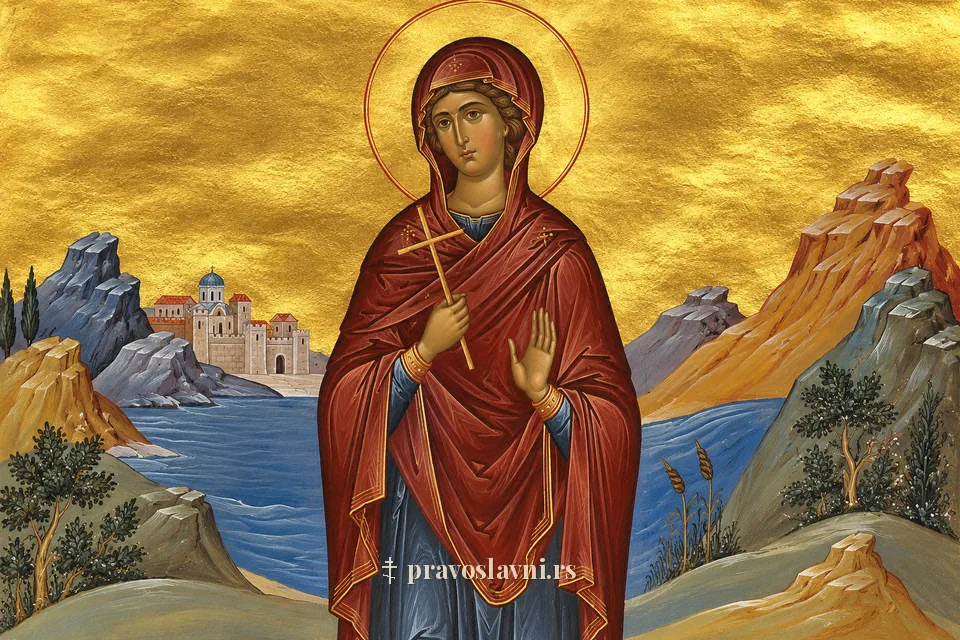
Illustration
Saint of the day
Holy Martyr Charitina
What happenedAn orphan brought up by the Christian Claudius; before the governor Dometius she did not deny Christ, and she remained unharmed in the sea and on the wheel.
“My grace is sufficient for you, for My strength is made perfect in weakness.”
— 2 Cor 12:9
Life
Charitina was left without parents at an early age. In Pontus, in the time of the Emperor Diocletian, she was taken in, according to her Life, by Claudius, a rich man with a soft heart. The Prologue says that he was a Christian, and so the orphan found in his house both a home and the faith. She grew up quiet and prayerful, according to the Prologue with the Holy Scriptures every day, and she made a vow to Christ that she would remain a virgin. Claudius, according to her Life, built her a separate house for prayer. Christians sought her advice, and many pagans, the Prologue records, were baptised because of her. In this way a modest girl became the teacher of many.
When the governor Dometius sent his soldiers, the hardest thing for Claudius, according to her Life, was to let her go. Charitina told him not to be anxious for her, for she was going to her Lord. He had only one request, which her Life preserves: “Remember me before the Heavenly King.”
Before the judge she hid nothing. The Prologue preserves her words: “it is true that I am a Christian”. But that she was deceiving people she firmly denied: she was only leading them to Christ. Neither offers nor instruments of torture made her waver.
Tortures followed, but God was with her, and then it was seen how strong the faith of one frail girl can be. The Prologue records that neither the fire nor the wheel did her any harm — an angel stopped the wheel. Nor did the sea, into which they threw her, manage to hold her, as both the Prologue and her Life say. All that time, her Life says, she was praying inwardly to Christ.
At last the judge wanted to put her to shame. Death did not frighten her, but shame did. According to the Prologue, she knelt down and begged God to keep her pure, even at the cost of her life — and during that prayer she breathed her last. Even when she was dead the sea would not have her: her Life says that it carried her body out onto the shore once more. She was buried by Claudius, the man who had once taken her into his home as an orphan.
Charitina's example shows that even the weakest person, leaning on God, stands firm before every power of this world.
Full Life
An Orphan Who Found a Home
Charitina remembered neither her father nor her mother. The Life says that, in the time of Emperor Diocletian, in Pontus, she was taken under his roof by Claudius — a respected and well-to-do man, known for his kindness to the poor. The Prologue adds the most important thing: Claudius was a Christian. So the little girl found in his house both a home and the faith.
She grew up into a quiet, retiring girl, wholly turned towards God. According to the Prologue, Holy Scripture was her daily food, and she made a vow to Christ that she would remain a virgin. Claudius, according to the Life, received that choice with joy and built her a separate house, where she could pray in peace. Soon Christians too were coming to her for instruction. And the Prologue records that many pagans, on hearing her, were baptised.
So it was that an orphan became a light for a whole region. But such a light cannot be hidden, and word of her reached even the place where it should not have.
The Parting
The governor Dometius learned of the Christian girl in Claudius's house and sent soldiers for her. Against the imperial authority Claudius could do nothing. The Life nevertheless remembers his pain: when they came, he embraced her and would not let her go.
Then it became clear who was comforting whom. Charitina begged her foster-father not to hold her back. This is not a day for tears, she told him, but for joy — she is going to Christ. Claudius walked behind the soldiers as they led her away. According to the Life, he had only one request: “Remember me before the Heavenly King.”
Confession before the Judge
Now she stood alone before a man who could have her put to death. They accused her of drawing people away into Christianity. The Prologue preserves the beginning of her answer: “it is true that I am a Christian”. But the charge that she was deceiving people she rejected — she was only leading them to Christ.
The judge, according to the Life, first tried gentleness. He reminded her of her youth, and offered honours and the favour of the gods and of the Emperor. The instruments of torture stood in plain sight, like a silent threat. Charitina made the sign of the cross and stood her ground. Youth and honours meant nothing to her if she had to pay for them by betraying Christ.
God Keeps His Own
Then the torments began, and with them the miracles too. First they deprived her of her hair, but, according to the Life, God showed His power even there — her hair grew again. The Prologue also mentions burning coals, which did her no harm, for the hand of God was over her. Throughout all this, according to the Life, she was praying within herself to Christ to give her strength to the end.
The sea did not swallow her — both the Prologue and the Life record this. The Life adds that the stone came untied from her neck and that she came out onto the shore. She went straight to the judge and called on him also to believe in the God who had preserved her. He saw nothing in all of it but sorcery. Nor did the torture wheel succeed: according to the Prologue, an angel of God prevented it.
Pure to Her Last Breath
In the end the judge devised the worst thing of all — he wanted to have her dishonoured. Death did not frighten Charitina, but dishonour did. The Prologue says that she knelt down and asked God to keep her pure, even at the price of her life. There, at prayer, she gave up her soul and departed into the Kingdom of Christ.
Her body, according to the Life, was thrown into the waves at the judge's command. But the sea did not keep it: on the third day it gave it back to the shore, whole. Claudius buried his Charitina — grieving as a father, yet rejoicing as a Christian.
Charitina's example shows that even the weakest person, when he leans on God, remains firm before every power of this world.
Other saints of the day
Hieromartyr Dionysius, Bishop of Alexandria
Dionysius grew up in Alexandria, in a wealthy pagan family. According to his Life, he was a rhetorician and taught younger men to speak well. He did not accept the truth on someone's word: for years he compared the teachings of the philosophers, until his own searching brought him to Christ. He studied under Origen and read Paul's epistles, and, according to the Prologue, he received baptism from Bishop Demetrius. He became Bishop of Alexandria in the year 247, and hard years awaited him — plague, persecutions and heresies. The Prologue says that, while the persecution raged, the faithful kept him hidden outside the city for three years. Even then he did not forget his people: by his letters he taught them and strengthened them in the faith. In Valerian's time, according to his Life, he came, though ill, before the governor Aemilian and said that God must be obeyed rather than men. His Life says that he was then exiled to the Libyan desert, where he went on preaching, and when he returned to a city stricken by famine and disease, he nursed the sick without asking who was of which faith. He died in the year 265, after seventeen years of ministry, and the Church to this day keeps some of his rules among her canons. Neither in hiding nor in exile does a good shepherd abandon his flock.