Friday, 6 August 2027strict fast (no oil) · 24 July (according to the Julian calendar)
Friday06August 202724 July (according to the Julian calendar)
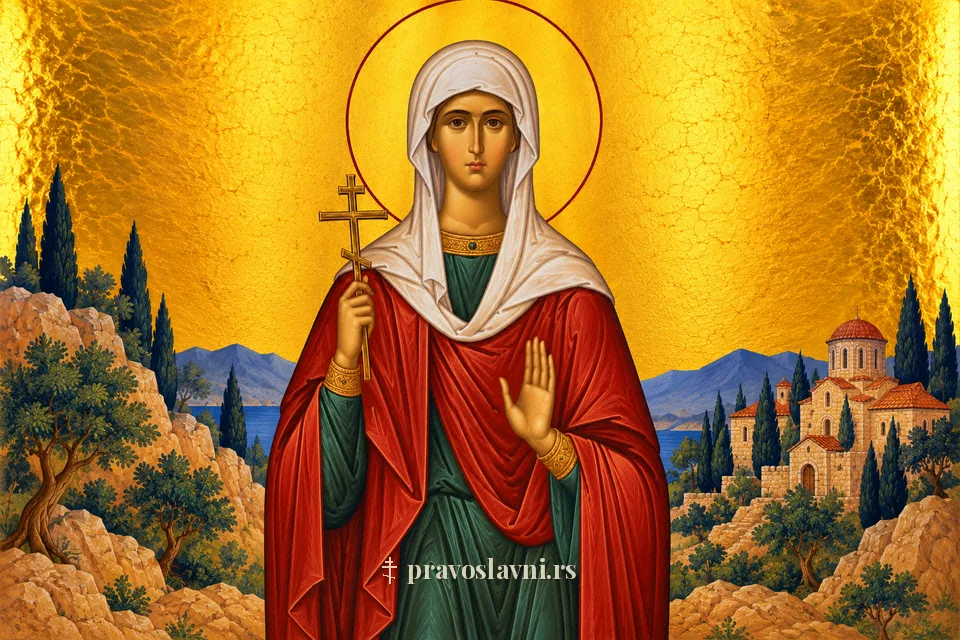
Illustration
Saint of the day
Holy Martyr Christina
What happenedThe Holy Martyr Christina, daughter of the pagan governor of Tyre, came to know God the Creator by herself and confessed Christ before her father and the judges.
“For since the creation of the world His invisible attributes are clearly seen, being understood by the things that are made, even His eternal power and Godhead, so that they are without excuse.”
— Rom 1:20
Life
Christina of Tyre found God without a teacher. The Prologue says that until her eleventh year she had not heard of Christ, and that she was led to faith by contemplating the heavens and the world: from the beauty of created things she concluded that there is one living God, the Creator. God then sent her an angel, who instructed her in the faith as a bride of Christ, and according to her Life she was baptised in the sea, in a cloud of light.
Her faith came into conflict with her own home. Her father, the governor Urban, was an idol-worshipper and, because of her beauty, kept his daughter in a tower, surrounded by statues of gold and silver. Christina broke them to pieces. In his rage Urban brought her to trial, tortured her and imprisoned her, but that same night he suddenly died. According to her Life, not even her mother could turn her away from Christ.
Nor did the judges win the victory. Of the governors who continued the trial, Dion fell down dead while he was judging her. Her Life records that she spent five days in a furnace and came out unharmed, and that her courage and her miracles in Tyre brought as many as three thousand pagans to Christ.
The Prologue says that she suffered in the 3rd century, and her body, according to her Life, was buried with honour by a relative who was a Christian. A girl brought up among idols was led to God by His creatures, and she confessed Him without fear even before her own father.
Full Life
A martyr from Tyre
Tyre remembers Christina as a girl who, having grown up among idols, brought many of her fellow citizens to Christ. Her courage and her miracles, according to her Life, converted as many as three thousand pagans. The Prologue places her suffering in the third century. The martyr's body, as her Life says, was taken by one of her relatives, himself a Christian, who buried it with honour.
God known from creation
Until her eleventh year, says the Prologue, Christina had not heard of Christ. No one taught her the faith: her signposts were the sun and the stars in the sky and the beauty of the world. Looking at them, she concluded that there must be one living God, who created everything. Her Life says that even her name is no accident: it was given by her pagan parents, but it was chosen by God.
The answer to her faith came from heaven: God sent her an angel, who instructed her in the faith as a bride of Christ. According to her Life, the angel revealed to her beforehand that she would be a martyr and gave her bread. Her Life also records her baptism: in the sea, in a bright cloud, while a voice called upon the Holy Trinity.
A struggle in her own home
The hardest trial came from her own home. Her father, Urban, the governor of Tyre, was an idolater and intended the same faith for his daughter. Since she was beautiful, he kept her at the top of a tower, with maidservants, in a chamber full of statues of gold and silver, which by his will she was to serve. Her Life says that he turned away even distinguished suitors, because he wanted to dedicate her to the gods.
Christina smashed the statues, and the gold and silver from them, according to her Life, she threw out of the chamber, so that it ended up in the hands of chance passers-by. Urban then in his anger brought her to trial, tortured her and imprisoned her. Her mother, according to her Life, begged her then to renounce Christ, and Christina answered her that she should no longer call her daughter. Her father next ordered her to be thrown into the sea with a stone around her neck, but an angel, according to her Life, saved her, and she walked upon the water. Urban resolved to put her to death the next day, but that same night he suddenly died.
A power stronger than the court
Nor did the judges after him overcome her. The trial was continued by other governors, and one of them, Dion, fell dead while he was judging her; according to her Life, before that the statue of Apollo had collapsed at her prayer. Her Life also records the miracles by which God guarded her: she spent five days in a furnace unharmed, while angels sang with her; nor did the snakes bite her.
As a child she did not know of Christ, but when she came to know Him, she confessed Him without fear, even before her own father.
Other saints of the day
Venerable Polycarp of the Kiev Caves
Venerable Polycarp was the abbot of the Kiev Caves Lavra. According to his Life, after the death of Archimandrite Akindynus the brethren chose him with one mind as their superior. He kept to the rule of St Theodosius just as it had been handed down, without additions from elsewhere. He was rich in virtues: love for God and for his neighbour, patience, meekness, mercy towards the poor, faith and love of truth. He governed the Lavra well, and his Life says that he wrote down the Lives of the saints of the Caves and the teachings of Bishop Simon. By his life and his word he influenced Prince Rostislav Mstislavich of Kiev, who repented, received Holy Communion regularly, according to the Life often with tears, and helped the poor. The prince wished to become a monk, but Polycarp, according to his Life, reminded him of the duties that a prince has. Having fallen ill in Smolensk, Rostislav set out for Kiev to receive the monastic tonsure, but he died before that. Polycarp reposed in the year 1182, according to his Life in deep old age, and was buried with the holy fathers. After his death the brethren chose a secular priest, Basil; the Prologue says that no worthy successor was found among the monks.
The memorial church in Prebilovci was built for the most part by voluntary labour, and in its crypt, after a Divine Liturgy served by Patriarch Pavle, about four thousand relics were laid. Until then the bones had lain in pits: after the war burial was not permitted, and the openings of the pits were sealed with concrete. Later the relatives opened twelve pits and carried the bones to the village. In 1992 the church was razed to its foundations, and with it about 95 per cent of the bones in the crypt were destroyed. The foundation stone for the rebuilding was blessed in 2013 by Bishop Atanasije. Prebilovci is an old Serbian village in Herzegovina, five kilometres from Čapljina, on the edge of the Neretva valley, and before 1941 it had about a thousand inhabitants. During the summer of 1941, 820 Serbs from Prebilovci were killed. In a single day alone, 6 August, between 550 and 600 women and children were killed, and 57 families died out. 170 people survived, most of them men.