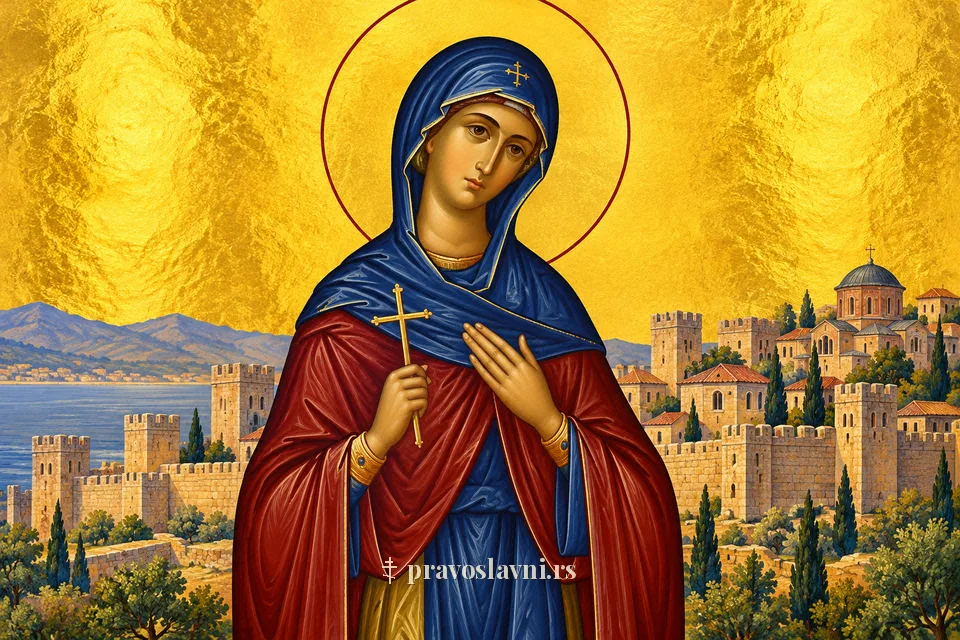
“But Peter and the other apostles answered and said: ”We ought to obey God rather than men.”“
— Acts 5:29
Life
In Thessalonica Bishop Alexander built a church to the martyr Matrona, because many miracles came from her — according to the Prologue over her grave, and according to her Life in her name, with her relics inside it. That martyr was a poor maidservant, according to the Prologue an orphan, in the house of a certain Jew.
Her mistress would not tolerate her faith in Christ: she mocked her and demanded that she renounce Christ and go to the synagogue. Matrona, according to the Prologue, did not resist in words, but in secret she went on praying to Christ and going to church. When her mistress asked her on that account why she did not go to the synagogue, Matrona, according to her Life, said to her: “Because God lives in the Christian Church, but from the Jewish synagogue He has departed.”
For this she was beaten, bound and shut up in the dark, but God set her free. Already after the first night she was found unbound, at prayer. Her Life says that this happened again after four days without food and water.
About her end the sources differ: the Prologue says that her mistress starved her to death, and her Life that she died in confinement after a severe beating. The body, which her mistress threw down from the house, the Christians buried with honour, and she herself soon fell from the same height and lost her life.
St Matrona teaches meekness and faithfulness to the end: God loosed His handmaid from her bonds and glorified her with miracles.
Full Life
A faith that was in the way
Matrona, a poor girl from Thessalonica — according to the Prologue an orphan — served in the house of a certain Jew. Her Life places her suffering in the third or fourth century. Her mistress, the Jew's wife, was troubled by Matrona's faith in Christ. Her Life gives her the name Pautila. She mocked the girl's faith and pressed her to renounce Christ and go to the synagogue, and according to her Life she often beat her as well.
Meekness as an answer
Matrona, according to the Prologue, did not resist with words. She carried out the work of the house carefully, while she prayed to Christ and went to church in secret. When this came to light and her mistress angrily demanded that she explain why she went to the church of the Christians instead of the synagogue, Matrona, according to her Life, said to her: “Because God lives in the Christian Church, while from the Jewish synagogue He has departed.”
The power of God stronger than bonds
The punishment was beatings, ropes and the darkness of a locked room. The next day, however, she was without bonds; God had set her free, and she was spending the time on her knees in prayer and in glorifying God. Her Life says that after this there came a still harder trial. After fresh beatings and tighter bonds, behind doors that were locked and sealed, she spent four days without food and water, and God sustained her. When the seals were broken, she was once again free of her bonds and standing at prayer.
Two accounts of her death
How Matrona died, the sources tell differently. According to the Prologue, her mistress shut her in twice more and in the end starved her to death. According to her Life, she beat her severely and shut her in again, and there Matrona gave up her soul to God. Her mistress then threw the dead body from the height of the house to the ground; the Christians took it up, according to her Life all bruised and battered, and buried it with honours.
Glory after death
When Alexander, the Bishop of Thessalonica, heard that the martyr was working many miracles, he built a church for her — according to the Prologue over her grave, and according to her Life one dedicated to her, in which he laid her relics. Soon the mistress too, as both sources record, lost her life: she slipped at the place from which she had thrown the body — her Life says from the roof — and fell onto the stone pavement.
St Matrona, poor and unprotected, remained meek and faithful in spite of constant pressure and torments. God loosed her from her bonds and after her death glorified her with miracles, while just punishment overtook her persecutor.