“Now I plead with you, brethren, by the name of our Lord Jesus Christ, that you all speak the same thing, and that there be no divisions among you, but that you be perfectly joined together in the same mind and in the same judgment.”
Sung at the Slava (family patron saint's feast) and on the saint's feast day.
As equal in manner of life to the Apostles and teachers of the universe, entreat the Master of all to grant peace unto the world and great mercy unto our souls.
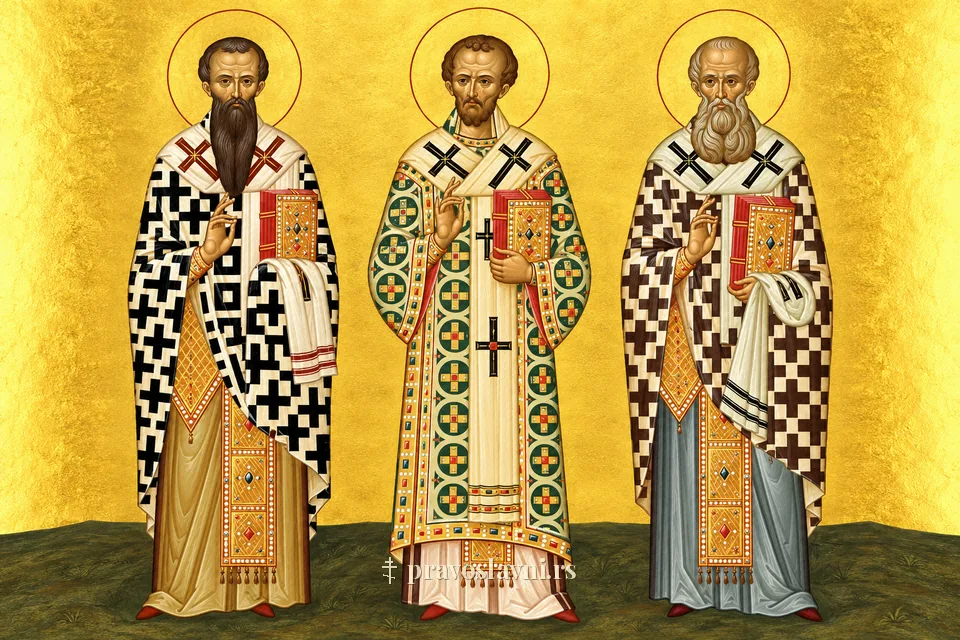
Today Basil the Great, Gregory the Theologian and John Chrysostom are celebrated together — the Three Holy Hierarchs. Each of them also has his own feast in the same month, while the common day was established only in the eleventh century, in Constantinople, in the time of Emperor Alexius Comnenus.
The occasion was a quarrel, and not even the Prologue knows where it came from. Educated and devout people in the capital could not agree which of the three was the greatest, and so the city split into three camps — according to the Prologue, into Basilians, Gregorians and Johannites. The camps differed over what was most important in each hierarch — Basil's purity and boldness, Gregory's theological thought, or John's eloquence and clarity.
Reconciliation was brought by a dream of Bishop John of Euchaita: in it he beheld all three hierarchs. Their message was clear: they are one in God and none of them is above another, and so — according to the Life — the people should put an end to the divisions on their account. They asked him for a common service and one common feast, promising, according to the Life, help on the path of salvation to all who would keep it.
The bishop obeyed and did everything they had asked. The Life says that by his standing and his word he calmed the people; he also wrote a service full of praises to the three. The day, according to the Life, was chosen in the month in which each of them already has his own commemoration. The Life also sees in the feast a lesson for those who at that time preferred to listen to the philosophers: the Church has her teachers in the holy Fathers. The Prologue records that the Greeks also celebrate it as a great national and school feast.
The Life also preserves their appearance: Basil as a tall, austere ascetic and a learned man, a bishop for eight years; Gregory as a meek theologian who lived to be more than eighty years old; John as a slight man of the greatest eloquence, who lived for sixty-three years.
This feast teaches that we do not measure the saints against one another. All three are one in God, and that is why we celebrate them together.
Full Life
A Message from a Dream
“We are one with God.” These words, which the Prologue ascribes to the three hierarchs, explain most briefly why the Church today celebrates Basil the Great, Gregory the Theologian and John Chrysostom together. Their Life also relates that in honour none of them stands ahead of another. Both sources say that there is nothing among them that would be in conflict with anything else. Their books, according to the Life, came into being at different times, but from the same inspiration of the Holy Spirit; that is why the three of them cannot be separated — the commemoration of one brings the others with it. They also sent word that the people should stop dividing over them.
The dream with these messages was given to John, Bishop of Euchaita, whom the sources remember for his learning and holiness. All three appeared to him in great glory and beauty. Their instruction was this: one service for all three and one day on which they would be celebrated together. According to the Life, they also promised that they would help on the path of salvation everyone who should keep that day.
Three Teachers, Three Gifts
Each of the three had his own admirers, and each one knew what he valued above all in his teacher. In Basil they pointed to purity of life and courage. The Life also ascribes to him an enquiring mind, which examined the nature of things, and a strictness that did not forgive easily. He was a bishop for eight years, right up to his death. The Life grants him knowledge in every field, but his deepest wisdom, the wisdom about God, it ascribes to his ascetic struggle.
Gregory's devotees valued most his theological mind, penetrating and lofty; the Life singles out his pen in particular — rich, thoughtful and never commonplace. Because of his wisdom they named him the Theologian. For several years he governed the Church in Constantinople, and he lived to be more than eighty years old.
John's supporters valued most his gift of speech and the clarity with which he explained the faith. To this the Life adds love for people, understanding for their weakness, and teaching that was both clear and pleasant. Some, according to the Life, set him against Basil as the gentle shepherd, beside whom a sinner returns to repentance more quickly. The Life calls him the most eloquent among the Greek orators and a profound interpreter of Scripture, and it says that he lived for sixty-three years.
Nor in appearance, judging by the Life, were they alike: Basil tall and pale, Gregory of medium height and with a gentle face, and John slight, with a large head.
A City Divided by Devotion
It was precisely over these gifts that a quarrel broke out. The question of which of them was the greatest divided the learned and virtuous people of Constantinople in the eleventh century. On the throne at that time was Alexius Comnenus, who, according to the Life, took power after Nicephorus Botaniates. Where the dispute began, the Prologue does not know. The Life adds that some at that time were following the ancient Greek philosophers. In any case, the supporters gathered into three parties — the Basilians, the Gregorians and the Johannites.
Reconciliation and a New Feast
Bishop John, according to the Life, did just as he had been instructed in the dream. His virtue and persuasive word brought the people to listen to him, and the discord died down. For the three of them he also composed a service in which he glorifies them abundantly. The common feast was given a day in the same month in which each of them also has his own commemoration, and the Life says that this was also the reason for such a choice.
What the Feast Tells Us
The Life sees in the feast a reminder as well: the Christians of the whole world receive their teaching from the holy Fathers. The Prologue records that for the Greeks this day is not only a church feast, but also a great national and school celebration.
Nor is it fitting for us to put the saints on the scales and divide them into greater and lesser. Whoever loves one, let him honour the other two as well, for the same Spirit led them. All three are one in God, and that is why the Church celebrates them together — as her true teachers.
Other saints of the day
Hieromartyr Hippolytus
Hieromartyr Hippolytus suffered in Rome in the time of the Emperor Claudius, in the year 269. The Prologue calls him a bishop of Rome, while his Life, in its own text, calls him a Roman priest. His Life relates that the senator and judge Censorinus, having confessed Christ, was thrown into prison, where he worked many miracles and raised a dead man to life. The soldiers who were guarding him came to believe in Christ and were all beheaded, twenty of them. At that time there also suffered for Christ Chryse, a maiden of noble birth and devout, whom they tortured long and cruelly, and the Life says that in the end she was thrown into the sea with a stone around her neck. The Life also mentions the martyr Sabinus, who after his torments breathed his last giving thanks to God. Hippolytus stood up in defence of Chryse and denounced her torturers, and according to the Life he called the governor a bloodsucker because of his cruelty. The Prologue says that after long interrogations he was condemned to death. He met his death in the sea, bound; according to the Life, the same fate was shared by the priests and deacons who were in his company. The sources interpret the number twenty differently: for the Prologue that is how many martyrs suffered together with Hippolytus and Chryse, while for the Life that is how many soldiers had been beheaded earlier. His example teaches that the courageous defence of the persecuted and faithful endurance are crowned with martyrdom.
The holy martyr Theophilus the New was born and grew up in Constantinople. He was a military commander in the time of the Emperor Constantine and the Empress Irene. His Life says that he was sent to war against the Hagarenes and that two commanders, his assistants, were envious of him. When the Hagarene fleet drew near, Theophilus put out to sea, broke in among the enemy and did them great harm. Then, according to the Life, his envious companions abandoned him and fled. Alone against a far larger Hagarene fleet, he was taken into captivity alive. He spent four years in prison. One Hagarene festival was meant to be the day of his falling away from the faith: they made him offers and they threatened him, but he did not forsake Christ, and so he was beheaded with the sword. The Prologue records that he suffered in the year 784. Theophilus teaches us that faithfulness to Christ in captivity and under pressure brings the unfading crown of martyrdom.