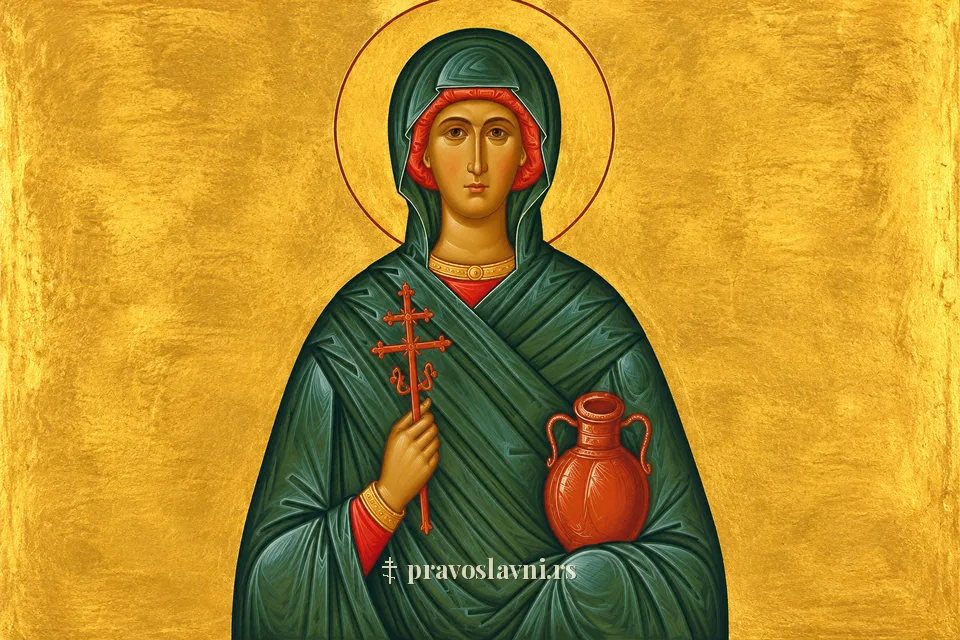
Anastasia came from a Roman senatorial house, in which her mother was a Christian and her father a pagan; from her childhood she was taught Christianity by Chrysogonus, who later became a martyr himself.
Married by her father's will to the pagan Publius, she avoided married life by feigning illness, and in secret, in another's clothes, she would go to the prisons: she paid the guards, and to the Christians she brought food and tended them. Her husband beat her for this and locked her in the house, but soon afterwards, sent by the Emperor to Persia, he perished at sea.
Free and wealthy, Anastasia distributed everything to the prisoners and the poor and remained a virgin. The Prologue records that she accompanied Chrysogonus to Aquileia, where he was beheaded because he would not renounce Christ. According to her Life, she encouraged the maidens Agape, Chionia and Irene before their martyrdom, and after their suffering she buried them. Her Life describes her as a traveller going from city to city, who brings food and medicine to prisoners, tends their wounds herself and strengthens those who are going to their death for Christ. Hence also her name, the Deliverer from Bonds — she who sets people free from fetters.
In Macedonia she worked together with the young widow Theodota, the mother of three sons. Her Life says that she wept when she found the prison empty, because all the Christians in it had been put to death in a single night. Her own faith did not remain hidden for long either, and so she was arrested. According to her Life, before the judge she confessed: “There is no place where Christ is not.” To Ulpian, the high priest, his impure intention towards her brought blindness and death. Theodota suffered with her sons in a furnace, while Anastasia was overcome neither by hunger in the prison nor by the ship in which she was meant to sink together with other condemned prisoners; her Life says that they saw Theodota steering the ship towards the shore.
In the end she finished her life in the fire, in the year 304. Her Life records that the devout Apollinaria buried her and built a church over her grave.
St Anastasia teaches us steadfast faith and trust in God alone, but above all mercy towards those who suffer and those who are in chains.
Full Life
She who looses bonds
St Anastasia did not receive the name Deliverer from Bonds on account of her martyrdom, but on account of the service she carried out before it. Her Life explains it by the fact that she took the chains off people in the prisons, obtained relief for them, healed them and strengthened those who were going to their death for Christ. This care for prisoners runs through her whole life, from her youth in Rome to her last interrogation.
A Roman home and an unwanted marriage
She came from a distinguished senatorial house in Rome, in which the faith was not one: her father remained a pagan, while her mother — Fausta, according to the Life — was a Christian. She was taught Christianity from her earliest years by Chrysogonus, himself later a martyr; the Life says that he also taught her to read and write.
Her father's will gave her in marriage to a distinguished pagan, Publius. In her marriage Anastasia feigned illness in order to avoid married life, and the Life adds that her guardian angel kept her in virginity. To the imprisoned Christians, to whom she carried food and whose wounds she washed, she came in secret: in disguise, accompanied by only one maidservant and with bribes for the guards.
Publius would not tolerate this. He beat her and locked her in the house, depriving her of food. According to the Life, in those days she wrote to Chrysogonus, asking for his prayers, and he answered that she should rely on God alone, and foretold to her that her husband would soon die. The prediction was fulfilled at sea, where Publius, sent to Persia by the emperor's order, lost his life.
From Aquileia to Macedonia
Widowhood brought her both freedom and an inheritance. Anastasia remained a virgin, and spent her property on prisoners and the poor. The Prologue records that she accompanied Chrysogonus on his journey to Aquileia, where Diocletian brought him to trial; since he did not renounce Christ, he was beheaded.
Here the Life also gives a sequel: the body and head of the martyr were hidden by the presbyter Zoilus, to whom Chrysogonus appeared after thirty days and foretold the arrest of three maidens. Anastasia came to know Agape, Chionia and Irene and encouraged them. When the maidens were put to death, Anastasia took their bodies and saw to it that they were given a worthy burial.
According to the Life, from then on she lived as a wanderer: she moved from city to city, gave the prisoners food and drink, brought them medicines, gave bribes to the gaolers, and also learned the art of medicine so as to tend their wounds herself. In Macedonia she shared this work with Theodota, a young widow from Nicaea in Bithynia, who had three sons.
The last confession
The Life also records the moment when in a single night, by Diocletian's order, every Christian who was in the prison was killed; Anastasia, finding the cells empty, wept. In the end her Christianity was discovered, and she was arrested and, according to the Life, brought before Florus, the governor of Illyricum. There she declared: “Truly, I am a Christian.” She mentioned her Roman origin and said: “There is no place where Christ is not.” To the emperor's curiosity about her fortune she answered, according to the Life, that it had all gone to the poor and that all that was left for her was to lay down her life for Christ.
The high priest Ulpian, to whom she was handed over after that, offered her, as the Life records, the choice between luxury and tortures; she chose the tortures. His impure intention towards her brought Ulpian blindness and death. Theodota, meanwhile, was put to death in a furnace together with her sons.
The two death sentences that were then devised for Anastasia did not succeed either. Condemned to starvation, she remained alive in the prison for a month, according to the Prologue, and for twice as long according to the Life, with Theodota coming to her by night. The ship on which she was put, with other condemned people, so that she would sink with it, reached the shore, by God's protection according to both sources — the Life says that Theodota steered it. According to the Life, Anastasia and Eutychian then taught the faith to the one hundred and twenty who had been saved and baptised them, and all of them were afterwards put to death.
Death found her at last in the fire; the Prologue places this suffering in the year 304. The Life adds that her body was not burnt, that Apollinaria, a devout woman, laid it in a tomb in her garden and later built a church over it, and that the relics were afterwards solemnly translated to Constantinople.
Along with steadfast faith, patience and trust in God alone, we learn from her above all mercy towards prisoners and all who suffer — and that is why we call her the Deliverer from Bonds.
Other saints of the day
St Nikephoros the Leper
St Nikephoros, in baptism Nicholas Tzanakakis, was born in the year 1890 in a village in the west of Crete; he was left early without his parents, simple and devout peasants, and grew up with his grandfather. At the age of thirteen he was learning the barber's trade in Chania, and there leprosy appeared on him. So as not to be shut away on Spinalonga, at sixteen, when the illness could already be seen, he went to Alexandria in Egypt and worked there as a barber. Chios, where in his twenty-fourth year he entered the leper colony, he chose on the advice of a priest, and the spiritual father there, Father Anthimus — today St Anthimus of Chios — tonsured him a monk after about two years and gave him the name Nikephoros. Strict fasting, obedience and work in the gardens filled his days, his nights he spent in prayer and prostrations, and among the church chanters he was the first. He wrote down the miracles of St Anthimus which he himself witnessed, and when the illness was slowly taking his sight, he chanted from memory. When the leper hospital on Chios was closed, he was moved to the leper hospital of St Barbara in Athens, badly disfigured and almost unable to move; there Father Eumenius became his disciple, a man who was cured of leprosy and stayed on to serve the sick. Many came to his cell for prayer and remembered him as a patient, gentle comforter, with the gift of discernment and clairvoyance. He passed away on 4 January 1964, and when his relics were taken from the grave about three years later, his Life records that they were fragrant; the miracles that took place through his prayers are attested by the writings of Father Eumenius. He teaches us that holiness is gained through patience in grave illness, through obedience and prayer, and that even one who is suffering himself can comfort others.
Separate page: St Nikephoros the Leper →