Saturday24July 202711 July (according to the Julian calendar)
Illustration
Saint of the day
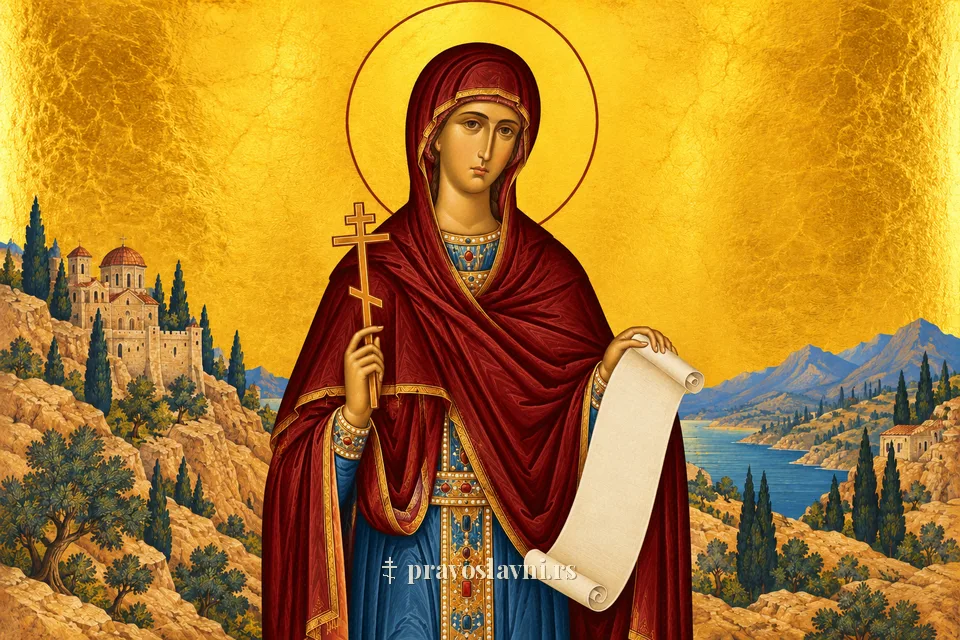
Great Martyr Euphemia the All-praised
What happenedThe miracle of the holy Great Martyr Euphemia at the Fourth Ecumenical Council in Chalcedon is commemorated, when the Orthodox confession of faith was found in her right hand.
The holy Great Martyr Euphemia, according to her Life, suffered in Chalcedon, across the water from Constantinople, in the time of Diocletian; the day of her martyrdom is 16 September (according to the Julian calendar). Today the miracle at the Fourth Ecumenical Council is commemorated.
Dioscorus of Alexandria and Eutyches of Constantinople taught that Christ has only one nature; according to her Life, their followers killed Patriarch Flavian at the robber council in Ephesus. In the year 451 Marcian and Pulcheria summoned a council in Chalcedon, which, according to her Life, sat in the church of St Euphemia, where her relics rested. Her Life says that about six hundred and thirty bishops gathered, and that every year on her feast fragrant and healing blood flowed from the relics. Patriarch Anatolius proposed that both sides should write down their confession of faith and lay it upon the relics. The coffin was placed under guard, and according to the Prologue under the imperial seal as well, and for three days all fasted and prayed. When they opened it on the fourth day, the martyr was holding in her right hand the scroll with the Orthodox faith, while the heretical scroll lay at her feet. According to her Life, those present saw that she herself was handing the Orthodox confession to the Emperor and the Patriarch. Many heretics, says her Life, returned to Orthodoxy, and the iconographers began to paint her with a scroll.
According to her Life, the Emperor Maurice doubted the miracle of the blood, but when the tomb was opened a great deal of blood flowed out, and the Emperor repented. Under Heraclius the relics were translated from Chalcedon to Constantinople, to her church by the Hippodrome. The iconoclast Leo the Isaurian ordered them to be thrown into the sea, but the coffin miraculously reached Lemnos and was laid in the church of St Glyceria; according to her Life, it was found at sea by two brothers who were shipowners, Sergius and Sergonus. Under the Empress Irene the relics were returned to Constantinople. Her relics gave forth blood, by which the sick and the afflicted were made well.
In this way God confirmed the true faith through His martyr: the dispute at the council was settled by prayer, by fasting and by a miracle at her relics.
Full Life
The martyr from Chalcedon
According to her Life, St Euphemia was born, brought up and suffered in Chalcedon in Bithynia, across the water from Constantinople, in the time of Diocletian. The day of her martyrdom is 16 September (according to the Julian calendar). Today we remember the miracle that took place at the council in Chalcedon, in the church where her relics rested.
The heresy and the council
Dioscorus of Alexandria and Eutyches of Constantinople taught that Christ has only one nature. According to her Life, at the Robber Council in Ephesus their supporters killed Flavian, Patriarch of Constantinople. After the death of Theodosius the Younger, Marcian and Pulcheria summoned the Fourth Ecumenical Council in Chalcedon in the year 451. Her Life says that about six hundred and thirty bishops gathered, among them Anatolius of Constantinople, Juvenal of Jerusalem and the legates of the Pope of Rome.
According to her Life, the council sat in the church of St Euphemia near Chalcedon, where her relics rested. Every year on her feast blood flowed from the relics, fragrant and healing.
The scroll in her right hand
Patriarch Anatolius proposed that both sides should write down their confession of faith and lay it on her relics. They then closed the reliquary and set a guard, and the Prologue adds that the imperial seal was placed upon it. For three days everyone fasted and prayed. When they opened it on the fourth day, the martyr was holding the scroll with the Orthodox faith in her right hand, and the scroll of the heretics lay at her feet. According to her Life, those present saw her raise her hand herself and give the Orthodox confession to the Emperor and the Patriarch. Many heretics returned to Orthodoxy, and iconographers began to paint her with a scroll in her hand.
Relics that heal
According to her Life, Emperor Maurice doubted the miracle of the blood and sealed the tomb; when it was opened, a great deal of blood flowed out and the Emperor repented. When the Persians invaded the land in the time of Heraclius, they tried to open the tomb, and then to burn it, but it remained undamaged. In the time of Heraclius her relics were translated from Chalcedon to Constantinople, to her church near the Hippodrome.
The iconoclast Leo the Isaurian ordered the relics to be thrown into the sea; her Life says that this was done secretly, by night, and that other bones were put in their place. The reliquary miraculously reached Lemnos and was laid in the church of St Glyceria. According to her Life, the reliquary was found at sea by two brothers who were shipowners, Sergius and Sergonus. On Lemnos Euphemia appeared to them and asked to remain there, and they built a small church and lived the ascetic life beside it.
In the time of Empress Irene the relics were returned to their place in Constantinople, according to her Life after the Seventh Ecumenical Council, under Patriarch Tarasius. Even then her relics gave forth blood, from which the sick and the afflicted recovered.
Other saints of the day
St Olga of Russia, Equal-to-the-Apostles
St Olga was born, according to her Life, in the village of Vybuty near Pskov. Her Life also tells that Prince Igor met her there, that she rebuked him for an unseemly word, and that he later took her as his wife. She was the wife of Prince Igor and the mother of Sviatoslav. According to her Life, after Igor was killed she ruled in place of her son, who was still a minor, justly and mercifully, and she did not marry again. Her Life says that she travelled to Constantinople to come to know the Christian faith, that she was received by the emperor and the patriarch, and that she refused the emperor's proposal of marriage. She was baptised in Constantinople and received the name Helen: according to the Prologue she was baptised by Patriarch Polyeuctus, and according to her Life the emperor was her godfather. According to her Life, the patriarch gave her a cross, icons, books and clergy to take with her to Russia. Her Life tells that at the place where the Pskova flows into the River Velikaya a light in three rays appeared to her, and that she foretold that a church of the Holy Trinity and a city would stand there, and in Kiev she built a church of St Nicholas. Her son Sviatoslav, says her Life, refused baptism, fearing that his retinue would abandon him. The Prologue remembers her for her great zeal for Orthodoxy in Russia. According to her Life, before her death she asked for a Christian burial, without pagan rites; she reposed, according to the Prologue, in the year 969, and according to her Life on 11 July (according to the Julian calendar). According to her Life, her grandson Vladimir was baptised about twenty years after her death, as she had foretold, and translated her incorrupt relics to the Church of the Tithes, where healings took place at her tomb.