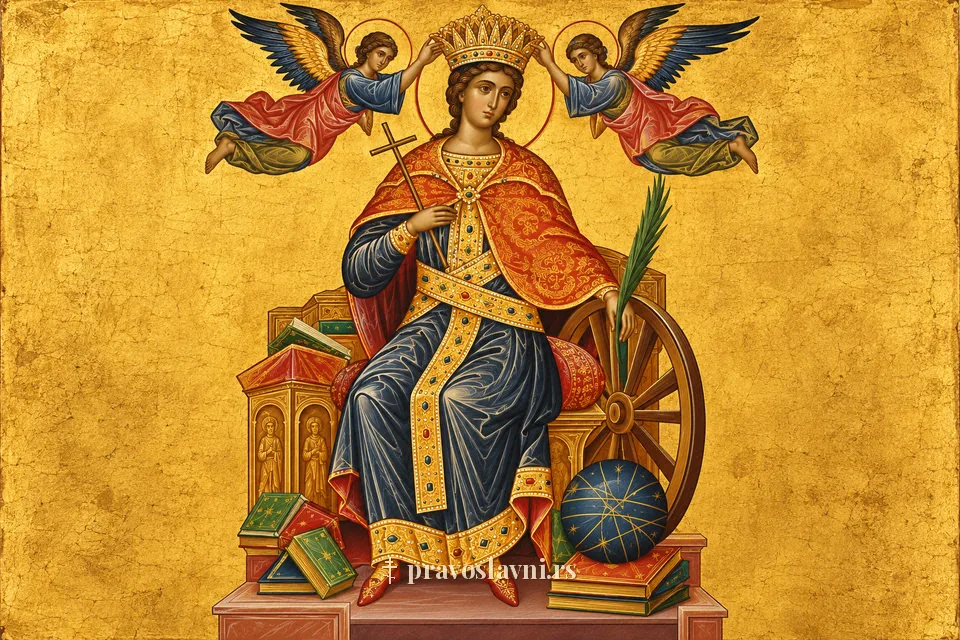
The holy Great Martyr Catherine was the daughter of a ruler and lived in Alexandria. She was tall and of rare beauty, and before she had turned eighteen she spoke many languages and knew philosophy, medicine and the art of oratory. Her mother was a Christian, but she kept her faith hidden, because Christians were being persecuted at that time.
There were many suitors, but Catherine, as her Life records, wanted a husband who would not fall behind her either in wisdom or in beauty, either in birth or in wealth. Her mother took her to her own spiritual father, a hermit outside the city, who, according to the Life, spoke to her about Christ as the true Bridegroom. While she was still a pagan, according to the Life, Christ in a vision would not even show her His face. When she accepted the faith and was baptised, in a new vision He betrothed her as His bride and gave her a ring.
When the emperor (her Life calls him Maximinus, and the Prologue Maxentius) came to Alexandria and ordered everyone to offer sacrifices to the idols, Catherine went into the temple and stood up to him in front of them all. To his praises of her beauty she replied, according to the Life: “I am earth and clay.” The emperor brought out against her fifty of the most learned philosophers, but she silenced them in the debate. Condemned to the pyre, the wise men, thanks to her prayer, confessed Christ even before their execution. The Life records that many pagans came to believe at that time.
While she was in prison, Empress Augusta, the commander Porphyrius and two hundred of his soldiers came to believe through her words. The device with wheels and spikes, according to the Prologue and the Life, was shattered by an angel before it could do her any harm. Porphyrius and the soldiers suffered for Christ, and the Life says that the empress was put to death as well. In the end Catherine was beheaded, after she had, according to the Life, refused even the emperor's last offer of marriage. Both sources record that it was not blood that flowed from her wound, but milk. Angels carried her relics to Mount Sinai, where they rest to this day.
Catherine teaches us that true wisdom and beauty come from the knowledge of Christ. Her faithfulness unto death brought many to the faith and showed that faith overcomes even the greatest earthly power.
Full Life
A king's daughter without equal
Catherine was the daughter of a ruler whom her Life calls Constus and a lesser king, and the Prologue Constas, and she lived in Alexandria in the time of the pagan Emperor Maximinus (the Prologue calls this emperor Maxentius). Tall and of rare beauty, before she had reached the age of eighteen she knew many languages and was versed in the philosophy of the Greeks, the art of medicine, rhetoric and logic; her Life also records that she knew Homer, Aristotle, Plato, Asclepius, Hippocrates and Galen.
She had no lack of suitors from rich and distinguished houses, but to all of them, as her Life relates, she gave the same answer: she would marry only a man who was not inferior to her either in wisdom or in beauty, either in wealth or in birth — and such a man her relatives could not find. Her mother was a Christian, but she hid her faith because of the persecution. She took her daughter to her spiritual father, a holy hermit who lived outside the city.
The Bridegroom Who turned His face away
The elder, according to her Life, spoke to her of Christ as the true Bridegroom, born of a Virgin without an earthly father, and the Virgin is venerated by the angels. He gave her an icon of the Theotokos with the Child and told her to pray before it, and she would receive a vision.
According to her Life, in the first vision the Queen of Heaven appeared to her with the Infant, but all three times the Infant turned His gaze away from her. When His Mother entreated Him on her behalf, the Infant replied that Catherine, as long as she was a pagan, was in His eyes dark, ugly, foolish and poor, and that she would come to see Him only when she obeyed the elder.
She went back to the elder, learned the whole faith from him and was baptised. In the second vision Christ, now joyful, called her beautiful, wise and rich, and said, as her Life relates: “Behold, today I take you as My bride, immortal and eternal”, and gave her a ring. When she awoke, the ring, according to her Life, was on her right hand. The Prologue affirms that she wears it even in our own time.
Before the emperor and fifty wise men
The emperor came to Alexandria for a great festival of sacrifice to the idols and ordered everyone to offer sacrifices. Catherine went to the temple and publicly opposed him. Her Life says that, appealing to Diodorus of Sicily and Plutarch of Chaeronea, she proved that the pagan gods had once been ordinary men, and preached the one true God Who became man. When the emperor praised her beauty, she replied: “I am earth and clay.” Her beauty, she said, had been given to her by God in order to show His wisdom.
The emperor then summoned against her fifty of the most learned pagan philosophers and orators, to overcome her in debate. Before the debate, as her Life says, the Archangel Michael appeared to her and promised her wisdom, victory and that many would become martyrs. According to her Life, the chief philosopher cited Homer and Orpheus as proof that the gods are immortal. Catherine showed him that Homer himself describes Zeus being deceived and bound by Hera, Poseidon and Athena. Their leader had nothing to answer, and the others gave up the debate.
Because of this the emperor in his anger sent them to the stake, but the wise men, thanks to Catherine's prayer, confessed Christ even before their execution and asked her to pray for them. Many pagans came to believe, as her Life says, when they saw that the fire had harmed neither the bodies of the wise men nor even their hair.
The prison, the wheel and the crown
Her Life goes on to tell that the emperor offered her a share of the empire and marriage if she would offer sacrifice to Hermes, and when she refused, she was scourged and thrown into prison without food or water. To the Empress Augusta, according to her Life, Catherine appeared in a dream and gave her a golden crown, which, as she said, Christ was sending her. The empress secretly visited her with the commander Porphyrius and two hundred soldiers, and Catherine converted them all to Christ. Her Life says that in prison she was fed by a dove which Christ sent, and that Christ Himself also appeared to her with angels and said: “Do not be afraid, My beloved bride.”
The courtier Chursaden proposed a device of four wheels set with spikes. The Prologue and her Life record that the device had no time to harm her: an angel loosed her from it and shattered the wheels. Her Life says that Augusta publicly rebuked the emperor and was beheaded, and that then Porphyrius and the soldiers also confessed Christ before the emperor and were put to death. The emperor, according to her Life, offered Catherine pardon and marriage for the last time, but she prayed that Christ would receive her soul, and she was beheaded with the sword. Both sources record that it was not blood that flowed from her wound, but milk. The Prologue states that this was in the year 310, in the eighteenth year of her life. Angels carried her relics to Mount Sinai, where they rest to this day and work miracles.
Catherine found true wisdom and beauty in Christ, and her faithfulness unto death brought philosophers, an empress and soldiers to the faith.
Other saints of the day
Great Martyr Mercurius
St Mercurius was a soldier in the Martenses regiment from Armenia, in the time of the Emperor Decius. The Prologue and his Life tell that in the war with the barbarians an angel handed him a sword and promised him victory. The victory was complete — the barbarian king also fell — and so Decius placed Mercurius at the head of the whole army. His Life says that the angel reminded him that same night to remember God and to be ready to suffer for Him, and he remembered the faith of his father Gordian and repented in tears. When he was summoned to offer sacrifice in the temple of Artemis, he withdrew, and he was denounced as a Christian — according to his Life by the courtier Catulus, and according to the Prologue by envious men. He declared before the emperor that he had won the victory by the power of Christ, and in front of him he cast off his belt and his commander's robe, and his Life also records his cry: “I am a Christian, hear me, all of you! I am a Christian!” After severe tortures he was thrown into prison, where an angel restored his health, and the next day before Decius he ascribed his healing to Jesus Christ. He was taken for execution to Caesarea in Cappadocia, where the Lord appeared to him and told him that his struggle was finished. He was beheaded, and the Prologue records that this was between the years 251 and 259. At his relics the sick were later healed, and straight after the execution many were brought to the faith by the fact that his body turned white and gave off a fragrance. His Life also ascribes to him a miracle after his death: at the hour when Julian the Apostate, in the war with the Persians, fell by the spear of an unknown soldier, St Basil the Great, praying before an icon, saw the figure of Mercurius vanish and come back with a bloodstained spear. Thus the brave soldier, who preferred the Heavenly King to earthly glory, remained a fighter for the Church of Christ even after his death.
Separate page: Great Martyr Mercurius →