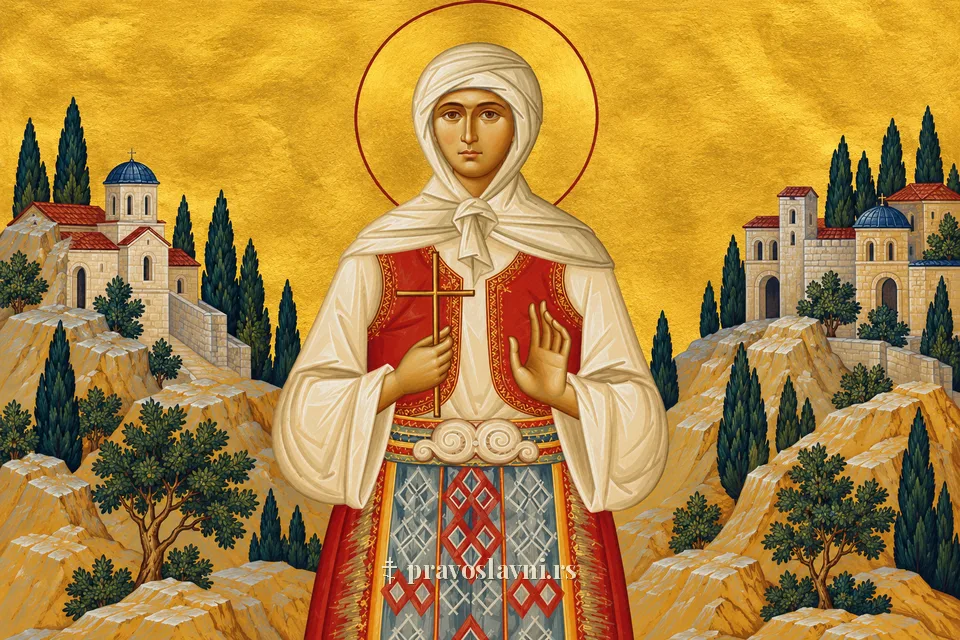
“He who loves father or mother more than Me is not worthy of Me. And he who loves son or daughter more than Me is not worthy of Me.”
— Mt 10:37
Life
St Zlata lived at the end of the eighteenth century in the village of Slatina, in the Meglen region, while those parts were under the Turks. She was one of the four daughters of poor peasants. The Prologue praises her meekness and piety, and her Life her beauty as well. That beauty attracted a certain Turk, who made up his mind to get hold of her. According to the Prologue, they seized her on the way to fetch water, and according to her Life in the forest, while she was gathering firewood with other women.
They demanded that she renounce her faith and go with her abductor as his wife. Zlata, according to the Prologue, gave an answer from which she did not depart to the end: “I believe in Christ, and Him alone I know as my Bridegroom.” Neither gifts nor months of persistent persuasion, according to her Life, made her waver.
Then it was the turn of those dearest to her. The Turks brought her parents and sisters and threatened that they too would suffer. According to the Prologue, her relatives begged her in tears to do what was asked at least in words, and so save both herself and them. That was perhaps the hardest thing of all. But Zlata knew to whom she belonged. Whoever draws her away from Christ, she told them, is no longer her kin: “you are no longer my parents nor my sisters.” Her family was now in heaven.
There followed, according to the Prologue, three months of prison and daily torture, but God kept giving her strength. Her Life says that she did not pray for deliverance. When she heard that Father Timothy, her father's spiritual father, was in the village, she sent him only one message: let him pray that she might endure to the end in the way that is pleasing to God.
At last, according to the Prologue, she was hanged on a tree. The Prologue gives the year as 1796, and her Life October 1795. The faithful buried her in secret, and, according to the Prologue, they carried particles of her relics to their homes as a blessing.
St Zlata teaches us that for the sake of Christ one must sometimes say “no” even to those we love the most. Whoever remains with Him, God does not leave without strength.
Full Life
Beauty that brought trouble
In the village of Slatina, in the Meglen region, which was then ruled by the Turks, there lived at the end of the eighteenth century a poor peasant family. Four daughters were growing up in the house, and Zlata was one of them. The Prologue praises her meekness and piety. The Life also mentions her modesty and purity, and especially her beauty. It was precisely that beauty that brought her trouble.
A Turk from the neighbourhood set his eye on her and waited for his chance. The sources do not agree about where she was seized. According to the Prologue, it happened while she was going to the spring, and according to the Life in the forest, where she was gathering firewood with other women. The outcome is the same: the girl was taken by force to a stranger's house.
The only Bridegroom
Her abductor wanted two things: that she renounce her faith and that she marry him. The Life says that he offered much, and threatened even more. The Prologue preserves Zlata's answer in her own words: “I believe in Christ, and Him alone I know as my Bridegroom.” She added that she would not depart from Him, whatever they might do to her.
When force did not succeed, they tried patience. According to the Life, for half a year the women of that house tried to persuade her in every possible way. They told her about a comfortable life, tempted her with gifts, and made use of cunning as well. Zlata did not give in. Six months is a long time, and yet her heart did not move by a hair's breadth.
When the dearest ones plead
The hardest temptation did not come from her enemies. The Life says that the Turks brought her parents and sisters and set them a condition: if they did not persuade her, she would lose her head, and torture and the loss of their property awaited them. The Prologue describes a scene full of tears. Her relatives begged her to give in at least outwardly and say what was being asked of her, and then all of them would be spared. God knows what is in the heart, they thought, and He will understand. It is hard to imagine a worse torture than the tears of one's own mother.
Zlata loved them, but she knew to whom she belonged. If they were asking her to betray Christ, she told them, then “you are no longer my parents nor my sisters.” According to the Prologue, she also told them that she now had another, heavenly family.
Prison and prayer
There followed, according to the Prologue, three months of prison. They tortured her every day, even with smoke. But God did not abandon Zlata. Where did she find such endurance? The Life answers by referring to St Symeon Metaphrastes: when the heart is given over to God, pain loses its power over it, and joy remains. A girl who had nothing at all proved stronger than all those who tortured her.
She did not ask to be rescued. The Life says that she learned that Father Timothy was in the village, her father's spiritual father and the pro-abbot of the Monastery of St Nicetas on the Holy Mountain. Her message, which a Christian carried to him, was not a cry for rescue. She asked for prayer that she might bring her struggle to its end in the way that is pleasing to God. The prayer, according to the Life, was heard.
A double crown
In the end, according to the Prologue, they hanged her from a tree. The Life sees a double victory in her death: she preserved her purity, and she sealed her faith with her life. The sources differ about the year: the Prologue gives 1796, and the Life October 1795. The faithful, hiding from the Turks, took her body and laid it in a grave with reverence. The Prologue adds that they carried particles of her relics to their homes, to be a blessing for them.
Zlata shows us that for the sake of faithfulness to Christ one must sometimes say “no” even to those whom we love the most. It is not an easy lesson. Her story is not a story about a hard heart, but about a heart that loved more than can be seen from the outside. But whoever stays with Christ is not alone: He gives him strength and a new family.
Other saints of the day
Holy Martyrs Carpus and Papylus
Under the Emperor Decius there suffered Sts Carpus, Bishop of Thyatira, and Papylus, his deacon, both of them, according to the Prologue, natives of Pergamum. The governor Valerius, who had a name for cruelty, led them as prisoners from Pergamum to Sardis and back, tied to horses, and tortured them without mercy. But God did not leave them to themselves: according to the Prologue, He sent them an angel, from whom they received both healing and strength. Carpus's faithful servant Agathodorus also stayed with them to the end, and he too suffered. Carpus, says the Prologue, had joy on his face under torture, for it was given to him to see heaven and the Lord in glory. Nor did Papylus think of himself: he prayed for a half-blind man, who received his sight, and many came to believe because of it. Neither wild beasts nor fire overcame them, and in the flames they were joined by Papylus's sister Agathonica, who entered there of her own will; according to the Prologue, the fire did no harm to any of them. They were all beheaded in the year 251. Their example shows that joy need not disappear even in the greatest trouble, if a person's gaze is turned towards heaven.
St Bosiljka Rajičić was born in Pasjane near Gnjilane, in a poor and devout Serbian home. Her Life, which was published by the Diocese of Raška and Prizren, remembers her as a hard-working and quiet girl, devoted to her home and to prayer. It was autumn, and Bosiljka was cutting wood for the winter with her father and brother when three armed Arnauts (Albanians) attacked them; they shot at the men and carried off the girl. In vain her relatives and the village priest sought justice in Gnjilane for days, for the authorities were in no hurry. In captivity Bosiljka was pressed with threats, without water and without sleep, to change her faith and marry her abductor. Not even the words of a woman who had once changed her faith herself could move her: Bosiljka knew that she already belonged to Christ. Since they did not succeed, they took her up along the Lapušnica and killed her there. According to her Life, before her death she prayed: “My God, keep me to the end; do not let me give way.” She rests in Pasjane: at first she was buried beside the old church, and later her relics were built into the church itself. The Serbian Orthodox Church numbered her among the saints in 2018, and her life teaches us that faith is worth more than life itself.