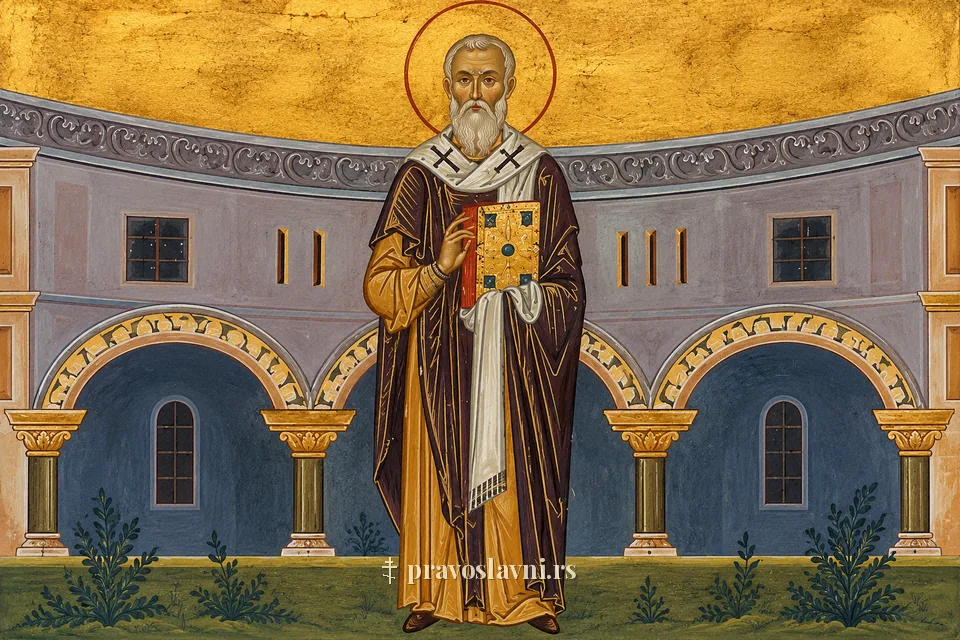
St Amphilochius of IconiumCommemoration: 6 December 2026 · 6 December 2027
Commemoration in our calendar
Sunday, 6 December 2026fast, fish allowed · Sunday — a festive day · 23 November (according to the Julian calendar)
Monday, 6 December 2027strict fast (no oil) · 23 November (according to the Julian calendar)
Sunday06December 202623 November (according to the Julian calendar)
Illustration
Saint of the day
St Amphilochius of Iconium
What happenedSt Amphilochius bowed to the Emperor Theodosius but did not greet his son Arcadius, to show the Emperor that God the Father does not tolerate dishonour shown to the Son.
“Fight the good fight of faith, lay hold on eternal life, to which you were also called.”
— 1 Tim 6:12
Life
St Amphilochius was born in the fourth century in Caesarea in Cappadocia, and his Life says that his father, also called Amphilochius, was the brother of Nonna, the mother of Gregory the Theologian. Basil the Great and Gregory the Theologian were his close friends and exchanged letters with him. While still young, he gave up the work of a rhetorician and advocate for the life of a hermit in a cave, where he spent four decades in prayer, fasting and the reading of the Scriptures.
He became the shepherd of Iconium, as both sources say, in a miraculous way. His Life says that for three nights an angel appeared to him and called him into the city. Twice he refused, fearing a deception of the evil one, and proposed that the two of them should stand in prayer. On the third night the angel led him into a church full of light, where he was consecrated a bishop. The bishops whom he met on the road, seven of them, simply kissed him and led him to his throne, without a new ordination.
As a bishop he was an opponent of the Arians and of Eunomius, and the heretics persecuted him for that. At the Second Ecumenical Council, in the year 381, he stood against Macedonius and the supporters of the Arians. Theodosius the Great did not agree to his request that the Arians be forbidden to hold assemblies. So the bishop gave him an unusual lesson: in the palace he paid honour only to the emperor, while he left his son and co-ruler Arcadius without a greeting, so that the offended Theodosius had him led out. Then Amphilochius said to him: “do you see, O Emperor, how you cannot bear the dishonouring of your son”, and added that “in the same way God the Father does not endure the dishonouring of His Son”. About the outcome the sources speak differently: according to the Prologue, the emperor recognised wisdom in the lesson, and according to the Life, he apologised and ordered that the Arians be driven out of all the cities.
The Life also mentions healings of the sick through his prayer. A peaceful death came to him in deep old age, in the year 395 according to the Prologue. His memory is celebrated on 23 November by the Julian calendar, that is, on 6 December by the Gregorian calendar.
St Amphilochius teaches us obedience to God's call and a wise, bold zeal for the true faith.
Full Life
A bow to the emperor alone
St Amphilochius of Iconium is remembered for the lesson which, almost without words, he gave to Emperor Theodosius the Great about the honour that belongs to the Son of God. Before that day, however, the bishop had travelled a long road.
From Caesarea to a cave
His Life records that Amphilochius was born in the fourth century in Caesarea of Cappadocia, the son of a scholar of the same name, a devout and eloquent man, whose sister Nonna was the mother of Gregory the Theologian. The Prologue counts Amphilochius among the kinsmen and friends of Basil the Great, and his Life says that both Basil and Gregory kept company and exchanged letters with him.
He spent his youth as a rhetorician and an advocate in the courts, but, on the advice of Gregory the Theologian, as his Life says, he turned his back on the world very early. The next four decades belonged to the desert: a cave was his home, and fasting, prayer and the Scriptures were his daily life.
The call to Iconium
His Life says that when John, Bishop of Iconium, died, an angel appeared to Amphilochius on three nights. He called him to go to the city and tend the flock. Amphilochius refused twice, because he feared that this was a deception of the evil one. So he proposed: “If you are an angel of God, then let us both stand at prayer”. On the third night, according to his Life, the angel led him to a nearby church whose doors opened of themselves; in the light which he found there the Gospel was handed to him, and there he was consecrated Bishop of Iconium. With the angel he sang the Thrice-Holy Hymn, the words of the Prophet Isaiah about God Who is Holy, Holy, Holy. Both sources, the Prologue and his Life, ascribe his election as bishop of the vacant see of Iconium to a miracle.
His Life goes on to say that on the road he was met by seven bishops who were looking for a new bishop. Once he had told them what had happened, their part came down to greeting him with a kiss and leading him to the throne; a new consecration was not needed.
Wisdom before the emperor
He began his service as bishop, according to his Life, under the Emperors Valentinian and Valens, and continued it under Theodosius the Great and his sons. The Arians and Eunomius had an opponent in him, and for that reason the heretics persecuted him. At the Second Ecumenical Council, in the year 381, he spoke out against Macedonius and the bishops who were inclined to Arianism.
His request that the Arians be forbidden to gather in the cities was not accepted by Theodosius, because, according to his Life, he was afraid of appearing to be a tyrant. The next time he found himself before the emperor, the bishop paid honour to Theodosius alone, while Arcadius, who was sitting beside his father, he deliberately passed by. To the emperor's reproach he replied that he had already paid the ruler the honour that was due and that this was enough, and Theodosius angrily ordered him to be led out.
Only at the door did Amphilochius explain what he had meant: “do you see, O Emperor, how you cannot bear the dishonouring of your son”, and “so too God the Father does not suffer the dishonouring of His Son”, but turns away from those who blaspheme Him. The emperor's reaction differs in the sources: according to the Prologue, the message reached the emperor, who recognised the wisdom in it, while according to his Life, he apologised to him and ordered the Arians to be driven out of all the cities.
A shepherd into deep old age
The Messalian heresy, which was spreading through Lycaonia, found an opponent in him, and his Life says that he was also among those who took part in the council at Side in Pamphylia, which condemned it; it also mentions healings of the sick through his prayer. The Prologue also ascribes to him writings on the faith. A peaceful death came to him in deep old age, and the Prologue gives the year 395. His memory is celebrated on 23 November according to the Julian calendar, that is, 6 December according to the Gregorian calendar.
St Amphilochius obeyed God's call, although at first he feared a deception of the evil one. And when the truth had to be defended, he was wise and bold. By one simple act he taught the emperor that the Son must be honoured equally with the Father.
Other saints of the day
St Gregory
St Gregory was born in Sicily, in the neighbourhood of Agrigentum, into the family of Chariton and Theodotia; his Life says that his godfather was Bishop Potamion and that at the age of twelve he became a cleric. He reached Jerusalem, where Patriarch Macarius ordained him deacon, in a miraculous way, according to both sources, and his Life adds that an elder of the desert, with whom he spent four years, foretold to him that he would suffer at the hands of envious men. In Constantinople he was held in esteem by Patriarch Eutychius, and at the Fifth Ecumenical Council, in the time of the Emperor Justinian, he defended Orthodoxy. When the see of Agrigentum fell vacant, in Rome, according to both sources, a dove alighted on his head while he was at prayer, and the pope consecrated him Bishop of Agrigentum. Because of the slander of two priests, Sabinus and Crescens, who hid a bribed harlot in his room, he ended up in prison, and then, in chains, in Rome, where he waited with the pope for two and a half years to be tried. His Life says that even in prison he healed the gaoler's son and a lame girl. The false witness, who was brought before the council out of her mind, admitted to the bribe only after Gregory's prayer had healed her. God's punishment, according to both sources, also overtook the slanderers, who were afterwards banished, while Gregory returned to Agrigentum with great honours and built a new church of the holy Apostles Peter and Paul. He reposed in peace in old age, at the turn of the sixth and seventh centuries, and his life bears witness that God defends the innocent and exposes falsehood.
Devout from childhood, St Alexander, the son of Prince Yaroslav, became, according to his Life, Prince of Novgorod in the year 1236. Before the battle, as his Life records, he said to his soldiers: “God is not in might but in truth”, and he bore the name Nevsky after the River Neva, where on 15 July 1240 he defeated the Swedes. Both sources record that help in that struggle was promised to him by his holy kinsmen, Boris and Gleb, in a vision granted to one of his commanders. From the year 1250, as Grand Prince of Vladimir, he laboured to restore the Russian land under the Tatar yoke, and in the Golden Horde he did not consent to the pagan rites that were demanded of him; to the khan, his Life says, he said: “I am a Christian, and I do not bow down to created things”, promising him the honour that a ruler deserves, but worship to God alone. Batu, as his Life calls the khan, respected him, and both sources give as the reason his wisdom, courage, strength and beauty. He is remembered for the many churches he built and for his generous almsgiving, and according to his Life he ruled for twenty-seven years and before his death became a monk with the name Alexis. He reposed on 14 November 1263, in the 43rd year of his life. His Life says that he was buried in the Monastery of the Nativity of the Most Holy Theotokos in Vladimir, that the departed took into his own hand the prayer of absolution which the metropolitan held out to him, and that his relics were found in the year 1381, while Peter the Great translated them in 1724 to Petrograd, to the Alexander Nevsky Lavra. His life shows that faith and truth are worth more than might.