Sunday20December 20267 December (according to the Julian calendar)
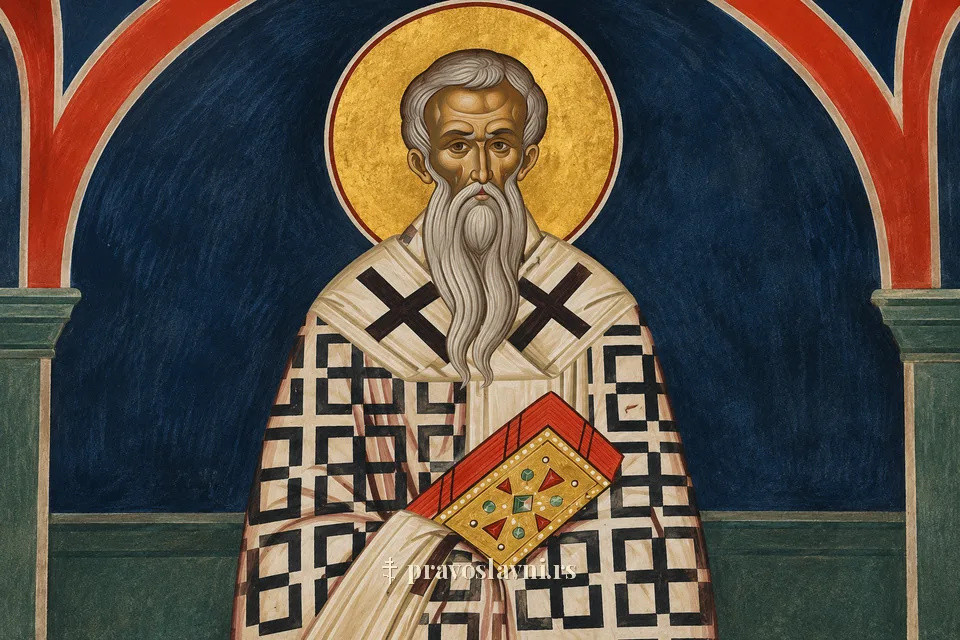
Illustration
Saint of the day
Detinjci — Children's Day (third Sunday before Christmas)
St Ambrose
What happenedA little child in the church of Milan cried out “Ambrose — bishop!”, and the people with one voice chose the governor, who was not yet baptised, as their shepherd.
“Assuredly, I say to you, unless you are converted and become as little children, you will by no means enter the kingdom of heaven.”
— Mt 18:3
About this day
Detinjci (Children's Day) is the third Sunday before Christmas and the first of the three family feasts before Christmas, after which come Materice (Mothers' Day) and Oci (Fathers' Day). It is recorded in the calendar under this name, and the form Detinci is also found. All three days belong above all to the home and the family: the mistress of the house then prepares a festive lunch, at which the whole family gathers.
By folk custom, early in the morning, before or after the church service, the adults tie up their own or other people's children. A belt, a plaited cord, ordinary string or thicker thread is used, the children's feet or hands are tied, and the end is fastened to a table or chair. The custom ends with a ransom and small gifts, and often it is enough just to show the string. Among the Serbs gifts are, in general, not exchanged on Christmas Day itself, but on these Sundays before it.
The little string with which the children are tied is a reminder of the bond founded in the Heavenly Father and His commandment to honour our parents. The tying also shows how important it is for the family to be bound together and in harmony, and for its members to help one another. Through this custom the members of the household learn to keep what they have and to be steadfast in good, and all are reminded that a person ransoms himself before the Last Judgement with good deeds and with what has been honestly earned.
Detinjci falls in that part of the Nativity Fast when Sunday is a day on which fish, oil and wine are allowed. For more on fasting on this day, see the guide “Fasting — simply explained”.
Life
Milan was divided: after the death of the Arian bishop Auxentius, the Orthodox and the Arians could not agree on who should succeed him. To calm the people, the governor Ambrose himself, a renowned orator, came into the church — and then a child's voice was heard: “Ambrose – bishop!” That cry brought both sides into agreement, even though the one chosen had not yet even been baptised. His Life records that for a long time he fled from this ministry, but in the end he was baptised and on the eighth day consecrated bishop.
He was the son of an imperial governor, and his mother was a Christian. The Prologue and his Life remember the bees above his cradle, in which his father saw a foretelling of his son's greatness, and his Life also remembers his childhood saying that he too would be a bishop.
As a shepherd he gave away his wealth, lived in fasting and prayer, wrote books and defended the true faith, so that his wisdom was heard of far and wide. His Life also mentions five books on the faith which he wrote for Emperor Gratian on the eve of the war with the Goths, in which the emperor was victorious.
To the powerful he did not yield. When the Arian Empress Justina wanted the cathedral church for the Arians, his Life says that he refused her. Emperor Theodosius, after the massacre in Thessalonica, had to repent publicly before Ambrose would admit him into the church again.
The Prologue and his Life bear witness to his miracles and clairvoyance. The relics of the martyrs Protasius and Gervasius, which he discovered, restored sight to the blind Severus.
Not even when the general Stilicho begged him to obtain a longer life for himself by prayer did he do so, for he had no fear of death. As his successor he approved the priest Simplician. His last vision before death was of Christ; he received Holy Communion and on 4 April 397, on the eve of Pascha, he fell asleep, and he was buried in Milan.
St Ambrose teaches us that God calls His chosen ones even when they resist it. A true shepherd speaks the truth to the powerful as well, and to every person, even to an emperor, he opens the path of repentance.
Full Life
A Sign in the Cradle
Ambrose came from a distinguished house in which the pagan and the Christian worlds met: his father, an imperial governor, was not a Christian, while his mother was. The first sign was seen while he was still in the cradle, and both the Prologue and his Life record it: in the bees that settled on the baby and left honey upon him his father saw a foretelling of greatness, if the child should live, and so he would not let them be driven away. His Life sees in this a foretelling of his speech, sweet as the honeycomb in the Proverbs of Solomon.
According to his Life, after his father's death his mother brought him up in Rome, with his brother Satyrus and a sister who dedicated her life to God in virginity. While still a boy he foretold, when those of the household rebuked him, that he too would be a bishop.
From Governor to Bishop
Rhetoric opened the way for him: he became renowned as an orator and defended those to whom injustice was done. According to his Life, the prefect Probus first had him as an adviser, and then entrusted Liguria and Aemilia to him, with his seat in Milan. When the Arian bishop Auxentius died, the city was divided, for both the Orthodox and the Arians wanted a successor of their own. Probus, as his Life records, sent him to calm Milan, with the advice: “Go there and act not as a judge but as a bishop.”
The dispute in the church was interrupted by the voice of a very small child: “Ambrose — bishop!” — and both sides agreed upon that name. Ambrose was then only a catechumen, still unbaptised, and his Life recounts how he tried in various ways to escape, even by fleeing at night towards Ticinum, after which at dawn he was nevertheless standing before the Roman Gate of Milan. Emperor Valentinian the Elder, to whom the citizens appealed, confirmed the election; Ambrose was then hiding on the estate of Leontius, but his host gave him away. Baptism, all the degrees of the priesthood within a week and consecration on the eighth day — that is how, according to both sources, a catechumen became a bishop.
A Shepherd Who Did Not Yield
He did not keep his wealth: the poor, orphans, prisoners and churches received it. He lived in fasting and unceasing prayer, with little sleep. His books and homilies in defence of Orthodoxy became known far and wide, and so even foreigners came to visit him — his Life mentions two learned Persians.
The Arian Empress Justina, according to his Life, demanded the cathedral church from him for the Arians; he replied that he could not give away what belonged to God, and for three days the faithful guarded the church, never ceasing their singing, until she gave way. His Life also mentions a hired assassin who was unable to harm him: his arm was left without strength, and Ambrose healed him and let him go. When he found the relics of the martyrs Protasius and Gervasius, the blind Severus received his sight by touching their garments. Nor did he spare the usurper Maximus: he declared him a murderer and cut him off from the Church.
Because of the massacre in Thessalonica, in which, after the killing of the commander Butheric, about seven thousand people perished, Ambrose did not allow Emperor Theodosius to enter the church. Before the Emperor he set, as an example, the repentance of David, whose sin Theodosius had already repeated. According to his Life, Theodosius repented publicly, and Ambrose received him only after the Emperor had introduced by law a period of thirty days before the carrying out of death sentences and confiscations.
Death at Pascha
Both sources speak of his gift of clairvoyance and of his miracles — from healings and the casting out of demons to the raising of the dead. His Life notes in particular that in Florence he brought the boy Pansophius back to life. To Stilicho, who begged him to obtain more years for himself by prayer, he replied that his life had not been shameful, and that he was not afraid of death. Hearing the deacons mention the priest Simplician as his successor, he approved their choice with the words: “he is old, but vigorous.”
The last thing that he saw, according to both sources, was Christ coming to him; he received Holy Communion and on 4 April 397, on the eve of Pascha, he fell asleep. He is buried in the cathedral church in Milan.
The life of St Ambrose shows that God calls His shepherd even when he resists it, and that a true bishop speaks the truth to emperors too, and opens the way of repentance to the mighty.
Other saints of the day
Venerable Grigorije of Gornjak
Venerable Grigorije of Gornjak was of Serbian origin. His Life says that he was a disciple of Gregory of Sinai and that he lived the ascetic life in Paroria, in Thrace, under the elders Hilarion and Romilo. Because of the Turkish attacks the monks kept moving, and so after the death of Hilarion he went to the Holy Mountain and placed himself under obedience to Romilo. He received the surname the Silent from his life in a cell a quarter of an hour from the monastery, where he spent his days in stillness, repentance and prayer. He built the monastery of St Nicholas on the Holy Mountain, which is called Gregoriou after him. According to his Life, he came to Serbia with monks of the Holy Mountain after Prince Lazar had liberated Braničevo. The prince granted him the Ždrelo gorge on the left bank of the Mlava, beneath the Homolje mountains. The Gornjak Monastery came into being when a cave above the river became the church of St Nicholas, and beneath it, with Lazar's help, the church of the Entry of the Theotokos into the Temple was built. The Prologue says that he passed away in peace in the year 1406, while his Life holds that it is not certain whether he died at Gregoriou or at Gornjak. After many removals his relics rest at Gornjak near Petrovac na Mlavi, an endowment (zadužbina) of the holy Prince Lazar. The Church calls upon him as a quiet man of prayer who linked the Holy Mountain and Serbia, and asks for his intercession for mercy and salvation.