“But sanctify the Lord God in your hearts, and always be ready to give a defense to everyone who asks you a reason for the hope that is in you, with meekness and fear.”
— 1 Pet 3:15
Life
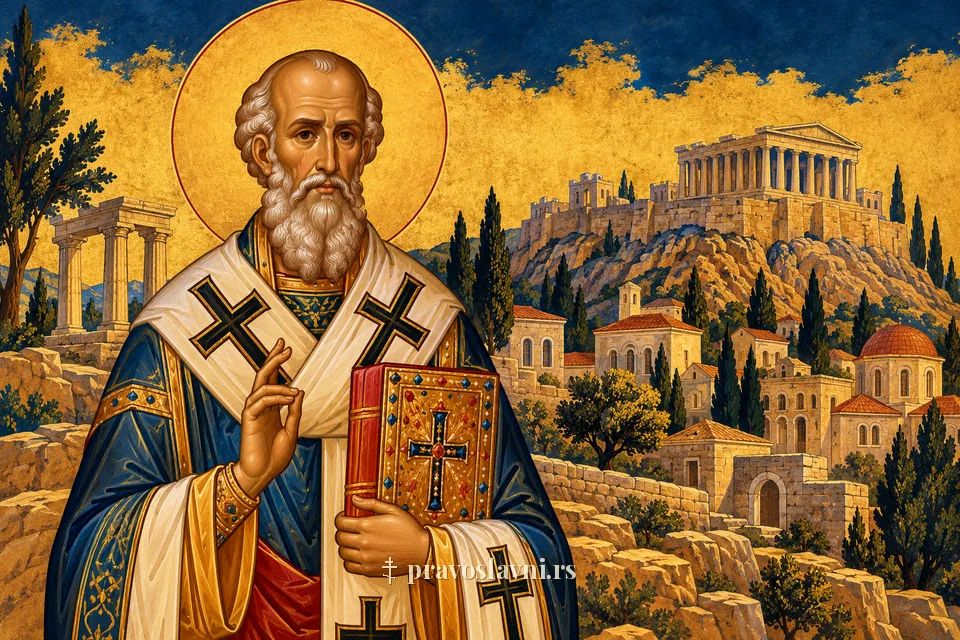
St Quadratus is numbered among the Seventy — the wider circle of disciples whom the Lord, as the Gospel according to Luke tells us, sent out two by two before His face. He is also called a disciple of the great apostles. He belonged, therefore, to the very earliest generation of Christians, to those for whom the faith was a living memory.
According to the Prologue, he had a broad secular education, yet his true strength lay not in books but in the grace of God. In him knowledge and faith were not set against each other: everything he knew he placed in the service of the Gospel.
He preached in Athens, the city of philosophers and idols, where it took courage to speak about the crucified Christ. There, according to the Prologue, he was bishop, as the successor of St Publius. Later we find him in Magnesia as well. Wherever he preached, according to the Prologue, idolatry lost ground. He had neither power nor money, only the word and prayer. And yet the more people accepted Christ, the more the hatred grew among those who did not wish to renounce the old gods.
Quadratus defended other Christians too. He addressed to the Emperor Hadrian an apology, a written work in defence of the faith. According to the Prologue, the work did what it was meant to do: the emperor ordered that no one might be punished simply for being a Christian. This learned man did not write in order to win glory or the favour of the powerful, but in order to protect his brethren. In this way his knowledge became a shield for many.
The hatred of the pagans reached him all the same. They stoned him and then shut him in prison. Neither the stones nor the hunger in the dungeon separated him from Christ, to Whom in the end he gave up his soul. The Prologue records that he suffered in Magnesia, around the year 130, and that he was buried there.
He to whom even the emperor listened, and who obtained protection for others, in the end did not have so much as a piece of bread. He taught, preached and defended others, and for Christ he endured hunger and the loneliness of the dungeon. By keeping silent he could have saved his life, but he chose to speak. Quadratus teaches us that knowledge is worth most when it serves the truth, and faith when it is ready for sacrifice.
Full Life
St Quadratus did not command a single army and did not sit on any throne. He had knowledge, faith and the courage to speak when it would have been easier to keep silent. With these he stood before idolatrous Athens, before the Roman Emperor and, in the end, before death.
One of the Seventy
Quadratus is numbered among the Seventy Apostles, and he is also called a disciple of the great apostles. He belonged, then, to the very earliest generation of Christians — to those for whom the faith was a living memory and not an old story.
The Gospel according to Luke tells how the Lord chose the Seventy and sent them two by two into the places that He Himself intended to visit. They carried neither money nor provisions. They relied only on God and on the good will of people. They were neither rich nor powerful, but they carried a message that was changing the world. This is how the spreading of the Good News began, and from that circle came Quadratus too.
According to the Prologue, Quadratus had a broad secular education. But his real strength was not in books; it was in the grace of God that worked through him. In him knowledge and faith did not come into conflict. Everything that he had learned he placed in the service of Christ.
A Preacher in the City of Philosophers
Athens at that time was still a city of philosophers, schools and temples. The Acts of the Apostles record that the Apostle Paul, when he came there, was deeply troubled that the city was full of idols. Quadratus found the same picture. In a place where people were proud of their own wisdom, it took courage to preach Christ crucified. Nevertheless he preached there and, according to the Prologue, became bishop, as the successor of St Publius. Later we find him in Magnesia as well.
Wherever he preached, according to the Prologue, idolatry lost ground. He did not achieve this by force. He had neither soldiers nor money, but only the word and prayer. But the more people accepted Christ, the more the hatred grew of those who did not want to renounce the old gods.
A Work Addressed to the Emperor
Quadratus did not defend only himself. To the Emperor Hadrian he addressed an apology — a written work in which he explained who the Christians are and what they believe. The Prologue records that this work did what it was meant to do: the Emperor ordered that no one might be punished simply for being a Christian.
To understand what that means, we need to remember what the times were like. A Christian could then easily become a target, simply because he prayed to Christ. The work of Quadratus brought at least a little protection to many people whom he had never met.
With so much learning he could easily have sought glory for himself or curried favour with the powerful. He could also have kept silent and preserved a peaceful life. Quadratus chose to write for the sake of others.
The Last Sacrifice
The hatred that his preaching had aroused did not cease. The pagans attacked him with stones, and then imprisoned him. Hunger in prison ended his life, but not his faithfulness to Christ, whom he served to his last breath. The Prologue records that this was in Magnesia, around the year 130, and that he was also buried there.
In this lies the greatest paradox of his life. A man to whom even the Emperor listened, and who obtained protection for others by his pleading, did not himself have so much as a piece of bread. He taught, he preached and he defended others, and in the end he endured hunger in prison for Christ.
What Quadratus Tells Us
The path of Quadratus was neither easy nor safe. Every sermon brought him new opponents. Yet he did not fall silent, nor did he look for an easier path. His life teaches us that knowledge is worth most when it serves the truth and people, and faith — when a person is ready to pay even the highest price for it.