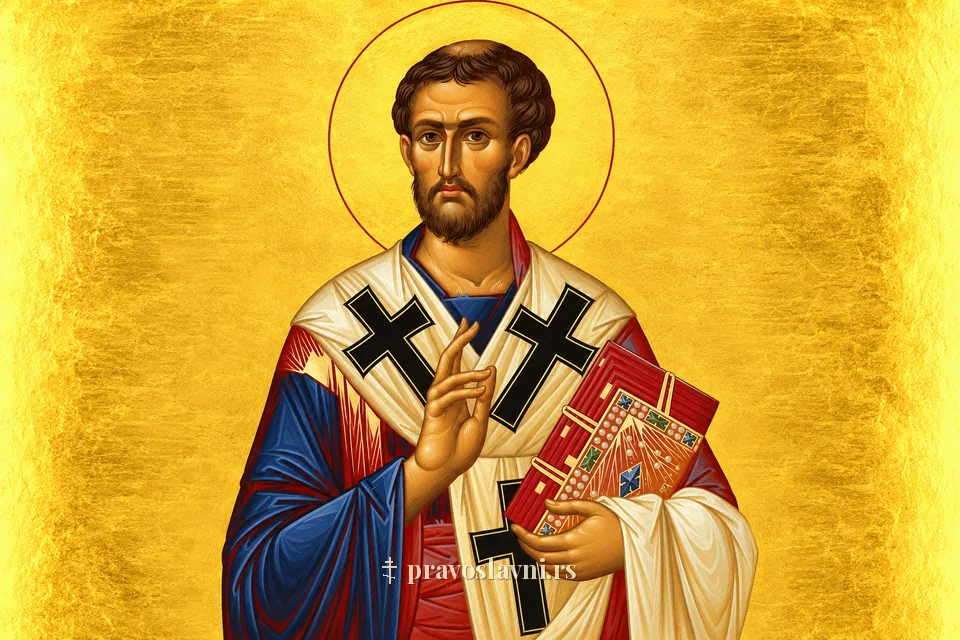
Thursday04February 202722 January (according to the Julian calendar)
Illustration
Saint of the day
Holy Apostle Timothy
What happenedSt Timothy, the faithful disciple of the Apostle Paul and Bishop of Ephesus, stood up openly against the violence of the pagans at an idol festival and laid down his life for it.
“Let no one despise your youth, but be an example to the believers in word, in conduct, in love, in spirit, in faith, in purity.”
— 1 Tim 4:12
Life
When the pagans in Ephesus were celebrating their idol, they went about the city in masks committing acts of violence. The bishop of the city, Timothy, did not keep silent: he rose up against it publicly. That, according to the Prologue and his Life, cost him his life. He breathed his last, according to his Life, outside the city, where the Christians had carried him, and he was buried at Pion.
Who was that brave bishop? Lystra in Lycaonia was his native city; his father was a Greek, and his mother a Jewess. He grew up beside his devout mother Eunice and his grandmother Lois, whose sincere faith Paul later mentioned with respect (2 Tim 1:4–5). His Life says that Timothy knew Holy Scripture while still a child.
In Lystra he watched as Paul, who had come with Barnabas, healed a man who had never walked since his birth. His mother came to believe and, according to his Life, handed her son over to the apostle. Later, when Paul returned with Silas, he took Timothy along with him. His Life says that he circumcised him so as not to scandalise the Jews of that place, even though circumcision is not needed for salvation. From then on they travelled together through Macedonia, Italy and Spain. In his epistles Paul addresses him as a fellow worker and a brother, and he also calls him his son in the faith (1 Tim 1:2); his Life says that he raised him to the rank of bishop while he was still young. Since his disciple was often ailing, the apostle recommended a little wine to him (1 Tim 5:23).
The Prologue adds that, when Paul had suffered, Timothy was further instructed by John the Evangelist. John's exile to Patmos left the Church of Ephesus in Timothy's care. The Prologue states that he suffered around the year 93. The Church of the Holy Apostles in Constantinople later received his relics, which were laid beside Luke and Andrew the First-called. The translation, according to his Life, was carried out by St Artemius, by order of the Emperor Constantius, the son of Constantine.
Timothy's life began with a faith learned at home, and ended with courage in the face of violence. Humble learning and discipline made him ready to lay down his life for the truth.
Full Life
In the epistle of Paul (1 Tim 1:2), to which the Prologue refers, Timothy is not only a disciple — the Apostle regards him as his own son in the faith. That disciple became Bishop of Ephesus and laid down his life for Christ.
Faith from the Family Home
Timothy was born and grew up in Lystra, in Lycaonia. His father was a Greek, and the Life says an idolater, while his mother was a Jewess. His mother Eunice and his grandmother Lois were devout women; both sources remind us that Paul later pointed out how sincere their faith was (2 Tim 1:4–5). The Life adds that Timothy had known the Holy Scriptures from childhood (2 Tim 3:15).
The Meeting That Shaped a Life
Timothy was among those who saw how Paul, who had arrived in Lystra with Barnabas, healed a man who had not been able to walk from birth. The Life says that the people took the apostles for gods, but that many at that time truly came to believe in Christ, among them Timothy's mother. She received Paul and handed her son over to him. Paul was afterwards stoned and driven out of the city, and Timothy remained with his teachers.
Years passed before the Apostle came back, this time with Silas. Then he took Timothy as his travelling companion. The Life states that he circumcised him so as not to scandalise the Jews of that place (Acts 16:1), but it also adds that circumcision is not necessary for salvation. From that moment on they were seldom apart.
Companion and Fellow Worker
The Prologue records that he travelled with Paul to Achaia, Macedonia, Italy and Spain, and the Life mentions Ephesus, Corinth, Macedonia, Italy and Spain. In several of his epistles Paul calls him his fellow worker and brother. The Life says that Timothy, while still young, passed by the hand of Paul through all the degrees of the priesthood up to that of bishop. Strict with himself in fasting, according to the Life, Timothy received from his teacher the advice that, for the sake of his frail health, he should nevertheless take a little wine (1 Tim 5:23).
When Paul had suffered, Timothy, according to the Prologue, learned from John the Evangelist. By order of Domitian, John had to go into exile on Patmos, and the care of the Church in Ephesus continued to be borne by Timothy as its bishop.
Witness to the End
The pagans in Ephesus had a festival in honour of the idols, when they went about the city wearing masks and committed acts of violence. Timothy did not keep silent: he preached against it publicly. The Prologue and the Life record that the pagans attacked and killed him because of this. The Life adds that the Christians found him still alive and carried him out of the city; he died shortly afterwards, and was buried in a place that was called Pion. The Prologue states that this happened around the year 93.
His relics were later taken to Constantinople, to the Church of the Holy Apostles, where Luke and Andrew the First-Called also rested. The Life records that the translation was carried out by St Artemius, by order of the Emperor Constantius, the son of Constantine the Great.
Timothy teaches us that faith learned in childhood, in a devout family, becomes a strength for the whole of life. A humble disciple's heart and discipline prepared him for courageous service, and when the time came, he was afraid of neither violence nor death.
Other saints of the day
Venerable Martyr Anastasius
St Anastasius was a Persian and his name was Magundat, and his father Bab, a well-known sorcerer, taught him sorcery. His Life says that the Persian King Chosroes captured Jerusalem and carried off the Precious Cross to Persia, and Magundat, on hearing of this, began to question Christians about Christ. As a soldier of the Persian army, in the war with the Emperor Heraclius he left the Persians and joined the Christians. In Jerusalem, with the blessing of Patriarch Modestus, the presbyter Elias baptised him and gave him the name Anastasius. He lived as a monk in one of the monasteries of Jerusalem for seven years, and the accounts of the sufferings of the martyrs awakened in him the desire to lay down his own life for Christ as well. His Life records that in a vision a radiant man held out to him a golden cup of wine, which he understood as a call to martyrdom. In Caesarea of Palestine he rebuked the Persian sorcerers, and so he was arrested as a spy. Before the commander Marzabanes he refused riches, called the monastic habit angelic, and said: “I am a Christian.” Then, according to his Life, he also spoke these words: “Only let me not deny You, O Christ the King!” The prison and the torments lasted a long time, and the final decision on his death was taken by King Chosroes himself; Anastasius foretold to the prisoners that the king would die and that they would be set free. As the Prologue and his Life record, he suffered for Christ near Nineveh in the year 628, together with about seventy other prisoners. A former sorcerer became a monk and a martyr, and neither threats, nor flattery, nor torments could bring him to deny Christ.