Tuesday28April 202615 April (according to the Julian calendar)
Illustration
Saints of the day
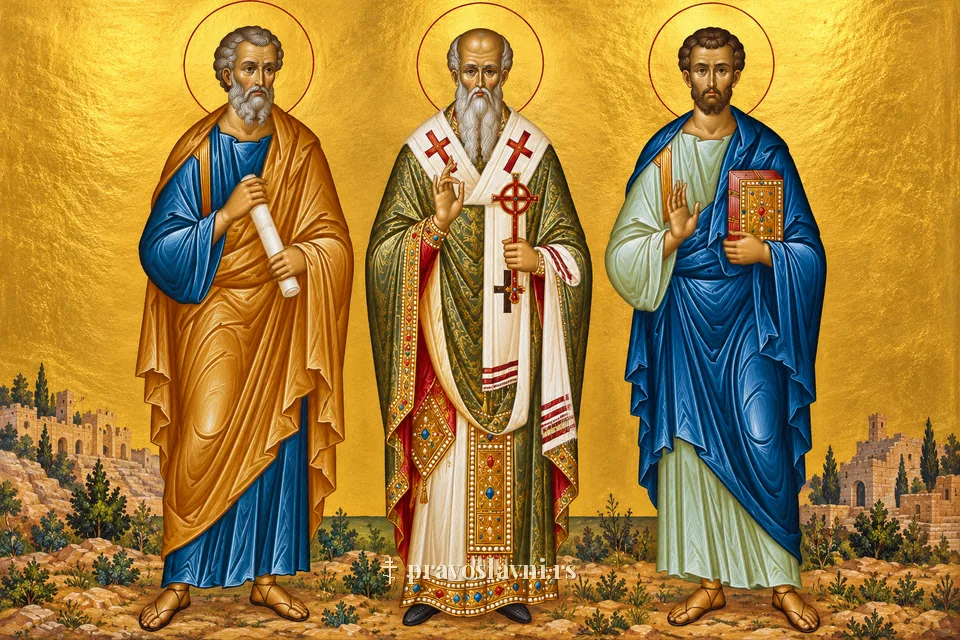
Holy Apostles Aristarchus, Pudens and Trophimus
What happenedAristarchus, Pudens and Trophimus, the Apostle Paul's companions in labours, chains and sickness, were beheaded in Nero's persecution, at the same time as Paul himself.
“Go your way; behold, I send you out as lambs among wolves.”
— Lk 10:3
Life
Aristarchus, Pudens and Trophimus were fellow workers of the Apostle Paul, and the Prologue numbers them among the Seventy Apostles. A trace of each of them has remained in Holy Scripture, in the epistles and in the Acts of the Apostles.
Trophimus was from Asia (Acts 20:4) and accompanied Paul on his journeys. The Apostle records that he left him sick in Miletus; the verse, as the Prologue quotes it, reads: “Trophimus I have left in Miletus sick” (2 Tim 4:20).
Aristarchus shared both danger and chains with Paul. The Prologue says that in Ephesus, together with Gaius, he was seized by the people who had risen up against the Apostle (Acts 19:29), and in the Epistle to the Colossians Paul sends a greeting from him; the verse, as the Prologue quotes it, reads: “Aristarchus my fellow prisoner greets you” (Col 4:10). Aristarchus became bishop in Apamea in Syria.
Pudens, a distinguished Roman citizen whom Paul mentions in the Second Epistle to Timothy (2 Tim 4:21), opened his home to the chief apostles. That house in Rome later became a church, called “the Shepherd's Church”, and the Life says it is told that the Apostle Peter himself served in it.
All three were beheaded in Nero's persecution, when Paul too was put to death. They stayed beside the Apostle in his labours, in prison and in sickness, and with him they also shared martyrdom.
Full Life
Three from Paul's Circle
Aristarchus, Pudens and Trophimus were, as the Prologue records, of the Seventy Apostles; the Life says that on 4 January they are celebrated together with the Seventy. All three are linked by the Apostle Paul, who mentions them in his epistles, and the book of the Acts of the Apostles also writes about two of them. Each shared something of his own with Paul: one his chains, another his home, the third the journey and illness.
Aristarchus, a Prisoner with the Apostle
Aristarchus became bishop in Apamea in Syria. Paul mentions him several times (Acts 19:29; Col 4:10; Philem 23). The Prologue records that in Ephesus, together with Gaius, he was seized by the people who had risen up against Paul (Acts 19:29). The Apostle calls him his fellow worker, and in the Epistle to the Colossians he sends a greeting from him; the verse, as the Prologue quotes it, reads: “Aristarchus my fellow prisoner greets you” (Col 4:10). The Life adds that Aristarchus is also celebrated on 27 September, together with the Apostles Mark and Zenas.
Pudens, Whose Home Became a Church
Pudens was a distinguished Roman citizen, whom Paul mentions in the Second Epistle to Timothy (2 Tim 4:21). The house of Pudens later became a church, called “the Shepherd's Church”; before that, according to the Life, Peter and Paul found refuge in it in Rome. The Life says that the story is told that the Apostle Peter himself also served in that church.
Trophimus, a Companion as far as Miletus
Trophimus was from Asia (Acts 20:4); the Life, referring to Acts 21:29, says that he was from Ephesus. He accompanied Paul on his journeys, and the Apostle records that he left him sick in Miletus; the verse, as the Prologue quotes it, reads: “Trophimus I have left in Miletus sick” (2 Tim 4:20).
Together to the End
All three lost their lives by the sword in Nero's persecution, at the time when Paul himself was also put to death. Those who shared with the Apostle his labours, prison and illness also shared martyrdom with him. The song which the Prologue sings on this day to the martyrs in general says that their love for Christ was stronger than fire and that the victorious Christ receives their souls.
Other saints of the day
Holy Martyr Sabbas the Goth
Sabbas was a Goth and lived in the land of the Goths at a time of fierce persecution of Christians. His Life, which begins as a letter from the Church of Gothia to the Church in Cappadocia, describes him as a meek, humble and truth-loving man, modest in speech and yet wise, who fasted, prayed, sang in church and took care of it. When the Gothic princes were forcing Christians to eat what had been sacrificed to idols, Sabbas refused and taught that anyone who eats it cannot be a Christian, and so, according to the Life, he was driven out of the village and later allowed to come back. When a certain prince came to the village and asked whether there were any Christians, the villagers swore that there were none, but Sabbas stood before the prince and, according to the Life, said: “Let no one swear on my behalf; I am a Christian.” Since Sabbas, as the Life says, owned nothing except the clothes he was wearing, the prince dismissed him with the words: “That one can neither be of any use nor do any harm.” The following year the priest Sansalas came to him, and Sabbas celebrated the feast with him. The pagans burst into the house, seized them both and beat them, and then tied them to a tree and offered them meat sacrificed to idols. Both of them refused, and Sabbas, according to the Life, said: “There is one Master — God, who is in heaven.” He received the sentence with joy and praised God all the way to the place of execution, and the Prologue records that the soldiers, seeing how good he was, were ready to let him go, but Sabbas reminded them that the order had to be carried out. They drowned him in a river — the Life calls it the Musaeus — with a stone around his neck, and his body was cast up on the bank. He suffered in the year 372 — according to the Prologue in his thirty-first year, and according to the Life he was thirty-eight years old. The Prologue adds that his body was later translated to Cappadocia.