Save your slava — you'll get a reminder a week and a day before.
Thursday24June 202711 June (according to the Julian calendar)
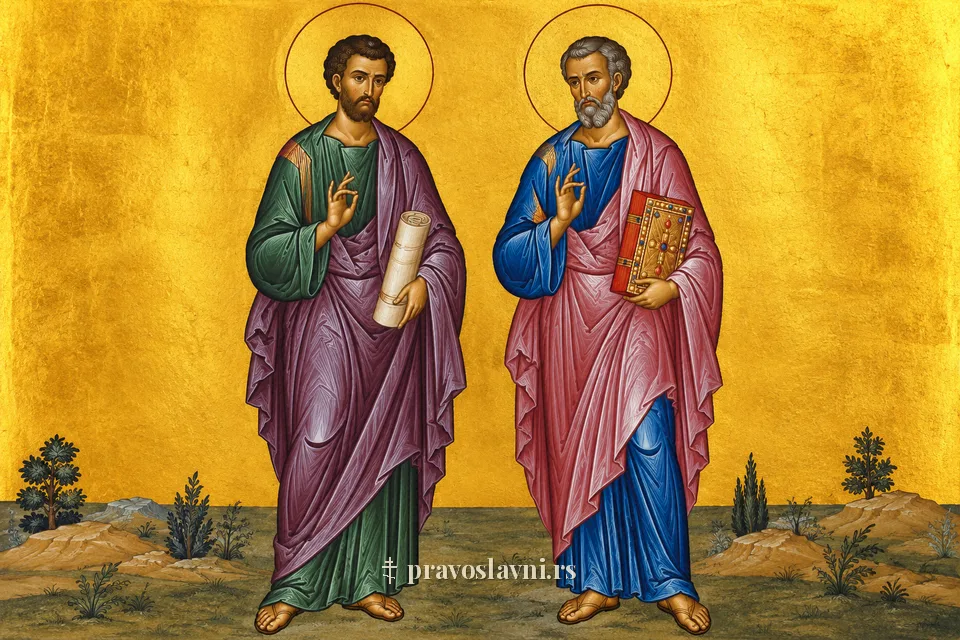
Illustration
Saints of the day
Holy Apostles Bartholomew and Barnabas
What happenedThe Holy Apostles Bartholomew and Barnabas preached the Gospel far from their homeland, and it was Barnabas who brought Saul, the future Apostle Paul, among the apostles.
“Jesus saw Nathanael coming toward Him, and said of him, ”Behold, an Israelite indeed, in whom is no deceit!”“
— Jn 1:47
Life
The Holy Apostles Bartholomew and Barnabas are commemorated on the same day. The first was one of the Twelve, the second one of the Seventy, and both of them carried the Gospel of Christ to distant lands.
Barnabas, born in Cyprus into a family of the tribe of Levi, was named Joseph, but the apostles called him Barnabas, the son of consolation, because he knew how to console. He studied under Gamaliel together with Saul and, as his friend, prayed for him and spoke to him about Christ. When Saul was converted, Barnabas brought him in among the apostles, and afterwards they preached together in Antioch and on their journey through Cyprus and Asia Minor, as the Acts of the Apostles bear witness. He was killed by the Jews in Cyprus, and Mark buried him near Salamis and laid the Gospel according to Matthew beside him. His grave was unknown for a long time, but many people were healed at that spot, and so it came to be called the Place of Health. Much later, in the time of Emperor Zeno, the apostle revealed his grave to Archbishop Anthemius in a vision, and the Church of Cyprus, because Barnabas had been an apostle, was proclaimed independent.
Bartholomew, of whom the Prologue says that he is, by all appearances, the same person as Nathanael, while the Life says that some think so, preached with the Apostle Philip and his sister Mariamne. In Hierapolis they destroyed by prayer a serpent to which the pagans paid divine honours, and they healed Stachys, who had been blind for forty years. Then they were crucified, but after an earthquake Bartholomew was taken down from the cross alive. He preached in India, and in Armenia he healed the king's daughter. He refused the king's gifts, according to his Life, because he cared not for treasure but for human souls. The king's brother Astyages had him tortured and put to death. The coffin with his relics, thrown into the sea, floated to the Lipari Islands, where Bishop Agathon received it. The apostle later appeared to Joseph the Hymnographer and blessed him to write spiritual hymns.
The Prologue says of Barnabas that true friendship is prayer for a friend's salvation. Both apostles teach us that human souls are worth more than any treasure.
Full Life
Two Apostles, One Day
On this day the Church honours two apostles together: Bartholomew, from the circle of the Twelve, and Barnabas, from the circle of the Seventy. We remember both of them because they did not keep the Gospel for themselves but carried it to distant lands, and because they gave their lives for Christ.
Of Bartholomew the Prologue says that he is, in all likelihood, the same person as Nathanael. His Life says that some think so, interpreting the name Bartholomew as “son of Tolmai”, while others identify Nathanael with Simon the Zealot. Barnabas was born in Cyprus, into a wealthy family of the tribe of Levi, and his name was Joseph. The apostles gave him a new name, Barnabas, son of consolation, because he had the gift of pouring consolation into people's hearts.
Companions
Neither of them went alone. Barnabas studied under Gamaliel together with Saul, and he was also Saul's friend: he prayed that he might be converted and often spoke to him about Christ. When Christ appeared to Saul, the Prologue says that he fell at his friend's feet and exclaimed: “O Barnabas, teacher of truth, now I am convinced that what you told me about Christ is true!” Barnabas embraced him, weeping for joy. It was he who brought the newly converted Saul to the apostles (Acts 9:26–27). Later, with Mark, they preached in Antioch, where the disciples of Christ were first given the name Christians, and then on the journey through Cyprus and Asia Minor (Acts 11; 13–14). According to the Life, they parted because of Mark, and the Life sees in this the providence of God, for in this way two missions arose instead of one. That Barnabas was not attached to his property either is recorded in the Acts of the Apostles (4:36–37): he sold it and gave the money to the apostles.
Bartholomew, according to his Life, was sent after receiving the Holy Spirit with the Apostle Philip to Syria and Asia Minor. With them was Philip's sister, the virgin Mariamne, and for a time also St John the Theologian. The Prologue says that he preached in Asia, in India and finally in Armenia; in India, according to the Prologue, he translated the Gospel of Matthew into the language of the people there.
Witness to the End
In Hierapolis the apostles overcame by prayer a serpent which the pagans honoured as a deity, and they restored the sight of Stachys, who had not seen for forty years. Because of this the people rose up against them, and Philip and Bartholomew were crucified, Bartholomew with his head downwards. The earth shook and the people took them down; Philip was no longer among the living, but Bartholomew survived. In Armenia he later healed the king's daughter. To King Polymius, who wished to give him gifts, he replied, according to the Life: “I do not trade in such things; I seek the souls of men.” The king's brother Astyages nevertheless seized him, crucified him, tortured him and in the end beheaded him.
Barnabas ended his life in Cyprus, where he had been born. He was killed by the Jews; the Life says that they stoned him outside Salamis.
Tombs That Speak
Christians laid the relics of Bartholomew in a leaden coffin, and the miracles which took place there led the pagans to throw the coffin into the sea. The waves brought it to the Lipari Islands, where, by a revelation, Bishop Agathon met it and carried it into the church. The Prologue says that the relics were afterwards translated to Benevento, and then to Rome. To Joseph the Hymnographer the apostle appeared in white garments and with the Gospel blessed him to write spiritual hymns, saying, according to the Prologue: “Let the waters of heavenly wisdom flow from your tongue!”
Mark buried Barnabas near Salamis, on the western side of the city, and placed on his breast the Gospel according to Matthew, which Barnabas himself had copied. For a long time it was not known where the tomb was, but many people recovered their health at that spot, and so they called it “the Place of Health”. Under Emperor Zeno, Patriarch Peter of Antioch wanted the Church of Cyprus to come under Antioch. Then the apostle appeared to Archbishop Anthemius on three nights and showed him where he lay. Since Barnabas is an apostle, the Church of Cyprus received lasting independence.
Of Barnabas the Prologue says that true friendship means praying for a friend's salvation and leading him to the truth. Barnabas did not give up on Saul, and Bartholomew did not seek gifts, but souls.
Other saints of the day
Icon of the Mother of God “It Is Truly Meet”
The hymn “It Is Truly Meet”, with which the Church glorifies the Theotokos, was, according to the Prologue, first sung in a cell of the Pantocrator Monastery on the Holy Mountain, which after it is called “It Is Truly Meet” to this day. This was in the time of Nicholas Chrysoberges, Patriarch of Constantinople (983–996). While the elder was away, in Karyes, the monk was reading the canon to the Theotokos alone at night. Then an unknown guest joined him in the church and began to sing a hymn which the monk had not heard until then, saying that this is how it is sung in the place he came from. The guest wrote it down with his finger on a stone slab, which gave way under his hand like wax, and he vanished at once: it was the Archangel Gabriel. The slab was taken to Constantinople, and with this hymn the Church addresses the Theotokos to this day.