Tuesday25May 202712 May (according to the Julian calendar)
Illustration
Saint of the day
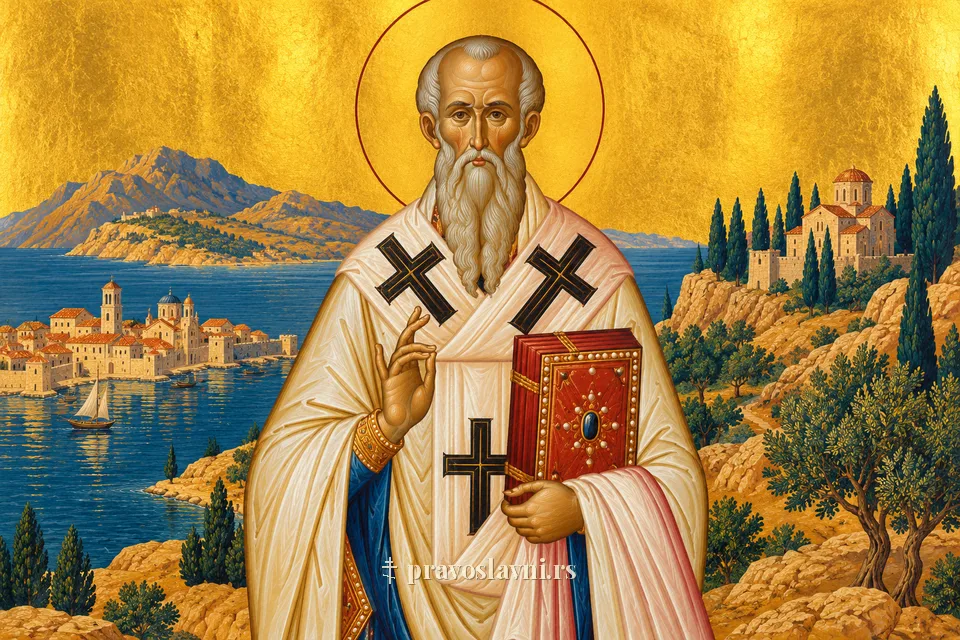
St Epiphanius of Cyprus
What happenedSt Epiphanius, a Jew by birth, was baptised together with his sister, became a monk, and as Bishop of Salamis guarded the Orthodox faith for more than half a century.
“Holding fast the faithful word as he has been taught, that he may be able, by sound doctrine, both to exhort and convict those who contradict.”
— Tit 1:9
Life
St Epiphanius was Bishop of Salamis on Cyprus for more than half a century. The Prologue records that he took up that ministry at the age of sixty, served the Church for fifty-five years and reposed in the year 403, having lived to a hundred and fifteen.
He was born a Jew. His Life tells that as a boy he fell from a donkey and that a Christian named Cleobius healed him with the sign of the cross in the name of the crucified Christ; at that moment he resolved in his heart to believe. Later, after he had seen the monk Lucian give his own clothing to a beggar, he was baptised together with his sister Callitropia. According to his Life, he gave away his property to the poor and kept back a little money for books.
At the age of twenty-six he became a monk in the monastery of St Hilarion and, according to his Life, learnt from him strict fasting, which he kept all his life. Wherever people began to praise him, he would go away. In the desert, according to the Life, the Saracens found him: one, who raised his sword against him, was healed of blindness in one eye, and another came to believe and was baptised. In Egypt, as the Prologue and the Life record, Paphnutius the Great foretold to him that he would be a bishop on Cyprus. The fame of his ascetic life, according to the Prologue, spread through Palestine and Egypt. On Cyprus, by God's providence, he was unexpectedly chosen as bishop.
As a shepherd, according to his Life, he ordained only God-fearing priests, paid the debt of a certain prisoner and fed the hungry in a time of famine. He wrote the “Panarion”, which the Prologue also calls “The Medicine Chest”, a work in which he refutes eighty heresies.
Towards the end of his life, according to the Prologue, the Emperor Arcadius and the Empress Eudoxia summoned him to Constantinople to a council against St John Chrysostom and urged him to speak against him. Epiphanius would not consent to an injustice against his holy brother. Chrysostom and he foretold each other's end in their letters, and both prophecies were fulfilled. He secretly boarded a ship for Cyprus and reposed on the way.
He left his wealth behind, fled from fame and remained faithful to the truth to the end — and that is why his life bears witness even today to what it means to come to Christ with one's whole heart.
Full Life
From Jew to Christian
St Epiphanius was born a Jew. His Life says that he came from Phoenicia, from a family of farmers; his father died when he was ten years old, and his mother supported the family by her own work.
His road to Christ began, according to his Life, with an accident: the boy was driving a donkey to the market when the animal threw him off and injured him. A Christian named Cleobius healed him by making the sign of the cross over him three times, and in the name of the crucified Christ he stopped the donkey. The boy asked who Christ was, and in his heart he decided to believe. Later, according to his Life, a rich Jewish teacher of the Law named Tryphon took him into his house and taught him the Jewish books, and when Tryphon, his wife and Epiphanius's mother had died, he inherited Tryphon's estate.
The decisive moment was his meeting with the monk Lucian. His Life records that Lucian gave his own garment to a beggar, and Epiphanius saw a white, shining garment come down upon him, and fell down before him. The power of that faith won him over, so he received baptism, and with him his sister Callitrope; according to his Life, Lucian was his godfather, and at the baptism the bishop saw a crown of light above his head. According to his Life, he gave the estate away to the poor, keeping a little money for books, and he entrusted his sister to the virgin Veronica, who led a community of maidens.
A monk who flees from fame
At the age of twenty-six he became a monk in the monastery of St Hilarion. His Life says that Hilarion was younger than he was, but spiritually mature; with him Epiphanius learned Greek letters and took up the strict fast that he kept all his life.
The reverence of the monks after one miracle drove him further on: his Life says that he went away in secret to the desert of Spanidrion and lived on plants that grew wild. There forty Saracens found him; one of them, blind in one eye, swung his sword at him, and his eye was healed. For three months they took him about with them, and he restrained them from evil and taught them about the true God. One of them believed, was baptised with the name John and remained his disciple — that John later wrote down the first part of his Life.
Later, according to the Prologue, he also founded a monastery of his own, and word of his ascetic struggle, wisdom and miracles spread through Palestine and Egypt. Fame troubled him, so he withdrew to Egypt. The Prologue and his Life record that on the way Paphnutius the Great foretold to him that he would be a bishop on the island of Cyprus. His Life says that he fled from that too, until Hilarion, who had moved to Cyprus, directed him: “Go, my child, to the city of Salamis, which is on this island of Cyprus.”
Shepherd of Salamis
By God's providence he was unexpectedly chosen as bishop. His Life tells that the old bishop Pappus, who had suffered for the faith, learned in a revelation that Epiphanius would be archbishop, and found him in the market while he was buying grapes; Epiphanius agreed unwillingly. The Prologue records that he became Bishop of Salamis at the age of sixty and served the Church for fifty-five years.
As a hierarch, according to his Life, he paid the debt of a prisoner out of the church treasury, ordained only God-fearing priests and built a new stone church. To the mother of a boy who had died he said: “If you believe in the Crucified One, you will see your son alive.” She believed, and the boy came back to life. In a time of famine, when a certain rich man would not sell grain except at a high price, Epiphanius, led by a voice in prayer, found gold and silver in a closed pagan temple, bought grain and fed the hungry. The Prologue also mentions his best-known work, the “Panarion” or “Medicine Chest”, in which he describes and refutes eighty heresies.
The last witness
In his old age, according to the Prologue, the imperial couple — Arcadius and Eudoxia — brought him to Constantinople, where a council was being prepared against St John Chrysostom; they kept him at court and asked him to rise up against John. Chrysostom wrote to him: “Brother Epiphanius, I have heard that you advised the Emperor that I should be banished; know that you too will not see your throne again”. Epiphanius replied: “John, you who suffer, stand firm against insults; know that you too will not reach the place to which they are banishing you”. Both prophecies were fulfilled.
Epiphanius did not take the Emperor's side. He set out in secret back towards Cyprus and died while still at sea, in the year 403, having lived to the age of one hundred and fifteen, and Chrysostom, banished towards Armenia, died on the way.
Epiphanius came to Christ with his whole heart, gave his wealth to the poor, fled from fame and did not consent to injustice against a brother in holiness. On his day the Prologue warns that a body made dead to the passions becomes for the living spirit what a corpse was for the living captive whom the barbarians used to bind to it.
Other saints of the day
St Germanus of Constantinople
St Germanus suffered a great injustice in his childhood. The Emperor Constantine Pogonatus killed his father, the first senator of the Empire — according to his Life, the patrician Justin, out of envy — and had the boy made a eunuch and shut him up in a monastery, according to his Life so that he would not one day avenge his father. Germanus nevertheless chose the path of virtue: the Prologue and his Life record that as a monk he shone, and his Life adds that he read the holy books without ceasing. At first he governed the Church in Cyzicus. His Life says that together with Patriarch Cyrus he rose against the Monothelite heresy and that both of them went into exile under the Emperor Philip. He was chosen as Patriarch of Constantinople when Anastasius II came to the throne. The Prologue and his Life also remember an event at a baptism: the little Constantine, later called Copronymus, defiled the water in the font while Germanus was baptising him, and the Patriarch then foresaw that this child, when he grew up, would spread heresy and bring suffering upon Christians — and so it came to pass. When Leo the Isaurian raised his hand against the icons, the Patriarch opposed him. The Emperor, as the Prologue says, proclaimed himself with the words: “I am emperor and priest!”, and he deprived the Patriarch of his see and removed him to a monastery. According to his Life, before leaving Germanus declared that he was ready to give his life for the icon of Christ and that without an ecumenical council he dared not introduce any new teaching, and so he left his omophorion on the holy altar table. He spent ten more years in the monastery and reposed in peace in the year 740. The injustice he suffered as a child did not make him vengeful: he preferred to leave the patriarchal throne rather than the holy icons.
St Nikodim was a Serb, by origin from Raška. He became a monk on the Holy Mountain and was made abbot of Hilandar, which he governed from 1312 to 1316. When Archbishop Sava III died, Nikodim, according to the Prologue, was chosen in 1317 as Archbishop of all the Serbian and Maritime lands, and he governed the Serbian Church for about eight years. With a delegation from Hilandar he begged King Milutin to forgive his son Stefan Dečanski and bring him back from exile. He fulfilled the wish of St Sava: he translated the Typikon of Jerusalem into Serbian, and he also took care of Sava's cell in Karyes. He restored Žiča and built the Church of St Demetrius in Peć. He fought against the Bogomils and, according to the Prologue, zealously defended Orthodoxy. He reposed in the Lord in the year 1325, and his wonderworking relics rest in Peć, in the Church of St Demetrius.