Sunday, 7 February 2027no fast · Sunday — a festive day · 25 January (according to the Julian calendar)
Sunday07February 202725 January (according to the Julian calendar)
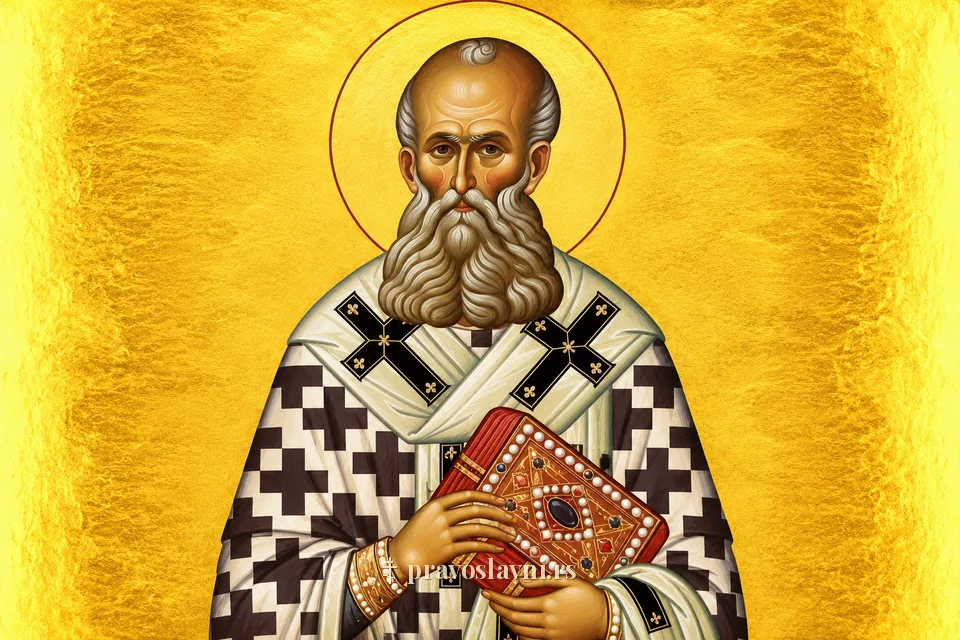
Illustration
Saint of the day
St Gregory the Theologian
What happenedSt Gregory the Theologian, defender of the faith in the Holy Trinity, willingly gave up the patriarchal throne of Constantinople for the sake of peace in the Church.
“In the beginning was the Word, and the Word was with God, and the Word was God.”
— Jn 1:1
Life
“Those who deprive us of our throne cannot deprive us of God.” With these words, which the Prologue remembers, St Gregory the Theologian came down from the see of Constantinople. The council of one hundred and fifty bishops, held in the year 381, was divided over whether he should remain, and Gregory preferred to step aside rather than let a schism arise on his account. His Life says that he was even ready to be thrown overboard like the Prophet Jonah, if only the discord would cease.
He was born in Nazianzus in Cappadocia. His mother Nonna was a Christian and, as his Life says, by her prayer she also brought to the faith her husband, Gregory's father, who later became a bishop. The Prologue records that his mother had a strong influence on her son. Gregory studied in Caesarea, Alexandria and Athens. In Athens he gained a lifelong friend, Basil the Great, and he also came to know the future Emperor Julian, in whom he recognised the apostate in advance.
He was baptised only when he had completed his studies. He fled from honours, and even from the rank of bishop, which they forced upon him against his will. More than once he withdrew into solitude, and for a time into the desert as well.
Nevertheless, when he was called, he came to Constantinople, where the Arians held almost all the churches, while the Orthodox gathered in the small church of St Anastasia. There he spoke and wrote about the Holy Trinity and defended the teaching on the Holy Spirit and on the human soul of Christ. Because of those homilies the Church called him, like St John, the Theologian. His Life records that his opponents stoned him, and that he forgave a young man who had been hired to kill him, when he repented.
After he withdrew from his see, he lived in his native region, prayed and wrote books and poems. His health was frail all his life, and he died in great old age, according to his Life in 389, and according to the Prologue in the year 390.
Gregory teaches us that a humble man may lose his throne and yet lose nothing, for no one can take God away from him.
Full Life
The Son of a Mother's Prayer
St Gregory, whom the Church calls the Theologian, was born in Nazianzus in Cappadocia, according to his Life around the year 330. His father was also called Gregory and at first was not a Christian, while his mother Nonna was a Christian. His Life says that Nonna brought her husband to the faith by her prayer, and that he was baptised by Bishop Leontius, who was on his way to the Council of Nicaea. Even before her son was born, Nonna, as Hannah once did with Samuel, vowed him to God, and in a dream she saw the child and his name. The Prologue stresses that his mother had a great influence on Gregory. He had a brother, Caesarius, and a sister, Gorgonia.
His Life records that as a boy he saw in a vision two maidens in white, Purity and Temperance. That vision set the course of his life: he remained pure and temperate all his days. His Life also remembers his decision never to swear an oath about anything — and he did not depart from it for the whole of his life.
Friendship with Basil
Gregory studied in the best schools of his time: in Caesarea of Cappadocia, in Caesarea of Palestine under the rhetorician Thespesius, in Alexandria and in Athens. His Life tells that on the voyage to Athens a storm arose, and that the sea grew calm when he prayed. In Athens, as the Prologue and his Life record, he studied together with Basil the Great and with the future Emperor Julian. With Basil he became an inseparable friend, and both of them surpassed their teachers. Even then he saw in Julian a future apostate and enemy of the Church, and time proved him right.
He was baptised only after he had finished his schooling, and his Life says that he was then a little over thirty years old and that his father baptised him. His father, by now the Bishop of Nazianzus, ordained him a presbyter. So as not to be made a bishop, Gregory took refuge with Basil in Pontus, where together they wrote rules for monks. He brought his father back from the Arian error and reconciled Archbishop Eusebius of Caesarea with Basil. Even so, Basil — according to his Life, against his will — appointed him Bishop of Sasima. Gregory withdrew from Sasima, served the sick in a monastery, and then went away into the desert.
The Theologian in the Capital
The see of Constantinople was vacant at that time, and Gregory was called to take it up; according to his Life, he arrived in the city at the end of the year 379. The Orthodox there were few and had only the small church of St Anastasia, while the great churches were held by the Arians. There Gregory preached and wrote. He refuted two false teachings of that time in his homilies and writings: that of Macedonius, which corrupted the faith in the Holy Spirit, and that of Apollinarius, according to which Christ did not have a human soul. According to the Prologue, he turned his pen against the Emperor Julian as well. Because of his theological writings, especially his homilies on the Holy Trinity, the Church named him, like St John, the Theologian.
It was not easy for him. His Life says that the disciples of Apollinarius stirred up a mob which stoned him, and that the prefect let him go unharmed. The turning point came with Emperor Theodosius the Great: the Arian patriarch Demophilus had to leave, and the cathedral church, four decades in Arian hands, was handed over to Gregory. When a young man who had been hired tried to kill him, Gregory forgave him, once he had repented.
A Throne Given Up for Peace
One hundred and fifty bishops gathered in Constantinople in the year 381, and among them opinions were divided about his election. So that the Church would not be divided, Gregory left the see of his own accord. His Life says that he was ready to be cast out like the Prophet Jonah, if only the discord would cease. The Prologue remembers his words: “Those who deprive us of the throne cannot deprive us of God.” After him Nectarius was chosen, and the council confirmed the Symbol of Faith (the Creed).
He spent the rest of his life in stillness, in Arianzus and Nazianzus, in prayer, writing books and poems. The Prologue notes that his health failed him all his life. The sources differ about the year of his death: according to the Prologue he died in the year 390, in his eightieth year, and according to his Life in 389, in deep old age. The Prologue numbers him among the greatest teachers of the Church.
St Gregory left the patriarchal throne in order to preserve peace, forgave the one who wanted to kill him, and defended the faith in the Holy Trinity. His example teaches that humility is greater than any authority.
Other saints of the day
Venerable Publius
St Publius was a native of Zeugma on the Euphrates and at first he was a senator. He gave away his property to the poor. His Life says that he withdrew to a high mountain near Zeugma and built a small cell. Many people gathered around him, and each one, at his command, built a cell for himself. He took care that the brethren kept nothing superfluous, not even bread beyond the appointed measure; whoever overstepped this heard a rebuke from him for insatiability. He also went round to them at night; whoever was sleeping instead of praying received an admonition from him. He founded two monasteries. After him the brotherhood was led by Theotecnus and Aphthonius, and Aphthonius, who later became a bishop, lived no differently on the episcopal throne than he had in the monastery. He reposed in the year 380. His strict yet caring love for the brethren helped many to advance in virtue.