Monday30November 202617 November (according to the Julian calendar)
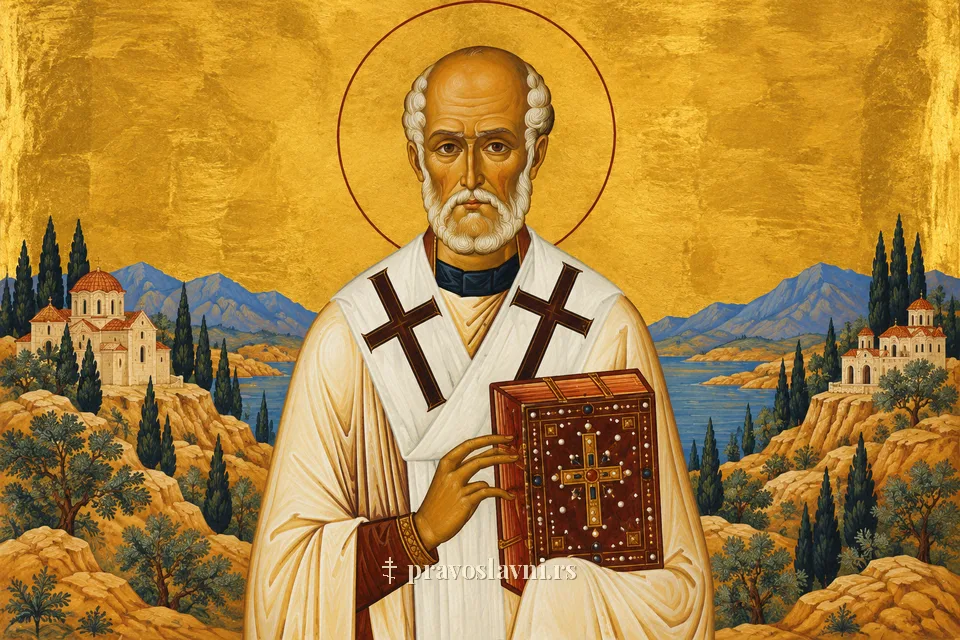
Illustration
Saint of the day
St Gregory the Wonderworker, Bishop of Neocaesarea
What happenedWhen Gregory the Wonderworker came to Neocaesarea, there were only seventeen Christians in the city, and when he was dying, only seventeen pagans remained.
“If you have faith as a mustard seed, you will say to this mountain, ”Move from here to there,” and it will move; and nothing will be impossible for you.“
— Mt 17:20
Life
St Gregory the Wonderworker, Bishop of Neocaesarea, has remained in the memory of the Church because of one number: seventeen. That number, according to both sources, appears twice in his life, and with opposite meanings: first as the small Christian community which he found when he became Bishop of Neocaesarea, and at the end as the handful of pagans who were left in the city when, in deep old age, he was preparing to depart from this world. Between those two numbers lies his whole life.
He was born in that same city, into a wealthy pagan family, and was left an orphan early. Philosophy gave him no answer, so he sought the one true God and found Him in the Gospel. He studied under Origen, and the Prologue says that it was Origen who baptised him too. He did not want honours: when his fellow citizens wanted him as a judge or a governor, he went away into the desert, and he hid from Bishop Phaedimus, who wanted to consecrate him. Both sources say that Phaedimus consecrated him nevertheless, from a distance, by prayer, and Gregory accepted this out of obedience.
Before he began to teach others, he wanted to be sure of the true faith himself. The Prologue and his Life tell that the Theotokos appeared to him in a vision together with John the Theologian, who at her command instructed him in the mystery of the Holy Trinity. Gregory wrote that confession down, and the Prologue knows it as the Creed of Gregory.
It is not without reason that he is called the Wonderworker. His Life says that with a written note he sent the demons back into a temple, that in the name of Christ he moved a rock, that by prayer he dried up a lake over which two brothers were quarrelling, and that with his staff he halted the river Lycus so that it would no longer flood the villages. Both sources remember that he also moved a mountain for the sake of a church, and the Prologue adds that he healed every illness and knew what people were thinking. When the persecution of Decius came, he withdrew into the desert, and the soldiers, according to both sources, were unable to see him.
He reposed, according to the Prologue, in the year 270, in a city which now belonged to Christ.
St Gregory teaches us that humility and pure faith have no need of power or glory in order to change the world around them.
Full Life
From philosophy to the Gospel
St Gregory came from Neocaesarea, from a rich and distinguished pagan house, and he was left without father and mother at an early age. He sought knowledge in philosophy, Greek and, the Prologue says, Egyptian too, but he concluded that it was empty. He was seeking the one true God, he lived in purity and self-restraint, and so he arrived at the Gospel and baptism. With his friend Firmilian from Cappadocia he left the pagan schools and both of them studied under Origen; according to the Prologue, it was Origen who baptised him.
His purity, says his Life, cost him a slander while he was still in Alexandria, where he was studying philosophy and medicine. Dissolute companions paid a harlot to slander him in public. Instead of defending himself, he sent a friend to pay her. The punishment came before everyone's eyes: a demon entered the woman, and she was set free only by Gregory's prayer.
The man who fled from honour
Neocaesarea wanted him as a judge or governor, but he went off into the wilderness to a hard ascetic struggle. Nor was it easy for Bishop Phaedimus of Amasea, three days' walk away: Gregory kept hiding and moving from place to place away from his messengers. Both sources say that Phaedimus at last consecrated him from a distance, by prayer, asking for God's blessing, and Gregory accepted this out of obedience.
He also wanted to be sure what the true faith is, for the heresies of Sabellius and Paul of Samosata were troubling him. The answer, according to the Prologue and his Life, was brought to him by a vision: the Theotokos came in light, accompanied by John the Theologian in a bishop's vestments, and entrusted him with revealing to Gregory how one ought to believe in the Holy Trinity. John dictated to him a confession concerning the Trinity, whose first words speak of one God as the Father of the living Word, and Gregory wrote it down with his own hand. For a long time afterwards the Church of Neocaesarea preserved the record that came from his pen, and in the Prologue the same text is called Gregory's Symbol of Faith.
Wonderworker over stones and water
Why he is called the Wonderworker, his Life shows by many stories. During one night spent in a pagan temple, his cross and his prayer drove the demons away. The priest, finding the oracles dumb, threatened him with the court, and from Gregory he received a little note — “Gregory to Satan: enter the temple again!” — after which the demons really did return. When the priest asked for one more sign, Gregory moved an enormous rock in the name of Christ, and the priest believed.
Two brothers, his Life relates, were quarrelling over a lake. When persuasion bore no fruit, Gregory prayed until morning and in the name of the Lord commanded the lake to disappear; dawn found a green valley in place of the water and the brothers without a quarrel. The river Lycus, which used to flood the villages, he stopped by thrusting his staff into the bank: “River, my Christ commands you not to cross your bounds.” The staff became an oak, and the river no longer overflowed. Both sources also remember that he moved a mountain so that there would be room for a church. The Prologue, without many stories, lists his gifts: authority over demons and over nature, the healing of every illness, invisibility, and insight into distant events and the thoughts of others.
From seventeen to seventeen
When he came to Neocaesarea as bishop, there were only seventeen Christians in the city. His Life relates that a crowd met him at the gates, that the wealthy Musonius received him, that he preached and healed, and that the faithful grew more and more numerous. He built a church, and the offerings went both to the poor and to the sick. He became the one to whom people come for the last word in disputes, and peace spread. One pagan festival gathered so many people that the theatre was too cramped, and from the crowd the cry rang out: “Zeus, give us room!” Gregory's answer was brief: soon there will be even too much space. At once the plague came, but the houses which he entered were spared, and many were baptised.
When the persecution of Decius began, he did not ask the same of everyone: whoever feared that he would not endure the torments was to take shelter. He himself, with one deacon, also withdrew into the wilderness. The soldiers searched the mountain, but, both sources say, they did not see them, and one of the soldiers was converted.
The story about him is rounded off with the number with which it began. Before his death he asked to be told the number of pagans who still remained in the city. There were seventeen of them. At the beginning there had been just as many Christians. He reposed in deep old age, according to the Prologue in the year 270.
The lesson: whoever keeps purity and humility, and trusts God to the end, can bring a whole city to Christ.
Other saints of the day
St Maximus, Patriarch of Constantinople
Little information has been preserved about St Maximus. That he is the same person as Patriarch Maximian, who was at the head of the Church of Constantinople from 431 to 434, is put forward by his Life only as a supposition. When he arrived from Rome, Constantinople came to know him as a man of pure life and of learning. He was ordained a presbyter by Sisinnius, Patriarch of Constantinople. When Nestorius was deposed, Maximus was chosen as patriarch. As patriarch, he defended his flock from temptations. He reposed in peace. The Prologue only mentions him among the saints of this day, without a Life. His life bears witness that a modest and learned life prepares a man for faithful pastoral service, and that authority is measured by care for the flock.
St Sebastian was born on 9 July 1863 in San Francisco, to parents who were Serbian immigrants from the Bay of Kotor, and at baptism he was given the name Jovan. He was the first Serb born in America to become an Orthodox monk, and also the first Orthodox priest born in America, and so he is called the Apostle of America and the father of Serbian Orthodoxy on American soil. From 1884 he served in Alaska, and then studied for three years at the theological academies in Russia, where he was tonsured a monk on the feast of the holy martyr Sebastian and took his name. He was ordained a hieromonk on 16 August 1892 by Bishop Nicholas of the Aleutians and Alaska, who sent him as a missionary to California and Washington. In the year 1894 he received permission to build the first Serbian church in America, the Church of St Sava in Jackson, California. He also helped with the building of the Serbian Church of St Sava in Douglas, Alaska, wrote a book about the services and holy mysteries of the Orthodox Church, and in the number of people he baptised, as is stated, he had no equal among the priests of the western hemisphere. From 1905 he was at the head of the Serbian Mission in America and several times asked Metropolitan Mihailo of Serbia to receive the mission under the Serbian Church, but without success, and he never became a bishop. He was a military chaplain of the Serbian army in the Balkan War and in the First World War, and from 1916 he served in Serbia. He devoted a total of forty-six years to mission, preaching and writing. He reposed on 30 November 1940 in the Žiča Monastery, where he was buried by Bishop Nikolaj Velimirović, his close friend, who considered him sinless and placed him above all the Serbian missionaries of recent times. In 2007 his relics were translated to Jackson, to the Church of St Sava, and the Assembly of the Serbian Orthodox Church glorified him in the year 2015, together with Mardarije of Libertyville.